





How Canva Turns Customer Feedback Into Product Decisions

Originally published March 2024 · Updated September 2026
About Canva
Canva is the visual communication platform that more than 200 million people use to design anything and publish anywhere. It calls itself a community-driven product, and it built a program to match: Close the Loop, which makes sure what Canva builds responds directly to what customers ask for.
Keeping that promise gets harder with every new user. Canva receives millions of pieces of feedback a year, in more than 100 languages.
The Challenge
The question was never whether customers were talking. It was how teams across Canva could hear what mattered, when there was far more feedback than anyone could read.
Pulling it together by hand is a job in itself. Canva's User Insights Ops Lead remembers what it took earlier in his career.
"You would need a data scientist from every different channel, like you'd need someone like a contact from social, you need a contact from the support team and you'd need to be able to talk to all of them and consolidate all the reports yourself."
User Insights Ops Lead, Canva
Even then, most teams couldn't get to the insight on their own. Canva had two problems at once: too much feedback to make sense of, and teams who couldn't self-serve what was there.
How Enterpret Helped
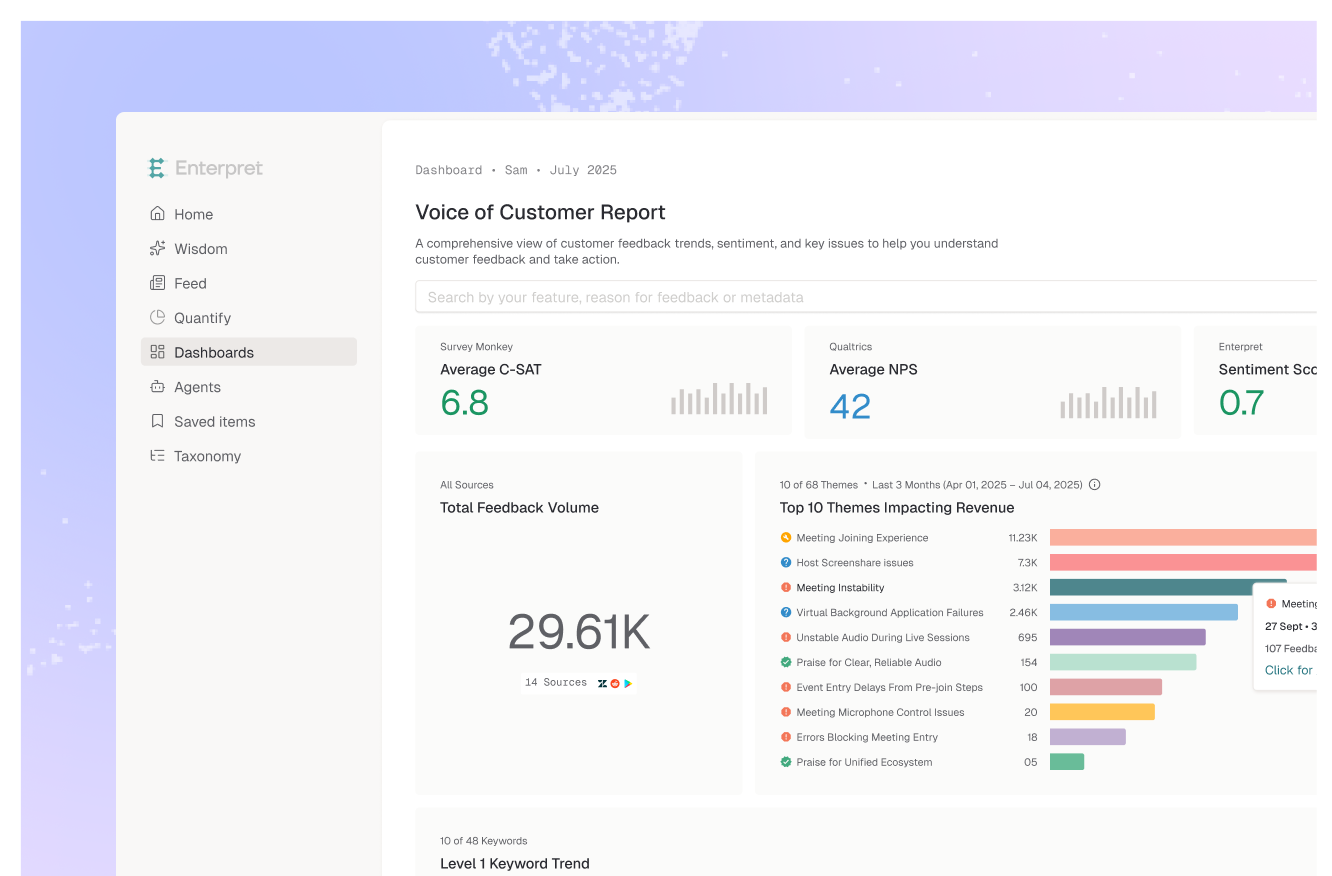
Canva trialed a few tools before choosing Enterpret, and what stood out was the granularity of its taxonomy. Where other tools stopped at broad themes like "requests for Docs," Enterpret surfaced the precise ask: "add page numbers to Docs." The goal was clear:
- Bring every feedback channel into one place
- Get specific enough that a team could act on what it found
- Let teams self-serve, without waiting on Close the Loop
Hearing from users the product can't detect
The clearest proof of why that matters comes from the team with the least data to go on.
Within Canva's Editing group, one team focuses on accessibility, for people who use Canva with assistive technologies. Most product teams can watch how a launch lands in their analytics. This team can't.
"In the accessibility space, we cannot detect that somebody is using assistive technologies, so instead we needed to find other ways of hearing from our users without explicitly asking them whether they were using these features."
Senior Engineering Manager, Canva
The answer was already sitting in Enterpret. Because feedback from every channel was collected in one place, the team could hear from those users in their own words, without asking anyone whether they use assistive technologies.
Now that signal comes to the team every week. Its Senior Engineering Manager connected Enterpret's MCP server to her AI work tool and scheduled it to search the latest feedback automatically, so what those users are saying lands with her instead of waiting to be found.
Putting It to Work
Close the Loop runs on the same idea: the feedback comes to the team, instead of the other way around. The team uses Enterpret's MCP server to cut noise. When Enterpret flags a potential bug, the team can check whether another team is already on it, with an ETA and a Jira ticket, and move on without worrying about it.
"Everything is just in one place now and we can focus a lot more on actually delivering the insights and advocating for users' pain points."
User Insights Ops Lead, Canva
Results
- Millions of pieces of feedback a year unified in one place, across 100+ languages and every channel from support to social
- 200+ employees across multiple teams with direct access to customer feedback
- 20,000+ searches in a single six-month stretch, run by teams answering their own questions
- Hundreds of saved reports keeping product owners connected to feedback in their areas
- Hundreds of thousands of survey responses analyzed in hours for Canva's 10th Anniversary Survey, instead of a multi-month manual project
The Bigger Shift
Close the Loop used to spend its time gathering feedback. Now its job is to give all of Canva the customer insight it needs. In the words of Canva's Senior Product Lead, teams have "access to that data and those insights to drive decisions," and they self-serve it without waiting on anyone. The time that frees up goes to advocating for users.
That brings the program back to where it started: a community-driven company, making sure the features it ships directly address what its community needs.
"Enterpret helps there because it helps turn that customer feedback and our community voices into action for our teams."
Senior Product Lead, Canva
Building a feedback program every team can actually use? Talk to our team.

