







What Feedback Signals Predict Churn?

We analyzed anonymized customer feedback across 28 software companies to understand what causes churn. The strongest signal was not in the feedback itself. It was the absence of feedback: churned accounts often went quiet before leaving. When they did speak up, the clearest warning signs were value not realized and product failures that blocked the core workflow.
Key findings
- Across 20,000+ churned accounts, complaint feedback breaks down as: product-functionality failure ~59% · exit-mechanics ~20% · value-not-realized ~9% · activation failure ~8% · genuine price-vs-value ~2.4% (0–5% in every company measured).
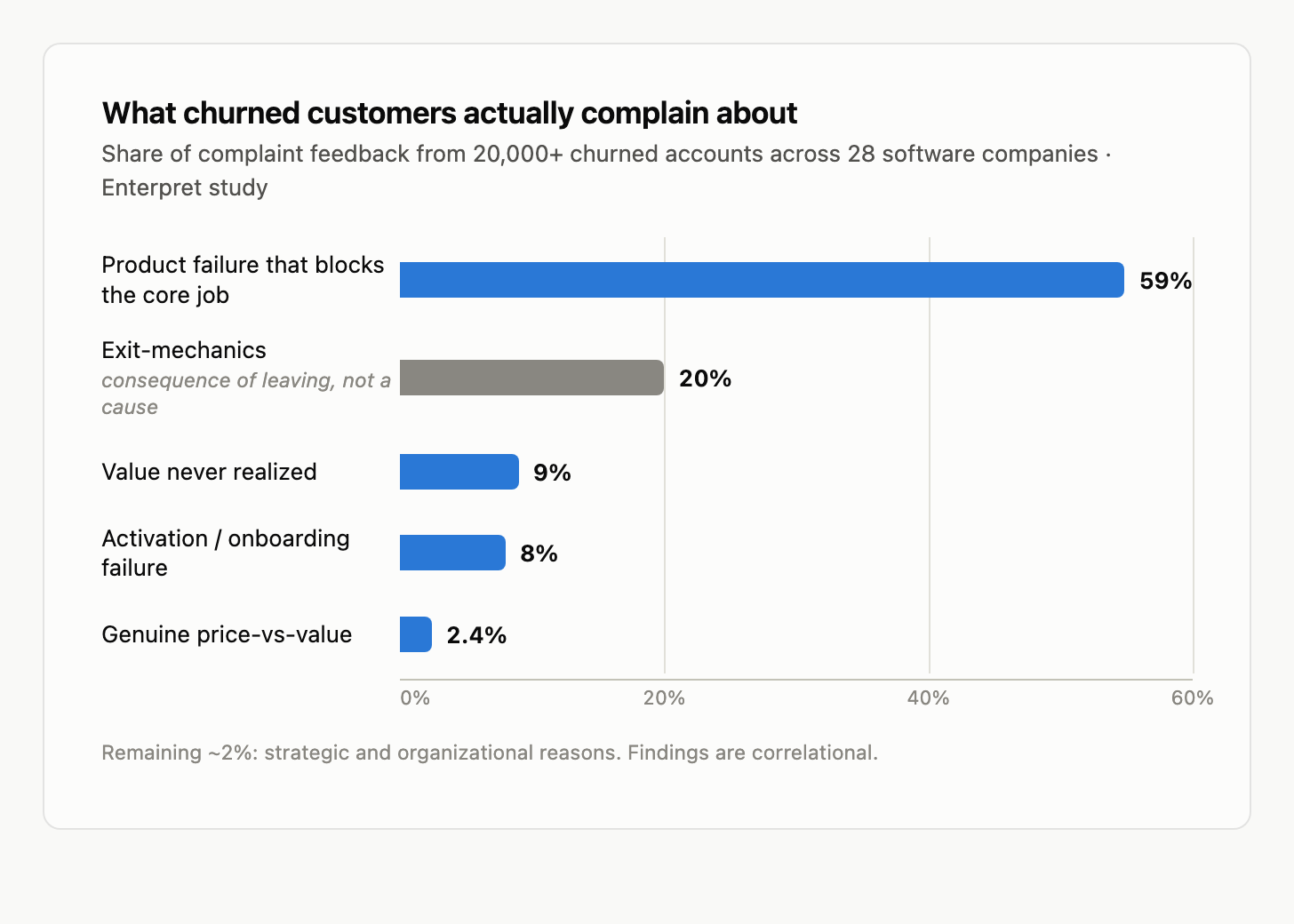
- Exit-mechanics feedback correlates with churn because it is churn, already in progress. Cancellation friction, refunds, and downgrade failures cluster at the exit, while the real reasons surface earlier.
- Engagement drop-off is an account-level warning sign. In many analyzable companies, active accounts generated 2×+ more feedback per account than churned accounts. That makes feedback volume useful as a company-calibrated signal, not a universal churn rule.
- Generic product complaints come from customers who stay; job-blocking failures are different. Complaint volume concentrates among retained power users, but when product failures block the core workflow, churn risk rises.
Three signals predict churn: disengagement, unrealized value, and job-blocking failure
None of the three is price, and only job-blocking failure typically arrives as a complaint.
- Job-blocking product failure: ~59% of pre-churn complaints. This feedback type was about 1.3× more common in churned accounts than in accounts that remained active. The pattern is specific: an enterprise software vendor saw 82% of churned accounts' complaints on reliability and access failures; an SMB SaaS saw 81% on core-workflow breakage; a consumer app saw 61% on its core UI failing; an AI-native company saw 58% on output quality (hallucinations). The common thread is not "bugs." It's the thing I bought this for stopped working. What this looks like in practice (illustrative):
- at a point-of-sale platform, checkouts freezing.
- at an enterprise document-management platform, users getting locked out of their account.
- at an AI support agent, the bot confidently quoting refund policies that don't exist to customers.
- Value-not-realized (~9%) and activation failure (~8%). Results that never came, learning-curve walls, credits burned without outcomes. Where measurable, value-not-realized language was roughly 1.2×+ more common in churned accounts than in accounts that remained active. This is often the deepest cause, and it frequently shows up indirectly, as disengagement rather than complaint.
- Disengagement. The account-level signal is not just what customers say, but how much less they say. Falling feedback volume can indicate risk, especially when it appears alongside value-not-realized language or declining sentiment.
The first two are shares of complaint feedback (percent of everything churned accounts complained about), while disengagement is measured at the account level through feedback volume. The next section unpacks it.
What are the early warning signs of churn?
The earliest warning sign is often a drop in engagement. In many analyzable companies, active accounts generated 2×+ more feedback per account than churned accounts. The useful signal is the change in account-level feedback volume, not a blanket claim that every quiet account is at risk.
Low feedback is common, not universal. Treat it as a pattern to calibrate, not a law. In some businesses, churn arrives loudly instead, with feedback spiking just before exit. The practical takeaway: monitor feedback volume per account alongside feedback content, and calibrate what a normal engagement curve looks like for your own customer base before reading lower volume as risk.
Loud product complaints don't predict churn
Complaint volume and churn risk are close to opposites. Feature requests and product-quality complaints come disproportionately from retained customers, not churned ones, because the people who file detailed product feedback are engaged power users invested in the product's future.
The signal that does predict churn is narrower: product failure that blocks the job. A power user complaining about search precision is leaning in; a customer reporting they can't access the product, their data won't sync, or the core workflow broke is being pushed out. The distinction is complaints versus blocked value, and conflating the two is how teams end up soothing their healthiest accounts while the at-risk ones exit quietly.
Do customers churn because of price?
No, not according to what they say before they leave. Across more than 20,000 churned accounts in the study, genuine price-vs-value complaints made up 0–5% of churned accounts' complaints, a mean of ~2.4%.
Price looks dominant because "money" feedback has two distinct faces, and only the smaller one is a real churn reason:
- Exit-mechanics (~20% of churned accounts' feedback, large but not a reason). Cancellation friction, refund requests, downgrade failures, charges after cancel. At some self-serve products this is 50–81% of churned accounts' feedback. It's what customers say while leaving: a consequence, not a cause.
- Genuine price-vs-value (real, but a minority). It survives scrutiny mainly at self-serve and mid-market products (roughly 10–21% of churned accounts' feedback at a handful of them) and stays at or below 5% everywhere else.
Cancellation surveys and CRM close-out notes aren't wrong, but they record the customer's conclusion, after the decision, in the easiest available words. "Too expensive" is the polite summary of "I didn't get enough value." In companies where churned customers' feedback could be read for months before they left, genuine price complaints were 0–5%. The price talk concentrated at the exit itself. For prediction, that's the point: by the time price is being stated, the decision is already made.
One caution: this is correlation, not proven causation. But the direction was consistent across the study.
What are the two types of customer churn?
Dissatisfaction-driven and strategic. Each sends different signals.
- Dissatisfaction-driven churn (SMB / self-serve): unrealized value, activation and learning-curve friction, cancellation friction, and some genuine price sensitivity. The tell is a drop in positive-sentiment share and falling engagement.
- Strategic / contract-driven churn (enterprise / managed): renewal disruption, reorganization, competitive replacement, often with high satisfaction right through the exit. Their feedback won't warn you; the tell is account health and whether the account is actively managed. One enterprise software vendor saw ~100% of its churn among low-touch, unmanaged accounts and zero among managed ones; at another, 87% of churned accounts were flagged Red health versus ~1% of active accounts.
The practical implication: a churn model built on feedback content will catch the dissatisfaction segment and miss the strategic one entirely. Enterprise churn is an account-health problem; self-serve churn is a feedback-and-sentiment problem.
Watch the quiet accounts, not the loud ones
If churn prediction is the goal, this study collapses to four instructions:
- Track feedback volume per account. Disengagement precedes churn more often than any complaint does; a fading account is a warning even when it says nothing.
- Weight job-blocking failures and unrealized value over complaint volume. A power user's bug list is investment; a workflow that quietly broke is risk.
- Treat billing and cancellation topics as churn in progress, not churn ahead. By the time money enters the conversation, the decision is usually made. That's a save play, not a prevention play.
- For enterprise accounts, watch account health, not feedback. Satisfied customers churn too. Reorgs and renewal decisions don't show up in what they say. The tell is the health score, and whether anyone is actively managing the account.
To run this playbook you need a platform layer that does four things:
- Unify feedback from every channel
- Classify it into categories
- Connect it to account records
- Monitor with proactive alerts
The classification step is what makes this workable: most feedback doesn't predict churn, so you only watch the categories that do: failures that block the core job, and value never realized. Tie feedback to accounts, and those categories become automated alerts: one fires when a risky theme hits one of your accounts, or when an account goes quiet. Enterpret does all four.
Customers do tell you they're leaving. They just don't say it in the words teams listen for. They say it in fading engagement, in value that never landed, and in product friction that blocked the job. The money talk comes last. Listen earlier.
FAQ
What is the single strongest churn signal in customer feedback?
The most overlooked signal is account disengagement: materially lower feedback volume than comparable active accounts. Among spoken signals, value-not-realized and job-blocking product failures are stronger than generic complaint volume.
Are billing complaints an early warning sign of churn?
Mostly no. Billing and cancellation feedback concentrates at the exit, not before it. It's a consequence of a decision already made.
Can you predict churn from customer feedback alone?
Partially. Feedback content catches product-failure and value-realization churn, but it misses accounts that disengage before they complain. Pair feedback content with per-account engagement volume and account health, especially for enterprise accounts, where churn is often strategic and quiet.
How does SMB churn differ from enterprise churn?
SMB/self-serve churn is dissatisfaction-driven (value, activation, some price) and is preceded by disengagement and fading positive sentiment. Enterprise churn is often strategic and high-satisfaction; the warning lives in account health and renewal dynamics, not complaints.
Why do our cancellation surveys say customers leave over price?
Because exit surveys record conclusions, not causes. "Too expensive" is the easiest summary of "I didn't get enough value." In companies where churned customers' feedback could be read before they left, genuine price complaints were 0–5%; the price talk concentrated at the exit itself.


