





InMoment vs Qualtrics
Two platforms. Two very different philosophies about what customer experience management actually means. InMoment and Qualtrics both sit at the center of enterprise CX programs — but the orgs that get the most out of each are often not the same kind of org at all. At Enterpret, we work with customers who run programs on both platforms, which gives us an honest picture of where each one wins and where each one frustrates.
This guide breaks down the real differences — not the marketing positioning, but what teams actually experience when they deploy these tools at scale.
The Core Philosophy: Integrated Experience Intelligence vs. Unified Experience Management
At their core, InMoment and Qualtrics are solving different problems. InMoment is built around a single, focused thesis: close the loop on customer experience faster and connect that experience data to measurable business outcomes. Its XI (Experience Intelligence) Platform is purpose-built for CX programs — surveys, social listening, digital feedback, and text analytics all feeding into a unified view of the customer relationship. The platform is designed to be operated by CX teams, not IT departments.
Qualtrics plays a different game entirely. It is an experience management platform in the broadest sense — spanning customer experience, employee experience, product experience, and brand research under one roof. Qualtrics is the Swiss Army knife of XM: extraordinarily capable, deeply configurable, and almost deliberately expansive in scope. That breadth is both its greatest asset and its most significant implementation challenge.
By the Numbers: Gartner Peer Insights
Both platforms are Leaders in Gartner's Magic Quadrant for Voice of the Customer Platforms — InMoment for the fourth consecutive year, Qualtrics for the fifth. The peer review data tells a more nuanced story.
Key Differences
1. Depth vs. Breadth: What the Platform Is Actually Optimized For
This is the most important dimension. InMoment is purpose-built for one thing: helping enterprise CX teams understand and act on customer experience signals. Every feature — from its AI-powered Engagement Engine to its frontline coaching tools — is designed to close the feedback loop faster. You feel this focus when you're in the platform. Workflows are opinionated. Dashboards are designed for CX professionals, not data scientists.
Qualtrics is optimized for range. A single Qualtrics account can run an NPS program, a 360 employee survey, a brand tracking study, and a conjoint analysis for product research — all under one login, with shared analytics infrastructure. That's genuinely powerful for organizations that need it. But for teams that only need the CX slice, that breadth creates complexity they're constantly navigating around.
The practical implication: CX-focused teams tend to find InMoment faster to operate day-to-day. Organizations running multi-program XM across HR, research, and brand tend to find Qualtrics more cost-effective at scale.
2. Implementation Complexity and Time to Value
InMoment cites an average of 12 months to measurable ROI — roughly half the industry average of 25 months. That's a credible claim, backed by their platform architecture: pre-built CRM integrations (including a two-way Salesforce integration), structured onboarding, and a focused feature set that doesn't require months of configuration to become operational.
Qualtrics is powerful but notoriously complex to stand up. Reviewers on Gartner and G2 consistently flag multi-month implementation timelines, the need for dedicated admin support, and a steep learning curve for non-technical program owners. Teams that don't have a Qualtrics-certified admin or an implementation partner often find themselves managing a platform that was designed with far more flexibility than they need. Day-to-day operations can become a bottleneck.
If speed-to-value is a priority — particularly for CX teams without dedicated ops resources — this difference matters more than any feature comparison.
3. Pricing Model and Total Cost
Neither platform is cheap, and neither is fully transparent about pricing. InMoment does not publish pricing and operates on custom enterprise contracts. Gartner rates their pricing flexibility as the highest in the VoC category, which suggests room to negotiate — but also means you're going in blind without a demo.
Qualtrics has a more structured (if still opaque) pricing model. Base licenses start around $1,500/user/year, but the platform's most valuable capabilities often sit behind add-ons. Cross-channel text analytics via Discover XM (their Gen AI layer) adds an estimated $300,000–$400,000 annually on top of base contract costs. For large enterprises, total Qualtrics investment can reach six figures easily. Budget carefully if AI-powered analytics are central to your use case.
4. AI Capabilities: GenAI vs. Traditional NLP
Both platforms have invested heavily in AI, but from different starting points. InMoment launched AI Studio in 2024, a framework for deploying GenAI features across the XI Platform. Its Smart Summary Generator (GPT-powered) converts raw feedback into structured summaries. Intent Detection uses AI to flag churn risk and repurchase likelihood from unstructured signals — a genuinely useful capability for frontline teams that need to act on individual accounts, not just aggregate trends.
Qualtrics' AI suite is broader but uneven. Text iQ and Predict iQ are mature NLP-based capabilities. Their newer Experience Agents (introduced at X4 2026) automate omnichannel deployment and real-time service recovery — a significant step forward. Synthetic research panels are also emerging. The honest criticism: Qualtrics' legacy NLP text analysis lacks the contextual accuracy of modern GenAI, and the most advanced AI features sit in Discover XM, which carries significant additional cost. The gap is closing, but the entry price for cutting-edge AI is higher on the Qualtrics side.
5. Integration Ecosystem and Data Connectivity
InMoment leads on CX-specific integrations. Its two-way Salesforce integration is deep — NPS, CSAT, and CES scores enrich contact and account records, and case management flows bi-directionally. The platform also connects to Zendesk, major CDPs, and ETL pipelines. For CX teams whose data stack is organized around a CRM, InMoment plugs in cleanly.
Qualtrics has a broader integration surface area, befitting a platform that spans customer, employee, and research programs. Salesforce integration exists but has received consistent criticism in reviews for reliability issues. The platform's strength is its API layer and the ability to route data across Qualtrics' own product suite — but teams that need tight CX-specific integrations with third-party tools sometimes find the native connectors less polished than expected for an enterprise platform of this scale.
What Both Tools Don't Do
Both InMoment and Qualtrics are measurement and listening platforms. They are exceptional at capturing structured feedback, running survey programs, and surfacing aggregate trends. What neither does well is synthesize the full universe of unsolicited customer signal — support tickets, sales call transcripts, app reviews, community posts — and connect that signal to the structured feedback coming through surveys. The result is a gap: programs built entirely on either platform tend to reflect what customers say when asked, not the full picture of what customers are experiencing unprompted.
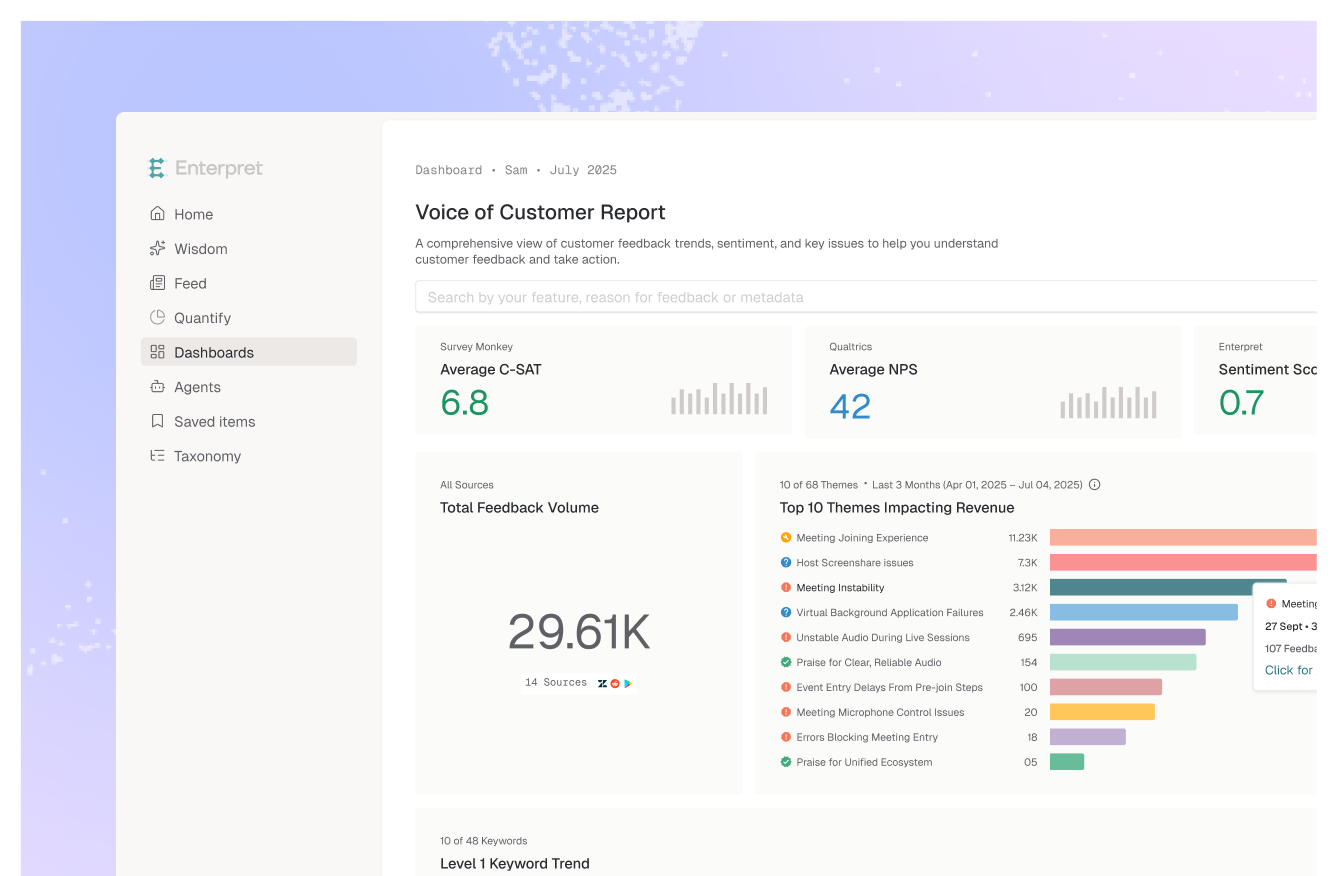
This is where teams typically layer in a customer intelligence platform like Enterpret — not to replace the survey program, but to connect the structured feedback from InMoment or Qualtrics with the unstructured signal from every other customer touchpoint. The combination gives product and CX teams a complete view of the customer, not just the sliver that shows up in scheduled surveys.
The Verdict
The right choice depends almost entirely on whether you need a CX specialist or an XM generalist — and how much internal resources you have to run a complex program.
Many large enterprises run both — Qualtrics for structured research and EX programs, InMoment for the operational CX program that frontline teams touch every day. That's not a failure of either platform. It's a recognition that breadth and depth are different things, and the category hasn't produced a single tool that does both without compromise.
