







Kit + Enterpret: The Last Mile Problem, and the First Mile of Something Bigger

One or two colleagues would engage when Miguel Pou shared customer intelligence output with his team. That was it.
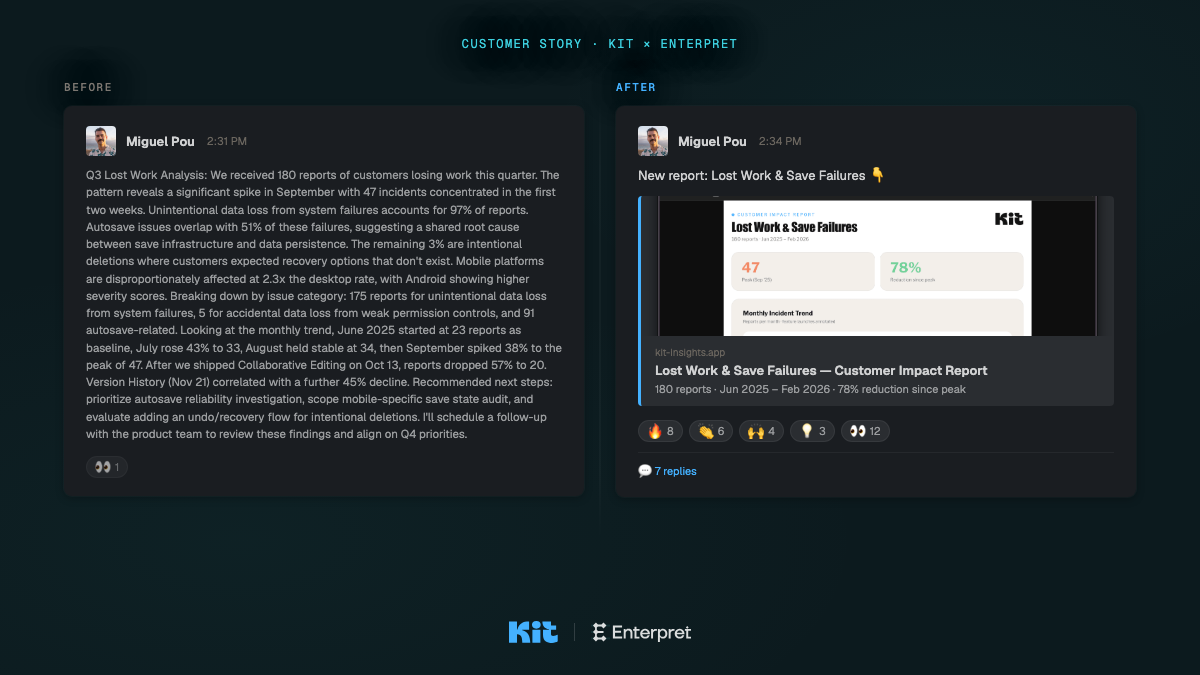
Not because the analysis was bad. Because their Tuesday already had 40 other things competing for that same ten minutes. Miguel had rich output — theme clustering, sentiment breakdowns, channel-level trends. He could ask a question and get a thorough answer. The answer just came back as text. And the people who most needed to see it were the least likely to sit down and read a long document.

He had a name for it: the last mile problem.
The Last Mile Problem
Think of a high-speed train. Incredible infrastructure. Hundreds of miles in minutes. But if there's no good way to get from the station to the hotel, the whole trip feels broken.
Customer intelligence has the same structural flaw. Collecting feedback from dozens of channels, clustering themes, tracking sentiment, surfacing what matters — Enterpret handles that. The output is solid. But solid output in the wrong format is still output that doesn't get read.
This is what quietly kills most VoC programs. The insights are real. The distribution model doesn't match how teams actually consume information.
Kit feeds support conversations, Gong calls, social mentions, and Slack community feedback into Enterpret. Miguel sits in the part of the company that talks to customers every day — which is exactly why he became Kit's most effective intelligence producer. And why the last mile became his problem to solve.
From Documents to Destinations
Miguel stopped attaching documents. He started sending URLs.
The workflow: query Enterpret's Wisdom, shape the output with Claude, render it as an interactive JSX application, deploy it, share the link. The whole thing takes hours, not weeks. And the reports stay live.
Instead of a 2,000-word analysis that required a calendar block to absorb, Miguel built filterable, role-specific web applications. A sales leader could filter by competitor mentions without scrolling past data she didn't need. Product managers drilled into feature requests by segment. The exec view gave the high-level read with the option to go one level deeper — each data point backed by the source conversation
“I'm very impressed with how easy it is to chat back and forth and have it pull in real customer data and comments. I will utilize Enterpret data way more now that I can access it from a place where I am already spending a lot of time."
What Changed
Colleagues who had never engaged with customer intelligence started asking Miguel how he built the reports. Then they started requesting reports for their own questions.
The dynamic reversed. Instead of Miguel pushing insights out, teams started pulling them in.
The sales leader saw what Miguel built for Product and CX and came to him directly. No executive sponsor pushed this. Sales saw the output from another team and wanted the same thing for themselves.
Miguel built a 6-month creator economy report: a comprehensive analysis of customer signal across every channel Kit monitors, structured as an interactive experience — filterable by source, with persistent navigation showing the context behind any data point. His team pulled it into strategy discussions. Customer intelligence went from answering "what happened last quarter" to shaping "where should we invest next."
Then Nathan Barry posted it on LinkedIn. Kit's CEO shared a screenshot of Miguel's Enterpret-powered report with his audience, framing it as an example of building features on top of AI.
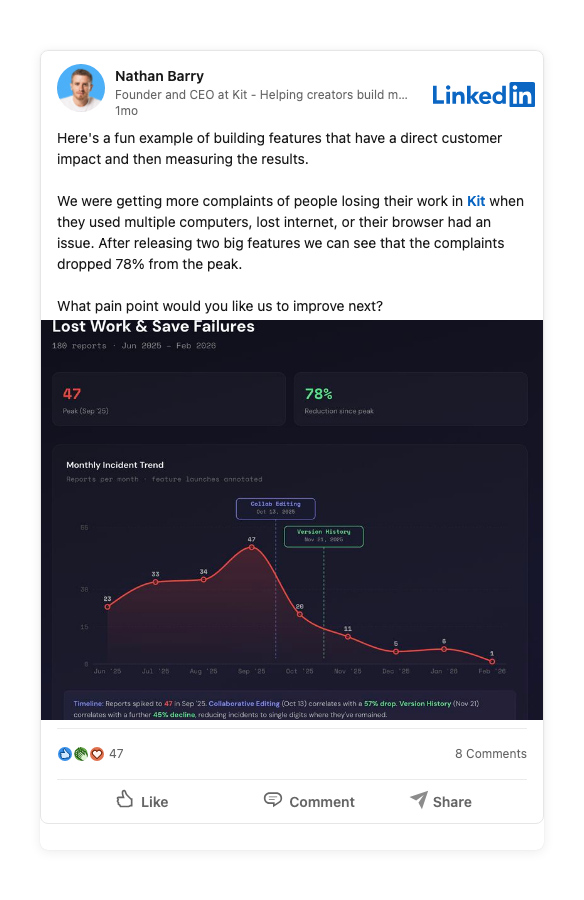
"It felt like a solid confirmation that what I'm doing is resonating and telling a clear story from the data I'm able to surface.” Miguel Pou, on Kit's CEO sharing his report on LinkedIn.
24 active users across 4 departments now rely on what started as one person's side project.
When leadership doesn't just read your customer intelligence but shares it publicly as a model for what's possible, you've moved from reporting to influence.
The Feedback Flywheel
The reports became infrastructure for how Kit operates. Customer feedback flows in through Enterpret, surfaces patterns the team analyzes, product ships changes, and Kit closes the loop — telling customers what changed and asking for more feedback. The cycle repeats.
Enterpret sits at the center, and the interactive reports are what make the whole thing visible to the rest of the company. Visibility is what turned a personal workflow into shared infrastructure.
The First Mile of Something Bigger
Miguel leads CX AI Operations at Kit. The role didn't exist before he started doing the work. He built enough value with Enterpret and AI tooling that the company created a position around what he was already doing.
"Old Wisdom felt like I was fighting against the tool. New Wisdom feels like I'm working with the tool."
That shift is what made everything else possible. The interactive reports. The cross-department adoption. The CEO sharing his work publicly.
And it's spreading. Miguel is onboarding PMs one by one, introducing the Sales Director, building workflows that connect Enterpret to Linear for PRD generation. He's proposing systems where customer feedback automatically shapes product documents. The executive team is coming to him directly for analysis they used to commission from consultants.
The last mile of VoC insights turned out to be the first mile of something bigger: a bottom-up AI transformation where one person's craft became the company's capability.
This story is just getting started.
Kit is an email, commerce, and automation platform for creators. Miguel Pou leads CX AI Operations at Kit.

