







Wispr Flow + Enterpret: How a Support Team Became Engineering's Frontline

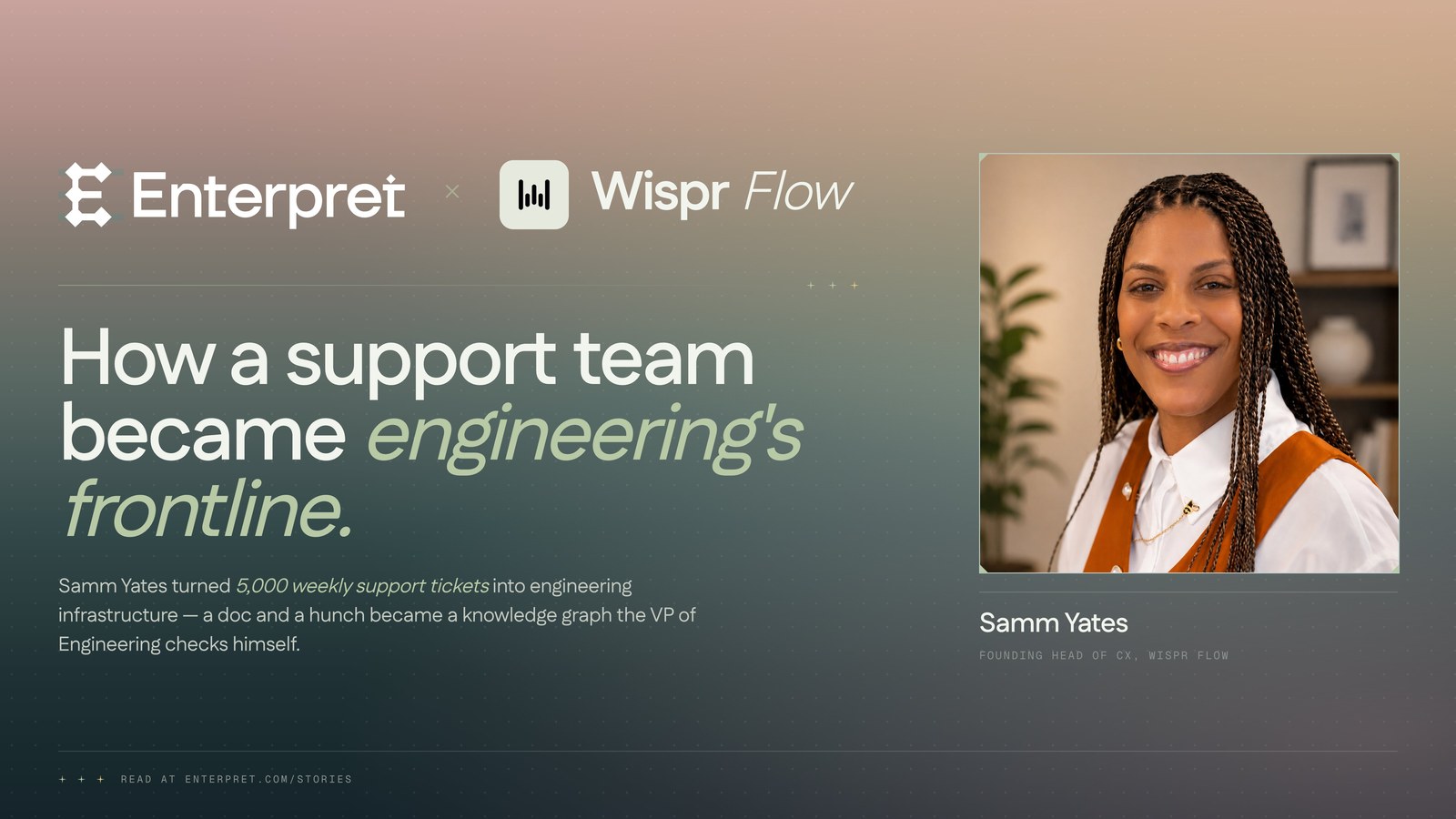
Samm Yates's CEO forwarded her a customer email asking her to help with a troubleshooting issue. Samm sent back the steps and kept on.
Here's what she didn't see yet: Enterpret had already caught the spike before her CEO ever hit send. By morning, the severity had been escalated to critical, the root cause was in hand, and hundreds of Wispr Flow users were accounted for. Later that morning, her CTO was in the channel:
"We should really figure out how to leverage this tool. It's catching things quite fast." — Wispr Flow CTO, internal Slack
A year earlier, none of that infrastructure existed. The closest thing Wispr Flow had to a bug detection system was Samm, at her laptop, scrolling through tickets in a doc.
How it started
“I’d come across a frustrated customer mentioning an issue,” Samm says. “And I’d think, wait, I’m pretty sure someone else brought this up before. So I’d go back and start digging to see if there was a bigger pattern.”
Samm joined Wispr Flow in May 2025 as the Founding Head of CX, which meant she was the CX team. Wispr turns speech into polished, context-aware text: casual for Slack, professional for email, formatted for docs. It supports 104 languages across Mac, Windows, iOS, and Android, and the support volume that comes with that reach is roughly 5,000+ tickets a week.
She'd open a doc. Build notes. Try to hold the thread. That was the whole system.
Within months, she'd grown her team, but the system scaled up with them, and now seven people needed the same kind of system Samm had been holding together herself.
The moment the CTO changed the rules
Every morning, Samm went to engineering with what she was seeing in the tickets.
"I'm noticing some concerning patterns in our tickets and a shift toward more frustrated customer sentiment. Can you have someone dig into this?" she'd say.
Each escalation was a judgment call, made on instinct and the patterns she'd been tracking.
The company had Pylon in place for ticket operations and AI agents, and it was doing that job well. Anomaly detection just wasn't the problem Samm needed solved. She needed a way to distinguish a real pattern from a one-off complaint, in a way engineering would trust.
Then the CTO named what the team needed: a proactive, structured way to surface trends and potential bugs to engineering.
Samm needed a third option: something that could tell her, with confidence, which patterns were real and which were noise. That's what Enterpret turned out to be.
Five days to trust
Anthony from Enterpret's customer success team introduced Samm to the product. Instead of a two-week pilot, Wispr did a five-day sprint.
.jpeg)
During those five days, they caught two regressions. Samm's team heard about issues on Slack, jumped into Enterpret, and handed the CTO a full readout with more detail than engineering already had. "Enterpret was spot on every time," she says.
The bigger surprise was the taxonomy. Months earlier, Samm had manually built one because she knew it mattered. Days of exports, groupings, and test-and-iterate cycles squeezed in between everything else a Founding Head of CX does in a startup. She just didn't know how much it mattered until she saw Enterpret's sitting right next to hers, almost identical.
“I built the taxonomy because I knew it mattered, but I didn’t fully understand just how important it was until I saw Enterpret in action. It took me a huge amount of time and countless back-and-forth sessions with Claude to get it into a good place. What was really impressive is that your team seemed to understand it almost immediately and deliver something valuable right out of the box.” — Samm Yates
Had Enterpret been in place a month earlier, she could have skipped that work entirely.
On accuracy, her take is simple: "Sometimes it's incomplete, but it's never been inaccurate." Accuracy is what earned the team's trust right away.
Enterpret as the team's interpreter
The volume matters: Enterpret has structured 73,000+ of Wispr's support tickets since they signed late last year. But Samm is quick to point out that the number isn't the headline. What her team can ask is.
When a new pattern shows up, they go into Enterpret and ask the questions that actually move engineering: How many users is this hitting? Is it showing up on social? What build are they on? They walk away with a picture, not a hunch.
“Structuring all of those tickets has been incredibly valuable, but what’s been even more helpful is being able to ask Enterpret questions like how many users are affected and what kind of impact it’s having across social media.”
When a new support engineer joins, Enterpret is part of the ramp. They go in, ask questions about whatever bug they're trying to understand, and walk away with a clear picture of what the issue is, who it's hitting, and where to start debugging.
"I even use it as an onboarding tool for my team. It helps them get answers to difficult questions quickly and build a much deeper understanding of the issues that are impacting our customers."
The team has also started running Enterpret's MCP alongside PostHog's inside Claude Code, pairing behavioral data with customer voice in one workflow.
Building the system the CTO asked for
Vishal Jain, Wispr's agent engineer, helped Samm build the Quality Monitor Agent (QMA for short). A dedicated section inside Enterpret where bug signals surface in a format engineers can actually act on.
The QMA pulls together everything an engineer needs to triage a potential bug in one place. A plain-language summary of what's happening. A sample customer ticket for context. The build version that customer was on. A full breakdown of which versions are affected.
Then it gets to Samm's favorite part: trend detail. Is this issue emerging, spiking, stable, or declining? Was it seen on the last build? Because if it wasn't, the "fix" might just be updating to the most recent version. The QMA also tracks reliability area, which is how Samm's team helped engineering put together an entire reliability sprint based purely on what Enterpret was showing them.
“It powers our entire bug workflow. We rely heavily on Enterpret to identify issues across the board. Even with sources like the QMA channel, which isn’t perfect, but is still directionally strong, we trust it because it’s more accurate than not. What’s especially worth calling out is how proactively your team has jumped in to make improvements and help fix issues as they come up. That level of partnership has made a huge difference.”
What the QMA caught
Since launch, the QMA has surfaced hundreds of bugs across a wide range of priorities, giving engineering the visibility needed to take action quickly, improve the product, and drive meaningful fixes. The trust showed up in places Samm wasn't expecting. Over the past few weeks, Wispr's VP of Engineering and Engineering Lead started jumping into the QMA channel directly. Commenting on threads. Flagging severity. In one case, the VP straight-up assigned a bug to one of his engineers directly from the Enterpret channel. He'd been at Wispr for a matter of weeks. The tool earned his trust fast.
Then there were the two incidents that earned the CTO's Slack message.
.jpeg)
And then there's the outage from the start of this story. While the email sat in Samm's inbox, Enterpret had been working the problem in the channel the whole time. The spike was caught before her CEO ever hit send. It was flagged critical not long after. The root cause was in hand by the time her team was online. By the time the CTO weighed in, his team had been moving on the issue for hours, with Enterpret as their through-line.
That's what tipped him from "this is useful" to "we should build alerting on this."
There's another moment worth calling out. One of Wispr's engineers noted in the QMA channel that the same issue had been picked up hours earlier by their internal monitoring. He let Samm and the Enterpret team know. Samm flagged it. Enterpret's team responded.
“He shared that feedback with your team, and your founder immediately reached out and said, ‘I see the issue, and we’re going to make this better.’ That responsiveness is a big reason we continue to trust the product. Even in cases where the signal came a little late, it was still accurate and ultimately caught the problem.”
The team trusts a tool that isn't always first because when it lands, it lands accurately. That's the kind of trust that survives a real outage.
What a support team becomes when it has data it trusts
The story Samm tells about her team now isn't about the QMA. It's about what they do before they hand a bug off.
Samm's technical support engineers run deep debugging on the bugs the QMA surfaces. They identify root causes. They reproduce issues. They write up findings with reliability area, affected versions, customer impact, and a hypothesis on the cause. Engineering doesn't get a ticket. They get a triaged, debugged, root-caused report.
“It elevates what our support engineers are capable of. They’re able to do much deeper debugging, identify root causes, and provide meaningful context before escalating bugs to engineering. That level of technical investigation is not typical for most support teams.”
They’re no longer just acting as a filter between customers and engineering, they’ve become engineering’s frontline. They take in customer signals, handle the diagnostic work themselves, and deliver engineering issues that are already actionable. That shift is only possible because the QMA saves the team hours of triage every single week.
The thing Samm used to do with a doc and a memory, an entire team now does with a knowledge graph behind them. Engineering's time stays protected. Bugs hit their queue already triaged.
From one person's memory to engineering infrastructure
A year ago, Samm was scrolling through tickets in a doc. Today, her team is seven people deep, the VP of Engineering checks the QMA channel himself, and the bugs they hand off are already triaged.
Enterpret didn't just give Samm a better dashboard. It gave her support team the data they needed to become engineering's frontline. The whole company moves faster because of it.
“Any time I mention that Enterpret is working really well for us, the immediate reaction is always: ‘Wait, what is Enterpret?’” — Samm Yates, Founding Head of Customer Experience, Wispr Flow
They're about to find out.
See how Enterpret can become your customer intelligence infrastructure. Book a demo →

