



The 5 Ways to Track Feedback for Just Your Part of the Product

September 22, 2026

Integration coverage is the spec buyers most often take at face value and most often regret. A vendor's website lists fifty logos, the demo shows a clean Zendesk sync, and the contract gets signed — then three months in, you discover the Salesforce "integration" is a one-way CSV export, the app-store connector only pulls one storefront, and the source your team actually lives in needs a custom build nobody scoped. The logo wall said "covered." Reality said otherwise.
You can avoid that by pressure-testing integration coverage during evaluation instead of after. The five checks that matter most are: map your real sources first, separate native from "supported," test depth not just connection, ask about maintenance ownership, and confirm the categorization survives every source. Run them and the logo wall stops being a substitute for the truth.
Coverage isn't a count of logos — it's whether your specific feedback reaches the platform, completely and reliably. Judge any vendor against these:
The real test isn't how many integrations exist. It's whether your feedback arrives complete, consistent, and in context.
A logo wall answers the wrong question. It tells you a connection exists; it says nothing about whether the connection is native or duct-taped, deep or shallow, vendor-maintained or yours to babysit. Two platforms can both list "Salesforce" — one with a real-time, bi-directional, vendor-owned integration, the other with a nightly one-way export — and the wall renders them identical. The gap only appears after you've signed.
The deeper issue is that integration coverage is meaningless without categorization that survives it. Pulling feedback from fifteen sources into one tool, only to have each source tagged differently, just relocates the fragmentation. The platforms that turn coverage into insight apply one adaptive taxonomy across every channel and preserve account context on ingest — so more sources mean a more complete picture, not a bigger mess. That's the difference between a connector count and actual coverage. For the broader evaluation, see what to check before consolidating to a single feedback platform.
Start from your ranked source list, never the vendor's. For each of your top sources, get a clear answer on native-vs-supported, depth, and maintenance ownership — in writing. Require a live ingestion test from your highest-volume source. Then confirm the categorization and context hold across all of it. Weight native depth and maintenance ownership on your specific sources most heavily, because a platform that covers your two biggest channels deeply beats one that lists fifty it connects to shallowly.
Start by mapping your own feedback sources and ranking them by volume, then evaluate each vendor against that list. For each source you need, confirm whether the integration is native or just "supported," how deep it pulls, who maintains it when the API changes, and whether the categorization stays consistent across every source.
A native integration is built and maintained by the vendor and typically pulls the full record in near real time. A "supported" integration often means a Zapier connection, a webhook, an API you build against, or a CSV import — far less reliable and usually your responsibility to maintain.
Because the count says nothing about whether your specific sources are covered, how deeply each connects, or who maintains them. Fifty connectors are worthless if they miss the two channels that hold most of your feedback, and a deep integration with your top source beats a shallow one with fifty.
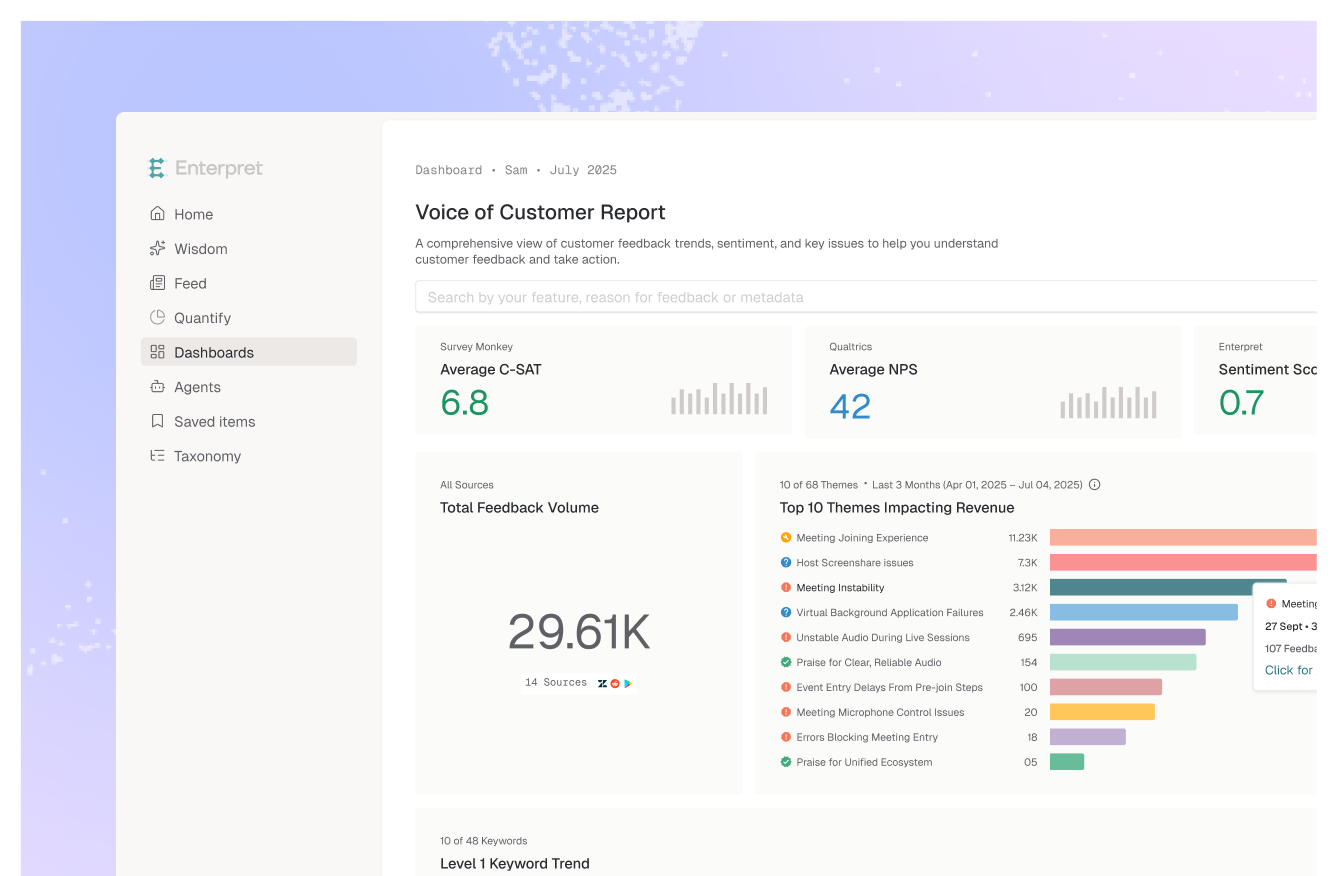
Enterpret natively ingests feedback from 50+ sources and applies one adaptive taxonomy across all of them, so themes total consistently no matter which channel feedback came from. Account and segment context is preserved on ingest through the customer context graph, and the integrations are vendor-maintained, so coverage stays reliable as sources change.
If you're evaluating feedback platforms, see how Enterpret's customer feedback integrations ingest every source into one taxonomy, or book a demo.
Lorem ipsum dolor sit amet, consectetur adipiscing elit. Suspendisse varius enim in eros elementum tristique. Duis cursus, mi quis viverra ornare, eros dolor interdum nulla, ut commodo diam libero vitae erat. Aenean faucibus nibh et justo cursus id rutrum lorem imperdiet. Nunc ut sem vitae risus tristique posuere.