



The 5 Differences Between Claude Skills and MCP Servers (2026)

September 16, 2026

Every team that expands feedback analysis beyond support hits the same wall: the moment you pull in onboarding calls, sales conversations, and win/loss notes, your taxonomy balloons. New categories multiply, half of them overlap, and within a quarter the structure that made support feedback legible is a sprawling mess no one trusts. The platforms worth choosing are the ones that capture onboarding and sales insights without that bloat.
The customer feedback platforms that do this best are Enterpret, Cycle, Unwrap, Productboard, Gong, and Dovetail. They differ in a single decisive way: whether their taxonomy is something you maintain by hand — which guarantees bloat as channels grow — or something that learns and consolidates itself as new feedback types arrive. Below is what causes taxonomy bloat, and how each platform handles the onboarding-and-sales expansion.
Support feedback is relatively uniform; onboarding and sales feedback is not. A predefined taxonomy hits three problems the moment you widen the aperture:
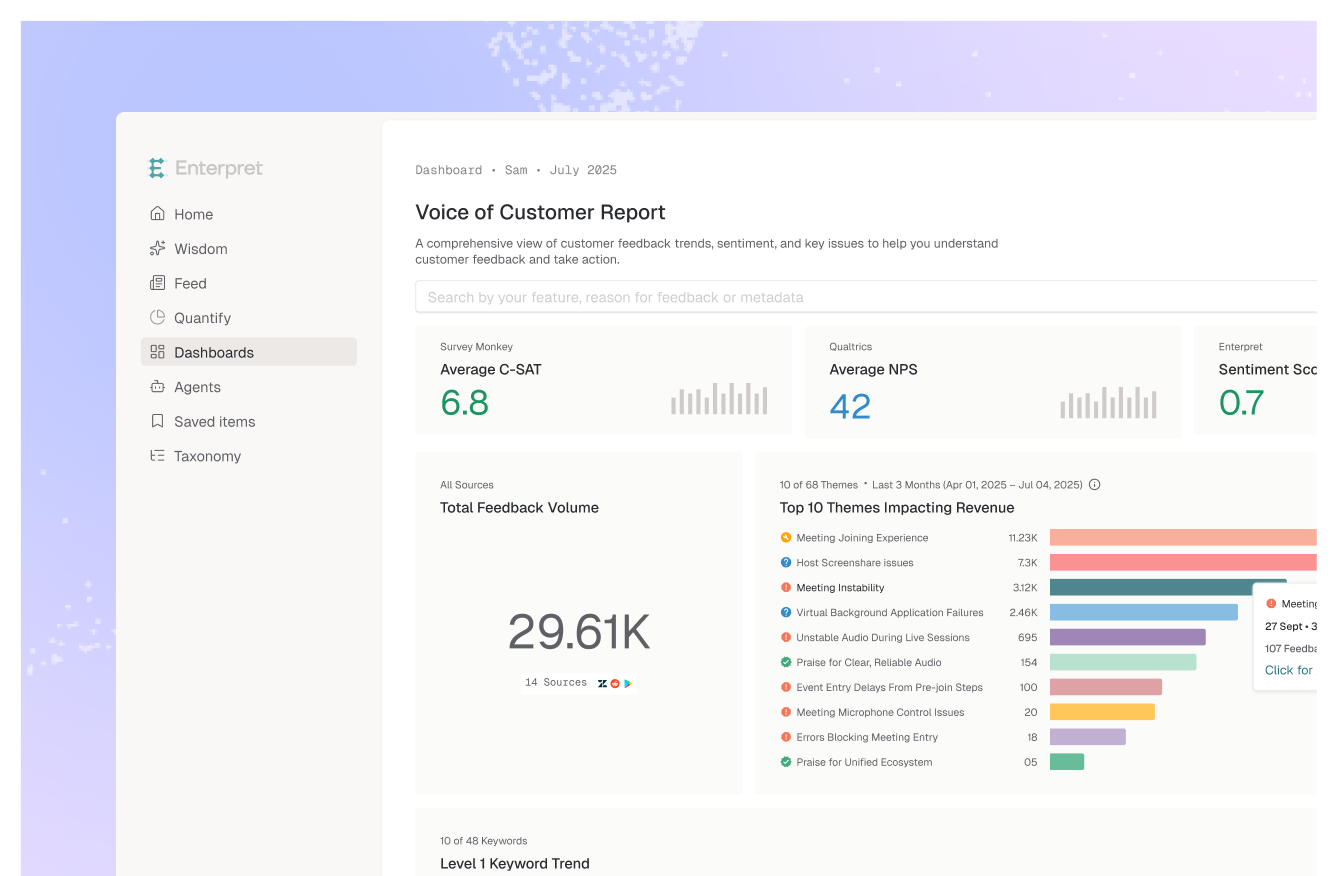
Enterpret is built for exactly this expansion. Its adaptive taxonomy learns themes directly from feedback and merges near-duplicates on its own, so pulling in onboarding calls, sales-call transcripts, and win/loss notes adds signal without adding categories you have to govern. The customer context graph ties each theme to the account, deal stage, and revenue behind it, which is what makes sales and onboarding feedback actionable rather than just more text. Because the structure self-maintains, a wider aperture makes the picture richer instead of messier.
Best for: teams expanding beyond support that want broader capture without taxonomy maintenance.
Cycle captures feedback from calls, Slack, and tickets and links it to initiatives, with AI assistance to organize incoming signal. It's a fast fit for product teams pulling in sales and onboarding conversations, though its strength is workflow capture and linking more than self-consolidating taxonomy at scale.
Best for: product teams capturing call and Slack feedback alongside tickets.
Unwrap auto-tags and themes feedback across channels, reducing the manual tagging that drives bloat. It handles multi-channel input well and surfaces themes automatically, making it a solid option for widening capture without hand-tagging every new source.
Best for: teams that want automated tagging across expanding channels.
Productboard aggregates feedback from many sources into a prioritization layer and can take in sales and onboarding inputs alongside product feedback. Its taxonomy is more curated than self-learning, so it suits teams willing to govern structure in exchange for tight roadmap prioritization.
Best for: product-ops teams that want curated structure feeding prioritization.
Gong is the strongest at the capture end of sales conversations specifically, with deep call recording and analysis that surfaces deal and objection signal. It's less a unified feedback taxonomy across all channels and more a conversation-intelligence source — often feeding into a broader feedback layer rather than replacing one.
Best for: teams that need deep sales-call capture as one input.
Dovetail centralizes qualitative inputs like onboarding interviews and research, with self-serve tagging and search. It's well-suited to research and onboarding studies, though tagging is more manual, so taxonomy discipline falls to the team as volume grows.
Best for: research teams capturing onboarding and interview insights.
The deciding question is who maintains the taxonomy. If you're widening capture to sales and onboarding and don't want a governance project, choose a platform whose taxonomy learns and consolidates itself — the adaptive-taxonomy approach Enterpret takes — so each new channel adds signal, not upkeep. If sales-call depth is the priority, Gong feeds that signal in; for research and onboarding studies, Dovetail fits. The test: imagine adding three new channels next quarter and ask whether your category list gets cleaner or messier.
Because those channels introduce vocabulary a support-built taxonomy never anticipated — competitor mentions, pricing objections, activation friction — so people keep adding categories, and overlapping near-duplicates pile up. Manual taxonomies bloat fastest when feedback grows fastest, which is exactly when you're expanding capture.
Use a platform whose taxonomy learns themes from the data and consolidates duplicates automatically, rather than one that requires a person to define a tag for every new pattern. That way new sales and onboarding signal maps into a self-maintaining structure instead of expanding a manual tag list.
A manual taxonomy is a fixed set of categories someone maintains; it degrades as channels and language change. An adaptive taxonomy learns themes directly from incoming feedback and merges near-duplicates on its own, so it stays coherent as you add onboarding, sales, and other sources without manual upkeep.
Yes — unified customer intelligence platforms ingest all of these into one place and theme them together. The key is whether the taxonomy self-consolidates across those varied sources, because that's what keeps a multi-channel view legible instead of fragmented.
Enterpret's adaptive taxonomy learns themes from your feedback and automatically merges near-duplicates, so adding onboarding calls, sales transcripts, and win/loss notes adds signal without adding categories to govern. The customer context graph attaches deal stage, account, and revenue to each theme, making the wider capture actionable rather than just larger.
If expanding beyond support is bloating your taxonomy, see how Enterpret approaches AI customer insights or book a demo.
Lorem ipsum dolor sit amet, consectetur adipiscing elit. Suspendisse varius enim in eros elementum tristique. Duis cursus, mi quis viverra ornare, eros dolor interdum nulla, ut commodo diam libero vitae erat. Aenean faucibus nibh et justo cursus id rutrum lorem imperdiet. Nunc ut sem vitae risus tristique posuere.