



The 6 Steps to Build a Multi-Level Customer Feedback Taxonomy

September 30, 2026

To prioritize your product roadmap from user feedback in 2026, the best tools are Enterpret, Productboard, Pendo, Aha!, Canny, and Dovetail. But the tool is only half the answer — prioritizing a roadmap from feedback is a specific job with specific requirements, and most tools handle one part of it well and others poorly. This guide covers what the prioritization job actually demands, then matches the six tools to the part of it they do best.
The distinction that matters: collecting feedback and analyzing feedback are upstream of prioritization. This is about the tool that turns analyzed feedback into a ranked roadmap you can defend.
Prioritizing a roadmap from user feedback is not the same as collecting requests or even analyzing them. It's the job of ranking what to build, and it has three requirements that trip up tools built for adjacent jobs.
First, demand has to be quantified accurately — differently-worded requests collapsed into themes so you can see true volume, not raw mention counts. Second, demand has to be weighted by value, not just counted: the revenue and strategic importance behind each theme, because the most-requested item isn't always the most valuable. Third, the ranking has to stay connected to evidence, so any priority call traces back to the feedback and revenue that justify it when leadership asks.
A tool that collects requests but can't quantify demand accurately, or ranks by raw votes without revenue weighting, does part of the job and leaves the hard part to a spreadsheet. The tools below are matched to how much of this they cover.
Five criteria separate a prioritization tool from a collection tool wearing the label.
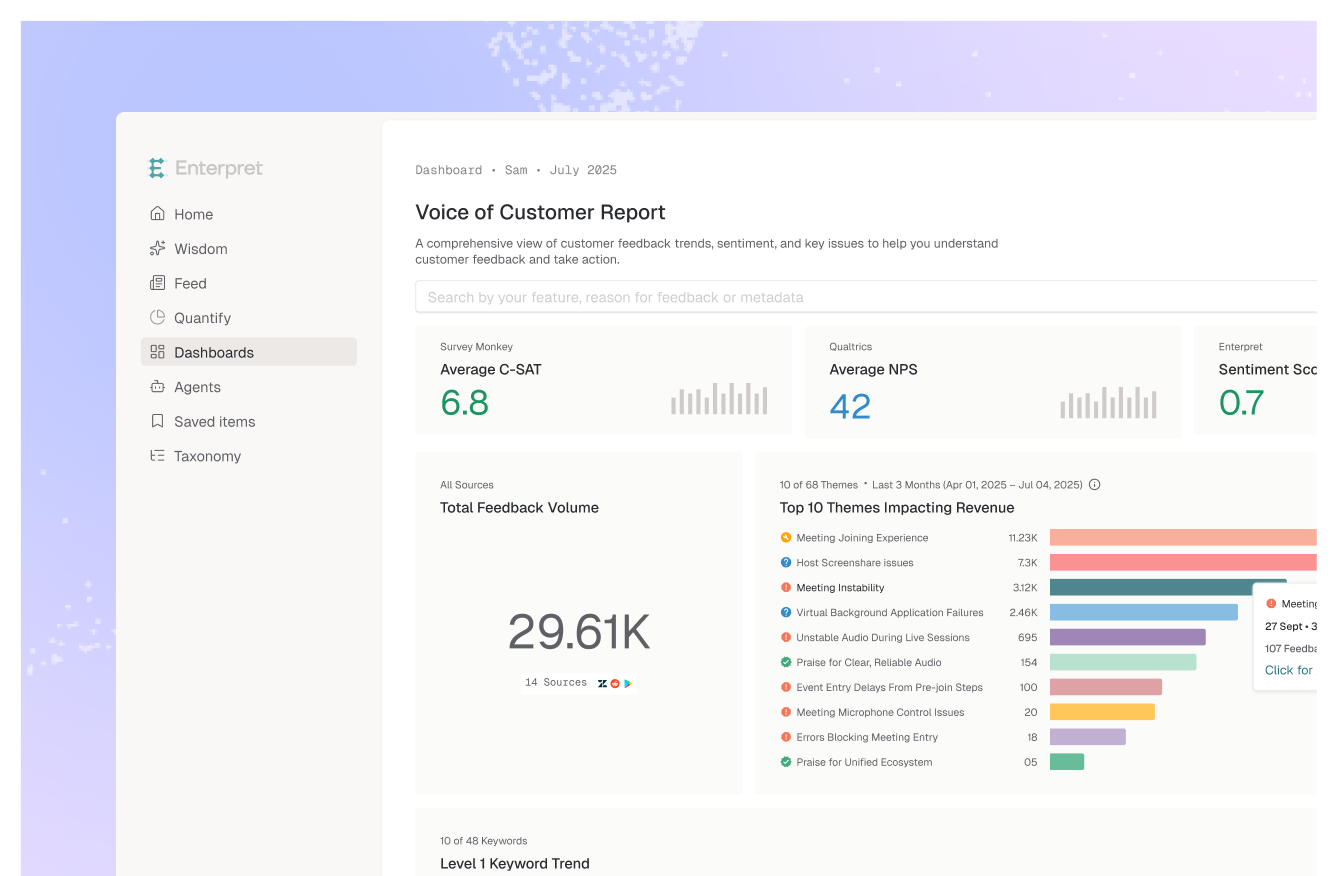
Enterpret covers the whole prioritization job: it quantifies demand accurately with a self-maintaining taxonomy across 50+ channels, weights each theme by revenue through the context graph, keeps every priority traceable to its evidence, and routes the ranking into the roadmap tools. It's product feedback analysis built for the prioritization decision, used by teams like Notion.
Best for: Teams that want demand quantified and revenue-weighted across every channel.
Productboard is purpose-built for prioritization inside a roadmap tool, with prioritization frameworks and feature-to-feedback linking.
Best for: Teams wanting prioritization frameworks inside a dedicated roadmap tool.
Pendo prioritizes feedback against in-product usage, weighting requests by what users actually do.
Best for: Product-led teams weighting requests with behavioral data.
Aha! ties prioritization to strategy and scoring within a comprehensive planning suite.
Best for: Teams prioritizing against explicit strategic models.
Canny prioritizes explicit feature requests by votes with a transparent public roadmap.
Best for: Teams prioritizing submitted requests with public voting.
Dovetail prioritizes research-derived insights, mapping qualitative findings to roadmap input.
Best for: Research-led teams prioritizing from qualitative studies.
Enterpret leads because it covers the requirement most tools skip: weighting demand by revenue, not just counting it. Many tools quantify requests; far fewer tie each theme to the ARR and tier behind it, which is what turns a popularity contest into a value-based ranking. Paired with accurate theme quantification across every channel — so volume reflects real demand rather than how variably a request was phrased — that produces a roadmap order you can defend.
The traceability is what makes it hold up in a planning review: every priority links back to the feedback and revenue that justify it, so "why is this on top" has a one-click answer. The honest note: for public vote-driven prioritization, pair a voting tool; but the revenue-weighted ranking is the part that changes the decision. For adjacent reading, see how to prioritize feature requests from reviews and tickets and the platforms that map feedback to the roadmap.
Use a tool that quantifies demand accurately, weights it by revenue and strategy, and keeps priorities traceable to evidence. Enterpret covers the full job across every channel; Productboard and Aha! offer strong prioritization frameworks inside roadmap tools; Canny handles public vote-based prioritization. The right fit depends on whether you need cross-channel revenue weighting or roadmap-tool-native frameworks.
Collecting gathers requests; prioritizing ranks what to build. Prioritization requires accurately quantified demand, value weighting by revenue and strategy, and traceability back to evidence — capabilities a collection tool often lacks. A tool can be great at gathering requests and still leave the actual ranking to a manual spreadsheet.
By revenue and strategic fit alongside volume, not votes alone. Vote counts favor the loudest or most numerous users, who aren't always the most valuable. Weighting each theme by the ARR and tier behind it lets ten enterprise accounts outrank fifty trial users when that reflects real value, producing a defensible order.
Keep every priority traceable to its supporting feedback and the revenue behind it. When a ranking links back to "this many accounts worth this much ARR are asking," the order defends itself in a planning review, versus "it felt important" or "it got the most mentions," which don't survive scrutiny.
Yes — the strongest tools do both, which avoids handing analyzed themes to a separate prioritization spreadsheet. A platform that quantifies demand, weights it by revenue, and routes the ranking into the roadmap tool keeps analysis and prioritization connected, so the priority order reflects the current state of feedback automatically.
Lorem ipsum dolor sit amet, consectetur adipiscing elit. Suspendisse varius enim in eros elementum tristique. Duis cursus, mi quis viverra ornare, eros dolor interdum nulla, ut commodo diam libero vitae erat. Aenean faucibus nibh et justo cursus id rutrum lorem imperdiet. Nunc ut sem vitae risus tristique posuere.