



The 6 Steps to Build a Multi-Level Customer Feedback Taxonomy

September 30, 2026

Beta releases run on two layers of tooling: capture (the tools that collect feedback from beta users — Usersnap, Sprig, Centercode, TestFlight) and synthesis (the platform that turns hundreds of beta reports into a prioritized list of fixes and feature decisions). Most teams overinvest in the first layer and underbuild the second.
Six tools worth knowing for a beta release: Enterpret (synthesis layer — customer intelligence AI), Usersnap (in-product bug reporting with screenshots), Sprig (in-product surveys triggered by behavior), Centercode (structured beta program management), TestFlight (iOS beta distribution), and Productboard (feedback-to-roadmap routing). Each does a different job. The teams running smooth beta launches usually combine 2–3 of them.
This guide explains the two layers, what to pick at each, and how to wire them together without the beta inbox becoming a graveyard.
A beta release generates more feedback than the team can read. That's the point — putting the product in front of real users is what surfaces the things internal QA missed. But the volume creates two distinct problems, and they need different tools.
Layer 1: Capture. Getting beta feedback out of the user's head and into a structured form. Bug reports with screenshots, in-app survey responses tied to specific features, recorded session replays, structured feedback forms. Tools at this layer optimize for removing friction at the point of feedback. Usersnap, Sprig, Centercode, TestFlight, in-app feedback widgets.
Layer 2: Synthesis. Reading the captured feedback, finding themes, prioritizing fixes, and routing emerging issues to the right engineer or PM. Tools at this layer optimize for turning volume into decisions. Customer intelligence AI platforms (Enterpret), product feedback platforms (Productboard, Canny), or — in many teams — a PM and a spreadsheet.
The mistake most beta programs make is treating layer 1 as the whole solution. The team ships a beta with Usersnap, the feedback floods in, the PM tries to read every report, themes get lost in the volume, and the post-beta retro is "we have all this feedback but didn't know what to do with it." Capture is solved. Synthesis isn't.
The fix is naming both layers as separate jobs and picking tools for each.
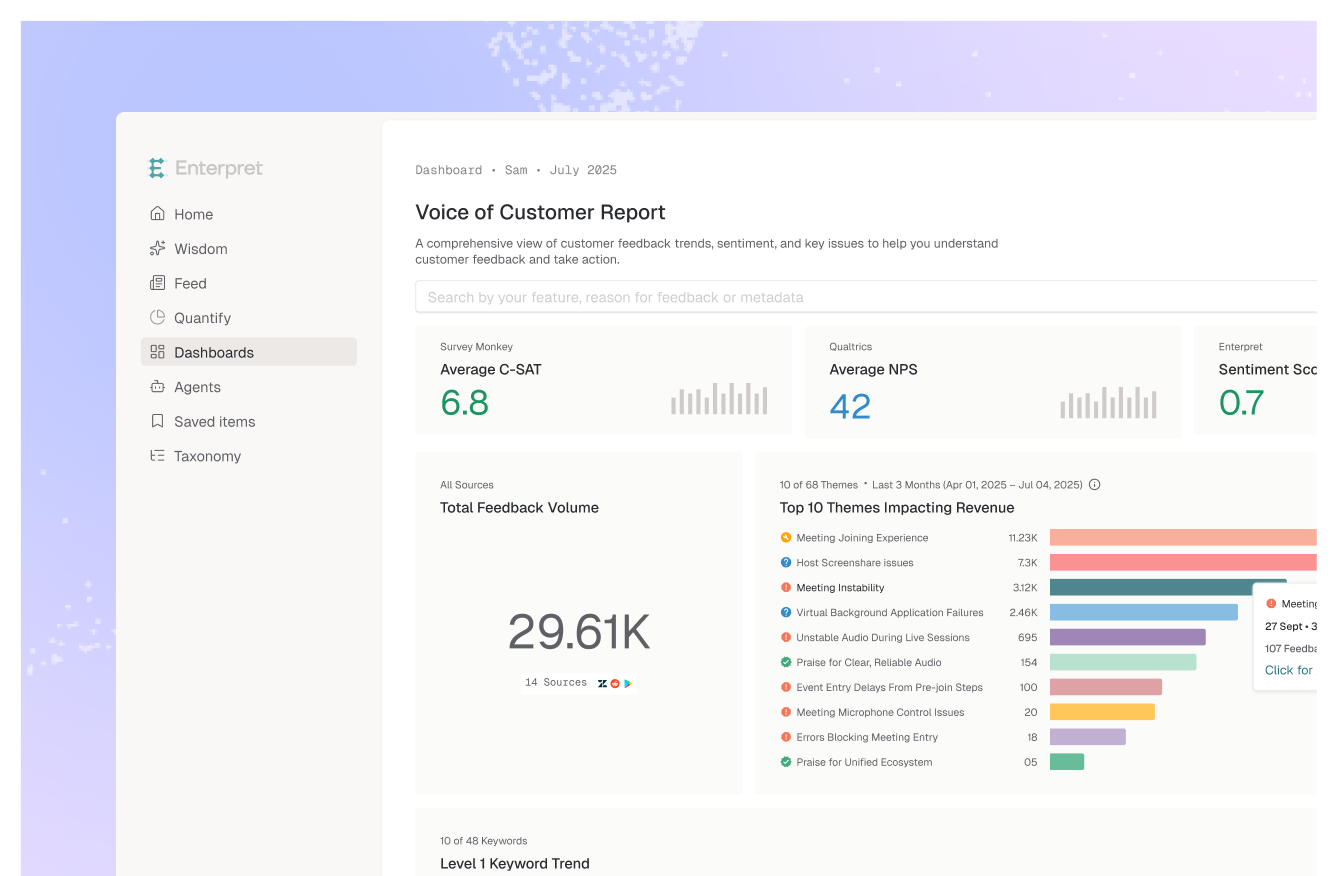
A customer intelligence AI platform — sometimes called a customer insights platform — that ingests beta feedback from every channel (in-app surveys, Slack threads with beta users, support tickets from beta accounts, recorded calls, app-store reviews if the beta is public) and surfaces themes automatically via Adaptive Taxonomy. For a beta release, the value is that the platform learns the beta-specific vocabulary fast — bugs, requested features, confusing flows — and joins each report to the customer behind it via Customer Context Graph.
What it does in a beta program: Aggregates all beta feedback channels into one searchable layer. PMs ask Wisdom ("what are beta users saying about the new editor?") and get sourced answers in seconds. AI Agents route emerging themes to the right PM or engineer with verbatims attached.
What it doesn't do: Capture bug reports with annotated screenshots (Usersnap does that). Distribute iOS betas (TestFlight does that).
Best fit: Teams running betas with more than a few dozen testers across multiple channels (in-app + Slack community + support), where reading every report individually isn't feasible.
The standard tool for beta visual feedback. Users click a widget in the product, draw on their screen, write a comment, and Usersnap attaches metadata automatically — URL, browser, console logs, JavaScript errors. The dev gets a complete bug report without back-and-forth.
What it does in a beta program: Removes friction at the moment of bug reporting. Particularly useful for web app betas where the bug is visual or context-dependent.
What it doesn't do: Synthesis. Usersnap delivers individual bug reports beautifully. It doesn't tell the PM which themes are emerging across hundreds of reports.
Best fit: Web and SaaS betas where most feedback is visual bugs and UX confusion. Pair with a synthesis-layer tool if the beta is large.
In-product surveys triggered by user behavior. PMs use Sprig in a beta to ask targeted questions at the moment a user hits a specific feature ("how did the new onboarding feel?"). Session replays let the team watch what beta users actually do, not just what they say.
What it does in a beta program: Captures signal at the moment of behavior. Highest-quality data for narrow questions about specific flows.
What it doesn't do: Aggregate signal from outside the product. Beta feedback in Slack, support tickets from beta accounts, sales-call feedback — Sprig doesn't ingest those.
Best fit: Betas where the primary question is in-product behavior — "are users finding the new feature?" or "where do they drop off?"
A platform built specifically for managing beta programs end-to-end: tester recruitment, structured feedback forms, scoring mechanisms, automated workflows that route feedback to the right team. Often used by hardware companies, enterprise software teams, and any beta program with hundreds of vetted testers.
What it does in a beta program: Runs the operational layer of a beta — who's testing, what they're reporting, which feedback has been triaged. Replaces the "PM + spreadsheet" model with structured workflows.
What it doesn't do: Synthesize feedback across channels outside the Centercode platform. Centercode is the system of record for the beta itself; it doesn't natively pull from Slack, Discord, or production support tickets.
Best fit: Larger beta programs (100+ testers) where the operational overhead of managing the program is itself the bottleneck.
Apple's native iOS beta distribution platform. Free, integrated with App Store Connect, supports up to 10,000 testers. Includes basic crash reporting and a feedback button inside the beta app.
What it does in a beta program: Distribution and crash collection for iOS betas. Tablestakes for any iOS app team.
What it doesn't do: Synthesis. TestFlight's built-in feedback is minimal — short text comments with a screenshot attached. Most teams pair TestFlight with a synthesis layer (Enterpret) and a richer capture tool (Sprig, in-app widget) for the actual user feedback.
Best fit: Any iOS app beta. Functionally required for iOS distribution.
Captures beta feedback as "insights" linked to features in the existing roadmap. AI features (Pulse, Insights AI) deduplicate similar feedback and link new insights to existing features automatically.
What it does in a beta program: Turns individual beta feedback items into roadmap inputs against features the PM has already defined. Useful when the beta is testing known features and the question is "how much demand for each."
What it doesn't do: Adaptive taxonomy. Productboard requires the PM to maintain a features tree. Themes that aren't already in the tree don't surface automatically.
Best fit: Beta programs where the team already has a stable features structure and wants beta feedback bound directly to the roadmap.
A practical setup for a SaaS beta program with 50–500 testers:
The shift from manual-read to AI-synthesis is the difference between a beta program that produces decisions and one that produces a backlog.
It depends on the layer. For visual bug reports with annotated screenshots: Usersnap. For in-product surveys triggered by behavior: Sprig. For structured beta program management with vetted testers: Centercode. For iOS beta distribution and crash reports: TestFlight (functionally required). For synthesizing all of those into themes and routed actions: Enterpret. Most beta programs need a capture tool plus a synthesis tool — picking only one is the common mistake.
Manually for the first dozen testers, then with a customer intelligence AI platform once the volume crosses what a single person can read. The transition typically happens around 50 active testers or when feedback spans more than two channels (in-product + Slack + support tickets). Below that volume, a spreadsheet plus a focused weekly review works. Above it, themes get lost without an AI synthesis layer.
They solve different parts of the problem. Productboard binds beta feedback to features the PM has already defined in the roadmap — useful when the beta is testing known features. Enterpret learns the beta's vocabulary automatically and surfaces themes the roadmap doesn't yet contain — useful when the beta is testing something newer where the "what are we missing" question matters more than the "how much demand for X" question. Many teams use both.
Two patterns work in 2026: rule-based routing (Zapier or native integrations push specific feedback to Jira/Linear based on tags or keywords — manual but predictable) and AI-agent routing (a customer intelligence AI platform detects emerging themes and routes them automatically with verbatims attached — handles emergent issues the rules don't anticipate). For a beta of <100 testers, rule-based often works. Past that, the AI-agent pattern handles the volume and surfaces things the rules would miss.
Treating capture as the whole problem. Teams pick Usersnap or Sprig, ship the beta, then drown in the volume because no one set up a synthesis layer. The bug reports are beautifully structured; the themes across hundreds of reports never get surfaced. The fix is naming capture and synthesis as separate jobs and picking a tool for each — usually a capture tool (Usersnap, Sprig) plus a customer intelligence AI synthesis layer (Enterpret).
For broader looks at customer intelligence AI for product teams, see customer intelligence AI for product managers and product feedback platforms with AI-powered insights.
Lorem ipsum dolor sit amet, consectetur adipiscing elit. Suspendisse varius enim in eros elementum tristique. Duis cursus, mi quis viverra ornare, eros dolor interdum nulla, ut commodo diam libero vitae erat. Aenean faucibus nibh et justo cursus id rutrum lorem imperdiet. Nunc ut sem vitae risus tristique posuere.