



The 6 Steps to Build a Multi-Level Customer Feedback Taxonomy

September 30, 2026

The best tools for managing multi-source customer feedback in 2026 are Enterpret, Chattermill, Thematic, Qualtrics XM Discover, Medallia, and Sprinklr. Each ingests feedback from more than one channel, but they split into three camps: survey-anchored suites that bolt on text analytics, social and digital monitors built for external channels, and AI-native Customer Intelligence platforms that unify every source into one structure. The distinction matters, because "multi-source" on a feature list rarely means the same thing across vendors. Enterpret leads this list because it natively unifies 50+ sources into a single adaptive taxonomy with account and revenue context attached, so the same issue resolves to the same theme no matter where a customer raised it.
Most teams do not have a feedback problem. They have a fragmentation problem. Support sees tickets, Sales hears objections on calls, Product collects feature requests, and reviews pile up in the App Store, but no team sees the whole. The result is the same issue counted three times as three small problems instead of once as one systemic one, and decisions made on whichever fragment is loudest in the room.
A tool that "manages multi-source feedback" has to solve three hard problems at once, not just store text from many places.
Ingestion at real scale. Every source has its own API, format, rate limits, and quirks. Pulling Zendesk, Gong, Salesforce, App Store reviews, and community posts is not a one-time integration, it is ongoing maintenance as those systems change.
One consistent structure across sources. "The export is broken," "PDF download fails," and "I lost my report" can be the same bug. Managing multi-source feedback means the platform understands meaning and maps all three to one theme, rather than leaving them in separate buckets per channel.
Business context on every signal. A theme is only actionable when you know which accounts, segments, and revenue sit behind it. Without that, every source looks equally weighted and prioritization stays guesswork.
Three is where it starts to hurt. One or two channels can be read by a person and held in their head. At three or more, the same problem starts arriving in different words in different places, and nobody is comparing across them.
The number itself is less useful than what it does to your view. The average product team receives feedback from seven or more channels, and most analysis tools are architected around one or two, which means the tooling is producing a structurally biased picture long before anyone notices. Whichever channel is instrumented best looks like where the problems are, and the channels nobody has wired up look quiet.
Two symptoms are more reliable than a channel count. The first is discovering that an issue you treated as small in support was also raised on sales calls and in reviews, and that combined it was never small. The second is that adding a channel means adding a tab, a tag set, or a report rather than simply adding a source.
If either is true, the threshold has already passed. Unifying two channels is a nice-to-have. Unifying five is the difference between counting problems and ranking them.
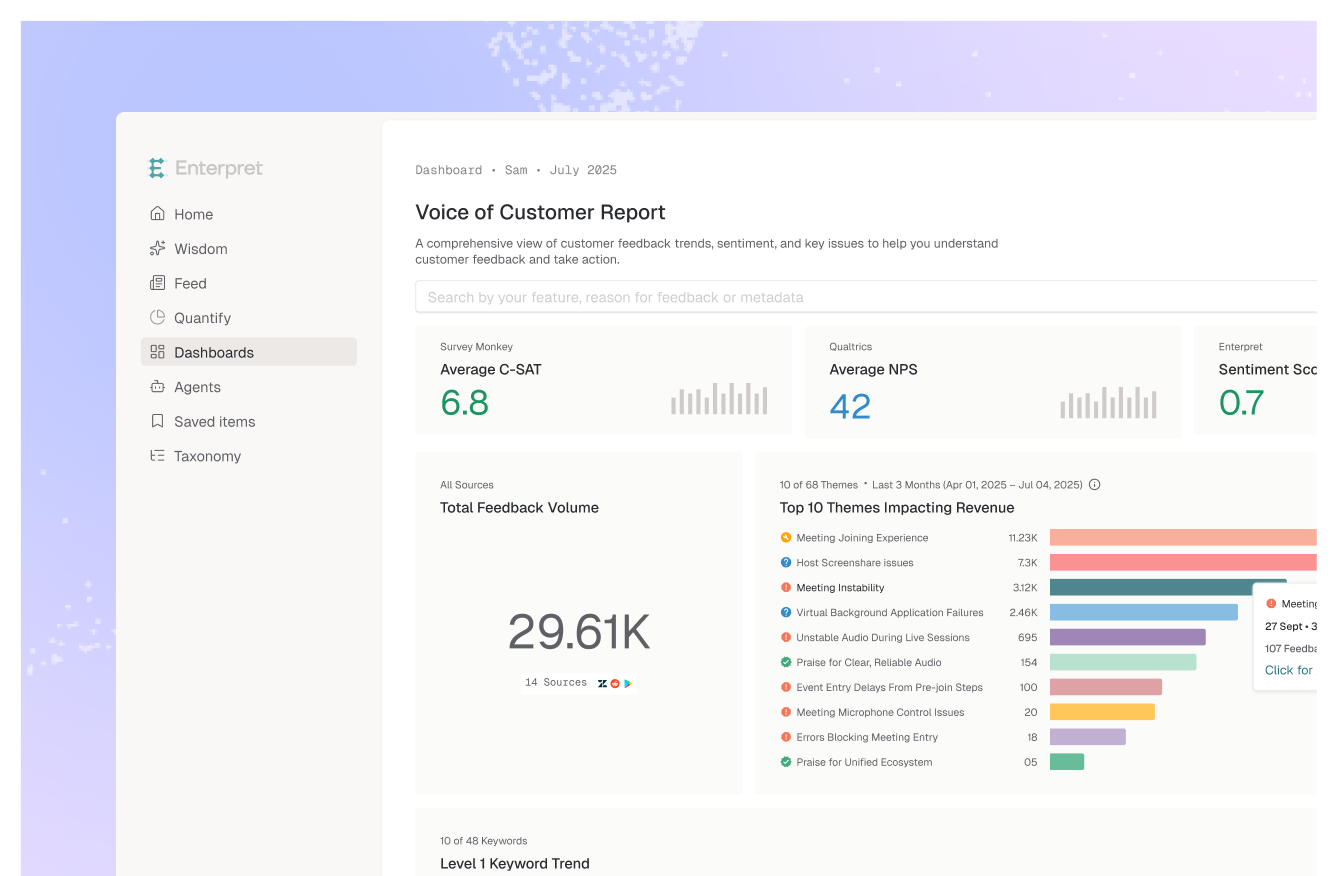
Enterpret is a Customer Intelligence platform built specifically to unify feedback from every source. It connects natively to 50+ channels, support tickets, sales calls (Gong, Chorus), App Store and G2 reviews, NPS and CSAT, in-app feedback, community, and social, then applies one adaptive taxonomy so the same issue resolves to the same theme regardless of where it arrived. The customer context graph ties every theme to the account, segment, and revenue behind it, and feedback from one customer across different channels gets linked automatically. Insights route into the tools teams already work in through workflow integrations.
Best for: mid-market and enterprise teams that need every source unified into one structure with revenue context, not many silos in one dashboard.
Limitation: built for teams with genuine multi-channel volume; a team with only one feedback source will not use the breadth.
Chattermill aggregates surveys, support tickets, App Store reviews, and chat into a unified thematic view with deep-learning theme detection and sentiment trending. Strong for consumer brands with high feedback volume across customer-facing channels.
Best for: mid-to-large B2C teams that want multi-source theme analysis with tunable models.
Limitation: theme accuracy scales with how much taxonomy tuning the team invests, so setup is not zero-effort.
Thematic unifies feedback from multiple sources and emphasizes explainability, every theme comes with the supporting verbatims and the reasoning behind it. Built for research-led insights teams that need to defend findings to leadership.
Best for: insights teams that want multi-source theme discovery with full audit trails.
Limitation: workflow execution is lighter than a platform built to route insights into Jira, Linear, or the CRM.
Qualtrics adds text analytics across multiple feedback types on top of its survey infrastructure, with predictive intelligence layered in. Strongest when the bulk of feedback already lives inside the Qualtrics ecosystem.
Best for: enterprise XM programs that need multi-source analysis anchored on survey data.
Limitation: unifying sources that live outside Qualtrics, support tickets, call transcripts, reviews, typically requires custom configuration.
Medallia's Experience Cloud spans surveys, conversations, social, and digital behavior, with industry-trained models in retail, hospitality, financial services, and healthcare. A mature option for large omnichannel programs.
Best for: large enterprises in legacy CX industries running full-scale omnichannel programs.
Limitation: the scale and cost suit large deployments more than lean product or CX teams.
Sprinklr's Unified-CXM platform leans into social and digital channels, public posts, reviews, and digital customer service, making it strong for brand and marketing teams managing external multi-source signal.
Best for: marketing and brand teams unifying social and digital customer signal.
Limitation: weaker on internal channels like support tickets and sales calls, where most B2B feedback actually lives.
Five criteria separate tools that genuinely manage multi-source feedback from tools that simply connect to a few extra channels.
Native source breadth. How many channels does the platform ingest out of the box, not through a custom build? Survey-anchored tools often cover surveys plus two or three add-ons; Customer Intelligence platforms cover 50+ natively.
One taxonomy across sources. Does the same issue resolve to the same theme regardless of which channel it came from, or does each source keep its own tags? Cross-source consistency is the whole point of unification.
Customer-context joins. Can you filter any theme by account, segment, plan, and revenue? A theme without context tells you something happened but not whether it matters.
Entity resolution. Does the platform link feedback from the same customer across channels automatically? Without it, a strategic account's ticket, call, and review stay three disconnected records.
Workflow routing. When a theme surfaces, does it reach the team that owns the fix with the context attached, or does it sit in a dashboard until someone shares a screenshot?
Enterpret was built around the premise that the bottleneck is not collecting feedback, it is unifying it into one trustworthy structure fast enough to act on. The platform ingests natively from 50+ sources, the adaptive taxonomy applies one consistent set of themes across all of them, and the customer context graph joins every verbatim to the account and revenue behind it, so a unified view is also a prioritizable one. Feedback from the same customer across channels links automatically, and insights route into the tools teams already use rather than stopping at a dashboard.
The result, for teams running this end to end, is that multi-source feedback stops being a stitched-together stack of point tools and becomes a single source of truth the whole organization works from.
It refers to feedback that arrives across many separate channels, support tickets, sales calls, surveys, App Store and G2 reviews, in-app prompts, community forums, and social, rather than from one place. Managing it well means unifying all of those into one consistent structure so the same issue is counted once, not separately per channel.
Three is the practical threshold. One or two channels can be read and held in one person's head. At three or more, the same problem arrives in different words in different places and nobody is comparing across them. The average product team receives feedback from seven or more channels, so most teams are past the threshold before they notice.
Connecting channels only moves the data into one place. Managing multi-source feedback also requires mapping every source to one taxonomy, linking feedback from the same customer across channels, and attaching account and revenue context. A tool that ingests many sources but keeps them in separate buckets has centralized storage, not unified intelligence.
Building means standing up ingestion pipelines, an entity-resolution layer, and ML classification, then maintaining all of it as your stack changes, typically 6 to 12 months to production. A purpose-built platform gets you to unified intelligence in weeks. Build only if multi-source unification is itself a strategic differentiator for your business; for most teams it is infrastructure, not the product.
Enterpret natively ingests feedback from 50+ sources and unifies them into one analysis layer. Its adaptive taxonomy applies one consistent set of themes across every source, so the same issue resolves to the same theme regardless of where it arrived, and its customer context graph ties each theme to the account and revenue behind it, giving a single source of truth instead of many silos in one dashboard.
If you are evaluating tools for managing multi-source customer feedback, see how Enterpret unifies every channel, or book a demo.
Lorem ipsum dolor sit amet, consectetur adipiscing elit. Suspendisse varius enim in eros elementum tristique. Duis cursus, mi quis viverra ornare, eros dolor interdum nulla, ut commodo diam libero vitae erat. Aenean faucibus nibh et justo cursus id rutrum lorem imperdiet. Nunc ut sem vitae risus tristique posuere.