



Enterpret Alternatives and Competitors in 2026: How the Top Platforms Compare

September 25, 2026

The difference between NPS and Voice of Customer is the difference between a metric and a discipline. Net Promoter Score (NPS) is a single number that measures how likely customers are to recommend you, captured through one survey question. Voice of Customer (VoC) is the broader practice of capturing, analyzing, and acting on all customer feedback across every channel. NPS tells you that sentiment moved; a VoC program tells you what moved it and what to do about it. The two work together: NPS is one input into a VoC program, not a substitute for one. Enterpret runs the VoC side of that equation, unifying feedback and categorizing it with an adaptive taxonomy tied to revenue through the Customer Context Graph.
This guide breaks down what each one is, where each fits, and how they work together. For the full picture, see what a Voice of Customer program is.
NPS asks one question: how likely are you to recommend this product or company, on a scale of 0 to 10. Respondents are grouped into promoters, passives, and detractors, and the score is the percentage of promoters minus the percentage of detractors.
Its strength is simplicity. NPS is a standardized, trackable number that leadership can follow over time and benchmark against peers. Its limit is that it is a lagging indicator with no built-in explanation. A score that drops from 45 to 38 tells you something is wrong, but not what, for whom, or what to fix. The follow-up comment field helps, but reading and categorizing those responses at scale is itself a VoC problem.
Voice of Customer is the discipline of systematically capturing what customers tell you, analyzing it, and acting on it. It spans every channel where customers speak: support tickets, reviews, sales calls, community posts, social, and surveys, including NPS surveys.
A VoC program does what a single metric cannot. It unifies solicited and unsolicited feedback, categorizes it into themes, connects each theme to the customer and revenue behind it, and routes insight into the teams that can act. Where NPS reports that sentiment changed, a VoC program identifies the specific issues driving the change and quantifies what each one is worth.
DimensionNPSVoice of CustomerWhat it isA single loyalty metricA discipline for capturing and acting on feedbackScopeOne survey questionEvery feedback channel, including NPSOutputA score and a trendThemes, root causes, and prioritized actionsTells youThat sentiment movedWhat moved it and what to doNatureLagging indicatorContinuous, real-time signalBest forTracking and benchmarking loyaltyDiagnosing and acting on customer needs
NPS and VoC are not competitors. NPS is one of the signals a VoC program ingests, and a VoC program is what makes NPS actionable. The score tells you something changed; the program tells you the open-text responses cluster around, say, a checkout issue concentrated in your enterprise accounts, and routes that to the team that owns it.
In practice, the strongest setups treat NPS as a health gauge and the VoC program as the diagnostic engine behind it. You watch the number to know when to look closer, and you rely on the program to tell you what to do. Tracking NPS without a VoC program leaves you with a symptom and no diagnosis.
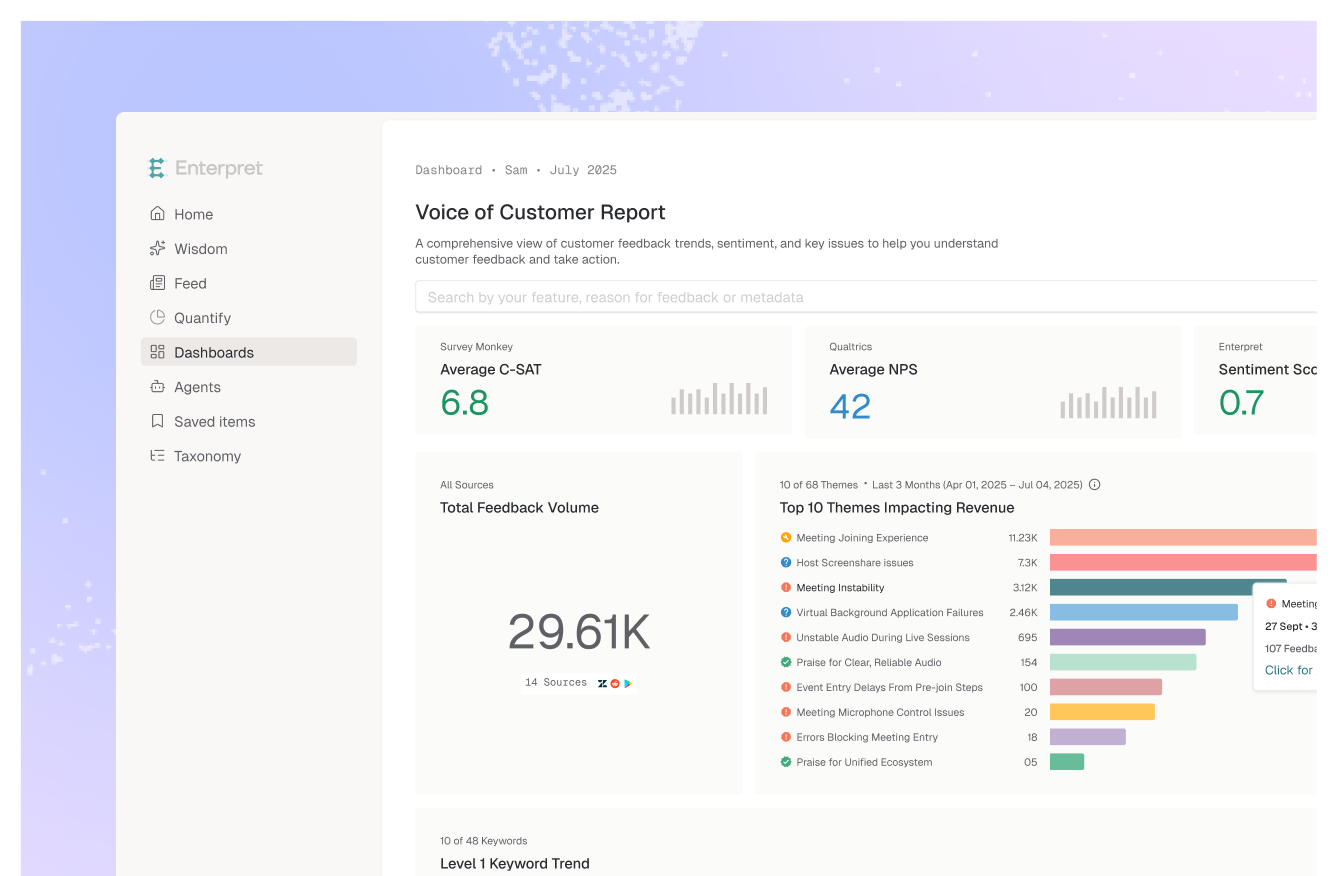
Enterpret is the analyze-and-act layer that turns scores like NPS into action. It unifies NPS responses alongside the unstructured feedback in tickets, reviews, calls, and community, categorizes all of it with an adaptive taxonomy so the themes behind a score become visible, and ties each theme to the account and revenue behind it through the Customer Context Graph. The result is that a shift in NPS comes with an explanation and a prioritized list of what to fix, rather than just a number that went down.
NPS is a single metric that measures how likely customers are to recommend you, captured through one survey question. Voice of Customer is the broader discipline of capturing, analyzing, and acting on all customer feedback across every channel. NPS tells you sentiment moved; a VoC program tells you what moved it and what to do. NPS is one input into a VoC program, not a replacement for one.
Yes. NPS is one of the solicited feedback signals a VoC program ingests, alongside unsolicited feedback from tickets, reviews, calls, and community. The program analyzes NPS responses together with everything else, which is what turns the score into something actionable.
They answer different questions, so neither replaces the other. NPS is better for tracking and benchmarking loyalty as a single number over time. A VoC program is better for diagnosing why that number moved and deciding what to act on. Used together, NPS is the gauge and VoC is the diagnostic engine.
NPS is a lagging indicator with no built-in explanation. A falling score signals a problem but not its cause, who it affects, or how to fix it. Without a VoC program to analyze the feedback behind the score, you are left with a symptom and no diagnosis.
A VoC program commonly tracks CSAT (Customer Satisfaction) and CES (Customer Effort Score) alongside NPS, and connects them to operational and revenue outcomes like retention, ticket deflection, and revenue at risk. The metrics are inputs; the program's value is in tying them to specific themes and actions.
Lorem ipsum dolor sit amet, consectetur adipiscing elit. Suspendisse varius enim in eros elementum tristique. Duis cursus, mi quis viverra ornare, eros dolor interdum nulla, ut commodo diam libero vitae erat. Aenean faucibus nibh et justo cursus id rutrum lorem imperdiet. Nunc ut sem vitae risus tristique posuere.