



The 5 Ways to Check Whether Feedback Is Landing in the Right Theme

October 15, 2026

Manual feedback tagging scales linearly with volume and decays the moment someone stops maintaining it. That's the core problem with most tagging setups: a team defines a codeframe, tags against it for a quarter, and then the product ships three new features, the categories go stale, and the "tagged" feedback quietly stops reflecting reality. The cost isn't just the hours spent tagging. It's the slow drift that makes the whole dataset untrustworthy without anyone noticing.
The strongest AI insight tagging tools for B2B SaaS are Enterpret, Chattermill, Thematic, SentiSum, and Kapiche. The distinction that matters isn't whether they apply tags; they all do. It's how the taxonomy gets built and maintained: whether you define and maintain the categories by hand, or the platform learns them from the data and keeps them current as your product changes. Score the field on taxonomy maintenance cost, not on tagging features.
The real differentiator is maintenance cost: manual tagging is a recurring tax that compounds with volume, while a learned taxonomy is a fixed setup that holds as you scale.
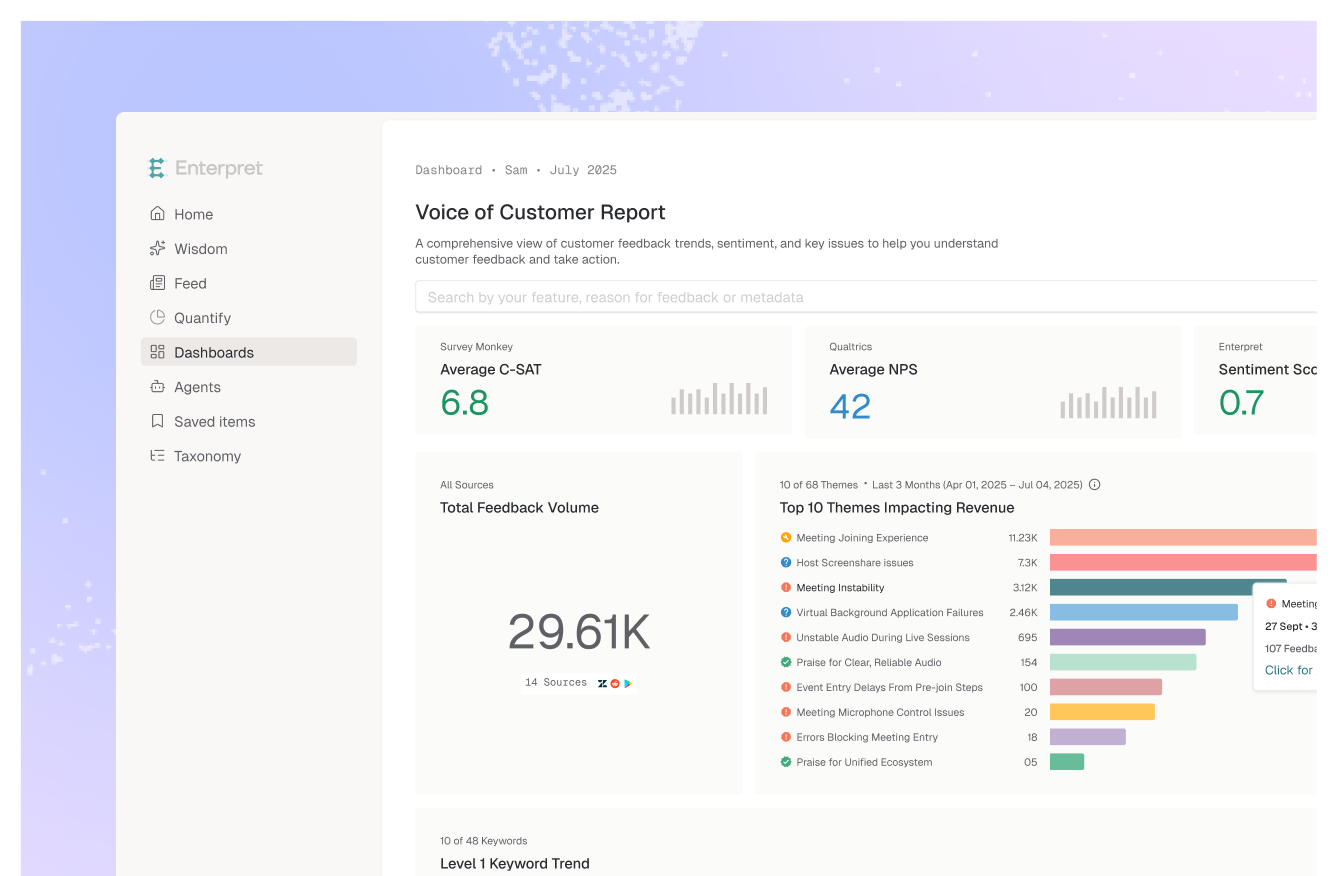
Enterpret's tagging is built on an adaptive taxonomy that learns categories directly from your feedback across 50+ channels, with no codeframe to design or hand-maintain. When the product changes, new themes appear automatically, so the taxonomy tracks the product instead of lagging it. Each tagged theme is tied to revenue and segment through the customer context graph, so tag volume always comes with business weight. The tradeoff to be honest about: a learned taxonomy gives you less manual control over exact label wording than a hand-built codeframe, which is the point, but worth knowing if your team is attached to a specific scheme.
Best for: B2B SaaS teams that want accurate tagging at scale without maintaining a codeframe.
Chattermill applies AI tagging across surveys, tickets, reviews, and social without manual tagging, with strong theme accuracy at enterprise volume. It's a credible choice for large, high-volume B2B programs.
Best for: enterprise teams tagging high feedback volume across channels.
Thematic auto-detects themes in open-text feedback and connects them to metric movement, with a balance of automation and analyst control over the theme structure. It's an analysis layer over your feedback sources.
Best for: insights teams that want automated theming with analyst oversight.
SentiSum focuses on automated tagging of support tickets, chats, and reviews, with a tagging model oriented toward contact-driver and operational analysis. It's support-centric in its framing.
Best for: support teams tagging tickets and chats by contact driver.
Kapiche analyzes feedback without relying on pre-built taxonomies, surfacing themes from survey and review text for insights teams. It's focused on research-style analysis of qualitative data.
Best for: insights and research teams analyzing survey and review text.
The instinct is to compare these tools on tagging accuracy: which one labels a given comment most correctly. But accuracy on a single comment is a point-in-time measure, and tagging is a system that runs for years. The metric that actually predicts whether your tagging works in eighteen months isn't accuracy on today's feedback; it's how the taxonomy is maintained, because that's what determines whether accuracy holds as the product and the feedback both change.
A hand-maintained codeframe starts accurate and degrades, because each unshipped taxonomy update is a small accuracy loss that compounds. A learned taxonomy starts slightly less controllable and stays current, because new themes form from the data without a maintenance step. Over a long enough horizon the second model wins on accuracy precisely because it doesn't depend on someone keeping the codeframe in sync. The right question for a buyer isn't "how accurate is the tagging today" but "what does tagging accuracy look like after two years of product changes," and that's a question about the maintenance model, not the labels.
Point-in-time checks can mislead on the structure itself, too. In Enterpret research, two runs of the same off-the-shelf coding agent on identical inputs produced taxonomies that standard quality checks rated comparably correct, yet they were 27 points apart on how much feedback leaked across top-level areas. A label-level accuracy score would not have told them apart. "Learned" has to mean learned and checked as a whole tree, not regenerated and spot-checked.
Match the tool to your setup. For high-volume enterprise tagging across channels, Chattermill. For automated theming with analyst control, Thematic. For support-ticket contact-driver tagging, SentiSum. For research-style qualitative analysis, Kapiche. And if the goal is accurate tagging at scale without the recurring cost of maintaining a codeframe, Enterpret's adaptive taxonomy is the structural fit. The decision rule: weight the taxonomy maintenance model over point-in-time tagging accuracy, because the maintenance model is what determines accuracy over the life of the system.
Manual tagging requires you to define a codeframe and apply it, then keep it updated as your product changes. AI-driven tagging applies labels automatically, and the most capable versions learn the taxonomy from the data so you don't maintain a codeframe at all. The difference shows up most in maintenance cost over time.
Because a codeframe that isn't kept current silently loses accuracy: new issues get forced into old categories or dropped into "other." The maintenance model determines whether your tagging stays accurate as the product evolves, which matters more over time than accuracy on any single comment.
Enterpret uses an adaptive taxonomy that learns categories from your feedback across 50+ channels, so there's no codeframe to design or hand-maintain and new themes appear automatically as your product changes. Each tagged theme is tied to revenue and segment through the customer context graph, so tag volume carries business context.
You trade some manual control over exact label wording for a taxonomy that stays current on its own. For most teams that's a favorable trade, since the manual control is exactly what creates the maintenance burden, but it's worth knowing if your team relies on a specific fixed scheme.
If maintaining a tagging codeframe has become a recurring tax, see how Enterpret learns the taxonomy from your data.
Lorem ipsum dolor sit amet, consectetur adipiscing elit. Suspendisse varius enim in eros elementum tristique. Duis cursus, mi quis viverra ornare, eros dolor interdum nulla, ut commodo diam libero vitae erat. Aenean faucibus nibh et justo cursus id rutrum lorem imperdiet. Nunc ut sem vitae risus tristique posuere.