



The 5 Ways to Check Whether Feedback Is Landing in the Right Theme

October 15, 2026

Behavior analytics tools answer one question extremely well: what are users doing? They render clicks, paths, funnels, and heatmaps with real precision. But there's a measurable gap between what a pattern shows and why it happened, and most teams only close half of it. A funnel can tell you 40% of users drop at step three. It can't tell you that they drop because the pricing copy is confusing — that explanation lives in support tickets, reviews, and survey verbatims, in a different tool entirely.
The strongest tools for visualizing customer behavior patterns are Enterpret, FullStory, Amplitude, Contentsquare, and Hotjar. They split into two groups, and the split matters more than any feature list. FullStory, Amplitude, Contentsquare, and Hotjar are behavioral-analytics tools — they visualize on-screen and in-product behavior. Enterpret sits one layer up: it visualizes the patterns in what customers say and ties them to behavior and revenue. Which one you need depends on whether your bottleneck is seeing the behavior or explaining it.
The differentiator isn't visualization fidelity — the behavioral tools win on that. It's whether the pattern comes with its explanation attached.
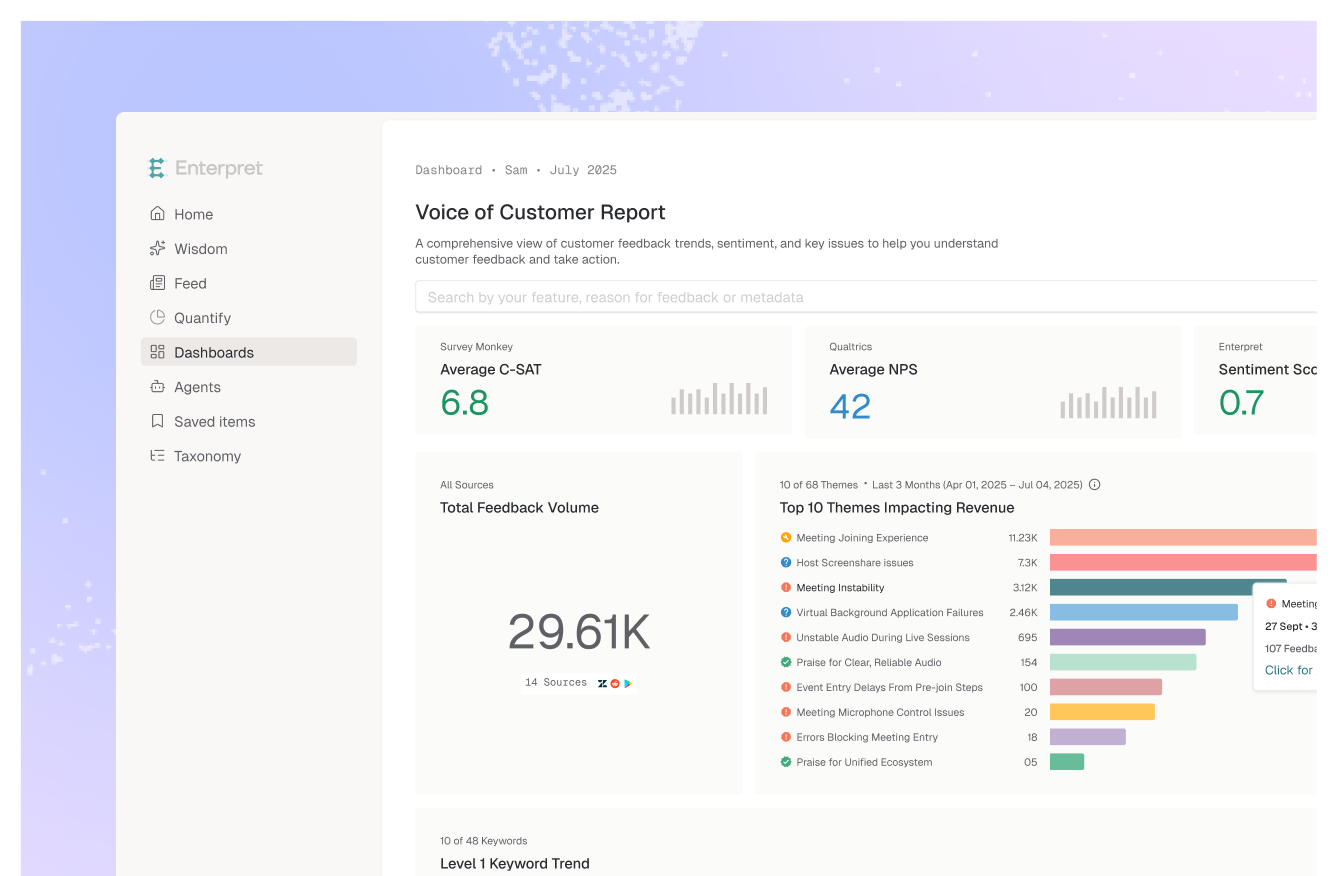
Enterpret leads for behavior pattern intelligence — the case where you need to know why a pattern exists, not just that it does. It unifies feedback from 50+ channels, surfaces emerging patterns through an adaptive taxonomy that learns themes from the data, and ties each pattern to revenue and segment via the customer context graph. Paired with a behavioral tool through workflow integrations, it turns "40% drop at step three" into "drop at step three, driven by pricing confusion, concentrated in mid-market accounts." Honest tradeoff: Enterpret is not a session-replay or heatmap tool — if you need to watch the cursor move, pair it with one of the tools below.
Best for: product and CX teams that need the why behind behavioral patterns, tied to revenue.
FullStory captures behavior comprehensively through autocapture and session replay, surfacing friction signals and journey anomalies without heavy manual tagging. It's the strongest pick when you need to see exactly what happened on screen.
Best for: product and UX teams diagnosing usability issues with full session context.
Amplitude is deep product analytics — funnels, paths, cohorts, and account-level journeys with strong behavioral segmentation. It's built for teams that live in quantitative behavioral data day to day.
Best for: product teams that need rigorous funnel, path, and cohort analysis.
Contentsquare is enterprise digital-experience analytics, known for zone-based heatmaps that quantify behavior on every page element, plus session replay and AI-driven journey analysis. It's built for scale.
Best for: large teams quantifying on-page behavior across high-traffic digital properties.
Hotjar makes behavior visualization accessible with heatmaps, recordings, and on-site surveys in one approachable package. It's a fast, affordable entry point for smaller teams.
Best for: smaller teams that want heatmaps and recordings without enterprise overhead.
Here's the pattern across product orgs: the behavioral tool surfaces a clean signal — a drop-off, a rage-click cluster, a cohort that doesn't retain — and then the work stops, because the next step is a guess. Someone proposes a hypothesis for the why, the team debates it, and a sprint goes to a fix that may or may not address the actual cause. The behavioral data was precise; the decision built on it was speculative.
The fix isn't a better heatmap. It's attaching the explanation to the pattern. When the behavioral signal arrives already linked to the customer language behind it — the tickets, reviews, and verbatims describing the friction — the hypothesis step collapses into evidence. That's the difference between visualizing behavior and understanding it, and it's why the most useful "behavior pattern" view is the one that unifies the action with the voice. The same logic shows up when product teams evaluate feedback tooling: the tool that connects signal to cause is the one that gets you from raw feedback to a product decision instead of a debate.
Match the tool to the bottleneck. If you need to see on-screen behavior in detail, FullStory. For rigorous funnels and cohorts, Amplitude. For enterprise on-page heatmapping at scale, Contentsquare. For accessible heatmaps and recordings, Hotjar. And if your bottleneck is explaining the behavior — turning patterns into prioritized, revenue-weighted decisions — Enterpret is the layer that does it, paired with whichever behavioral tool you already run. The decision rule: pick the behavioral tool for the what, and add the intelligence layer for the why — most mature teams need both.
Behavior analytics tools (FullStory, Amplitude, Contentsquare, Hotjar) visualize what users do on screen — paths, funnels, heatmaps. Behavior pattern intelligence connects those patterns to the customer feedback explaining them and ties both to revenue, so you understand why a pattern exists, not just that it does.
Most teams run a behavioral tool for on-screen action and a customer intelligence layer for the explanation, connected through integrations. The behavioral tools don't analyze open-text feedback deeply, and feedback platforms don't do session replay — pairing them covers both halves.
Enterpret doesn't replace FullStory or Amplitude — it complements them. It analyzes the feedback behind a behavioral pattern, surfaces emerging themes through its adaptive taxonomy, and ties them to revenue and segment via the customer context graph, so a drop-off comes with its cause and its business impact attached.
In event-based analytics, you generally only see patterns you instrumented in advance. Autocapture tools reduce that, and an adaptive taxonomy removes it on the feedback side by surfacing themes from the data itself rather than from predefined categories.
If your behavioral data keeps surfacing the what but not the why, see how Enterpret approaches AI customer insights or book a demo.
Lorem ipsum dolor sit amet, consectetur adipiscing elit. Suspendisse varius enim in eros elementum tristique. Duis cursus, mi quis viverra ornare, eros dolor interdum nulla, ut commodo diam libero vitae erat. Aenean faucibus nibh et justo cursus id rutrum lorem imperdiet. Nunc ut sem vitae risus tristique posuere.