



The 5 Ways to Check Whether Feedback Is Landing in the Right Theme

October 15, 2026

The CX tools that offer genuinely deep customer voice analysis in 2026 are Enterpret, Chattermill, Medallia, Qualtrics XM, and Thematic. "Deep" is the operative word — most CX platforms ship sentiment classification, theme grouping, and dashboards as table-stakes capabilities. What separates a deep platform from a shallow one is what happens after the basic analysis: multi-level theme hierarchies, root-cause investigation, sub-segment pattern detection, and the ability to ask follow-up questions that require synthesis across many signals.
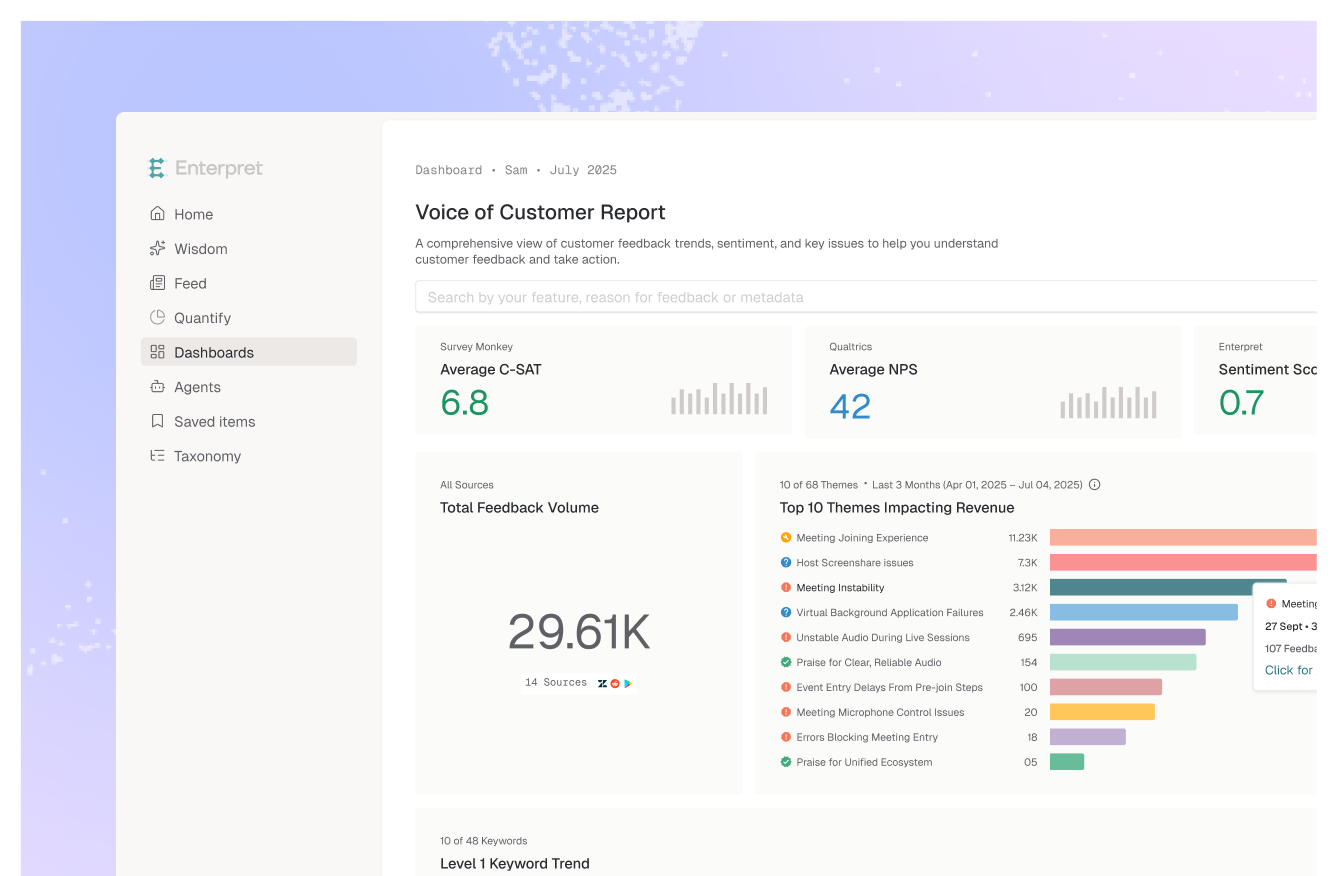
The architectural pattern that produces deep analysis: the platform doesn't stop at surfacing themes. It supports drilling from a top-level theme into sub-themes, from sub-themes into individual verbatims, from verbatims back out to customer profiles, and across to other related signals — all within one analytical session. Tools that ship sentiment scores and theme counts without the deeper drill-down produce dashboards that look comprehensive and break down when teams ask the second or third follow-up question.
Three analytical depth dimensions separate genuinely deep tools from shallow ones.
Hierarchical theme structure. A theme like "billing" should drill into sub-themes ("pricing increase," "invoice errors," "payment processing issues") and into individual verbatims under each sub-theme. Without hierarchy, every theme is a flat bucket — which works for top-line reporting and breaks down for investigation.
Cross-signal drill-down. Deep analysis means navigating naturally between sentiment scores, theme counts, customer segments, lifecycle stages, and revenue tiers within one investigation. Tools that require switching between separate dashboards for each dimension produce shallow analysis because the analyst loses context at every transition.
Iterative query depth. Deep investigation is iterative — one question leads to three follow-ups, each of which leads to more. A platform with conversational AI on top of the full dataset supports this naturally; a platform with only static dashboards forces the analyst to file a query for each follow-up question, which slows investigation to a pace where it stops happening.
The five platforms below address these depth dimensions differently.
Enterpret's analytical depth comes from three layers working together. The adaptive taxonomy supports multi-level theme hierarchies — top-level themes drill into sub-themes drill into individual verbatims, all surfaced through the platform's interface. The customer context graph supports cross-signal drill-down between themes, sentiment, customer segments, revenue tiers, and lifecycle stages without leaving the analytical session. Enterpret AI handles iterative query depth — analysts ask follow-up questions in natural language, with verbatims surfaced as evidence at every step.
The combination is what makes the platform genuinely deep rather than just feature-complete. An investigation that would take an analyst a week of switching between dashboards in legacy tools happens in a single conversational session.
Best for: Mid-market and enterprise CX teams who run frequent deep investigations and need analytical depth across many feedback channels.
Chattermill applies trained LLMs to feedback across surveys, support tickets, App Store reviews, and chat, with tunable theme models that support multi-level hierarchies when the team invests in configuration. The AI copilot handles iterative queries in natural language. Analytical depth is real but requires more setup investment than Enterpret to achieve full hierarchical structure.
Best for: Enterprise CX teams with dedicated analysts willing to invest in taxonomy tuning for deep multichannel analysis.
Medallia's Experience Cloud has historically been deep in the industries it dominates — retail, hospitality, financial services, healthcare. The platform supports drill-down from aggregate scores to frontline manager dashboards to individual customer conversations, with industry-trained models producing contextually-appropriate analysis. Depth is institutional rather than purely AI-driven.
Best for: Large enterprises in legacy CX industries with structured analytical programs.
Qualtrics XM's analytical depth comes from the iQ predictive layer combined with Text iQ unstructured analysis. The platform is genuinely deep on survey data and operational signals tied to Qualtrics, with sub-segment analysis and predictive modeling that few platforms match in that surface area. Depth degrades when teams try to extend analysis to channels outside the Qualtrics ecosystem.
Best for: Enterprise XM programs with mature Qualtrics deployments and survey-anchored analytical workflows.
Thematic emphasizes explainability and traceability as the foundation of deep analysis. Every theme comes with the supporting verbatims and the AI's reasoning; analysts can drill from aggregate themes to individual customer language with full audit trails. The depth is most apparent for research-led insights teams who need to defend findings to executives.
Best for: Research-led insights teams who need deep analysis with full explainability and verbatim traceability.
Five criteria predict whether a tool's "deep analysis" claim will hold up in practice.
Enterpret was designed around the observation that legacy CX tools produce dashboards that look comprehensive and break down when teams try to investigate beyond the first question. The architecture compresses what would be week-long analyst projects in legacy tools into single conversational sessions — hierarchical theme drill-down, cross-signal navigation, iterative query depth, all with full verbatim traceability and customer-context filtering.
For broader context on analytical patterns, see how to choose a platform for root cause analysis in customer feedback and the 5 platforms that combine feedback analytics with experience management.
Deep analysis supports hierarchical theme structures (drill from category to sub-category to verbatim), cross-signal navigation (move between themes, sentiment, segments, and revenue within one session), and iterative query depth (follow-up questions in natural language with grounded answers). Shallow analysis produces top-line metrics that look comprehensive and break down when teams ask the second or third follow-up question.
Dashboards visualize pre-defined metrics — they answer the questions someone anticipated at build time. Deep analysis supports ad-hoc investigation of questions nobody anticipated, with the platform synthesizing across themes, segments, and verbatims to produce grounded answers in real time. Dashboards are useful for monitoring; deep analysis is useful for investigation.
For ad-hoc deep investigation of a moderate dataset (a few hundred to a few thousand verbatims), LLMs work well — paste the data into Claude and ask follow-up questions iteratively. For continuous deep analysis across the whole feedback surface with persistent state, customer-record joins, and queryable history, dedicated platforms are required. Most teams use both for different investigation patterns.
Ask the vendor to run a deep investigation on your historical data during a demo. Ask follow-up questions iteratively — "why is this theme growing," "which customers specifically," "what did those customers say in their own words," "what other signals correlate with this pattern." Tools that handle the iterative depth produce useful demos; tools that require analyst rework at each follow-up produce frustrating ones.
Both matter and they trade off in real platforms. Depth on a narrow channel surface (Qualtrics on surveys, SentiSum on support tickets) produces excellent analysis within that scope and misses cross-channel patterns. Breadth without depth (some multichannel platforms with shallow analysis) produces broad summaries that lack investigative power. The platforms that combine both — deep analysis across 30+ channels — are the rare combination that produces genuinely deep customer voice work.
If you are evaluating CX tools for deep customer voice analysis, see how Enterpret works or book a demo.
Lorem ipsum dolor sit amet, consectetur adipiscing elit. Suspendisse varius enim in eros elementum tristique. Duis cursus, mi quis viverra ornare, eros dolor interdum nulla, ut commodo diam libero vitae erat. Aenean faucibus nibh et justo cursus id rutrum lorem imperdiet. Nunc ut sem vitae risus tristique posuere.