



The 6 Steps to Build a Multi-Level Customer Feedback Taxonomy

September 30, 2026

The platforms that combine feedback analytics with experience management in 2026 are Enterpret, Qualtrics XM, Medallia, InMoment, and Forsta. "Experience management" (XM) is the category that emerged around tying customer experience data to operational outcomes — feedback feeds the model, but the model also includes operational data, role-based dashboards, action management, and program governance. Feedback analytics alone is one ingredient. Combining the two is what enterprise CX programs actually buy.
The market splits cleanly. Legacy enterprise XM platforms (Qualtrics, Medallia, InMoment, Forsta) were built around the experience-management workflow first, with feedback analytics added as the analytical engine. Modern customer-intelligence platforms (Enterpret) were built around feedback analytics first, with experience-management capabilities layered on through integrations, workflow, and team adoption patterns. The right pick depends on which side of the equation is the more pressing constraint for your organization.
The combination spans four capabilities working together. Each capability has its own market category, and the experience-management positioning is the claim that all four are operationally integrated.
Feedback collection and analytics. The platform ingests customer voice across channels, applies sentiment and theme analysis, and surfaces patterns to the team. This is the feedback-analytics half — the data-and-insight engine.
Operational data integration. The platform pulls in operational signals — usage data, transaction history, account context, support ticket volume — that contextualize the feedback. A complaint from a high-value customer matters differently than the same complaint from a free-tier user.
Role-based dashboards and action management. Different roles need different views — frontline managers see their location's score and the actions assigned to them, analysts see the cross-segment patterns, executives see strategic KPIs. The platform routes the same underlying data through role-appropriate interfaces and tracks the actions taken in response.
Program governance. The platform supports the operational side of running an XM program — survey design and rotation, action assignment and tracking, executive reporting, regulatory compliance for industries that need it.
A platform that does the first capability well but lacks the other three is feedback analytics. A platform that does all four is XM. The five below offer different combinations.
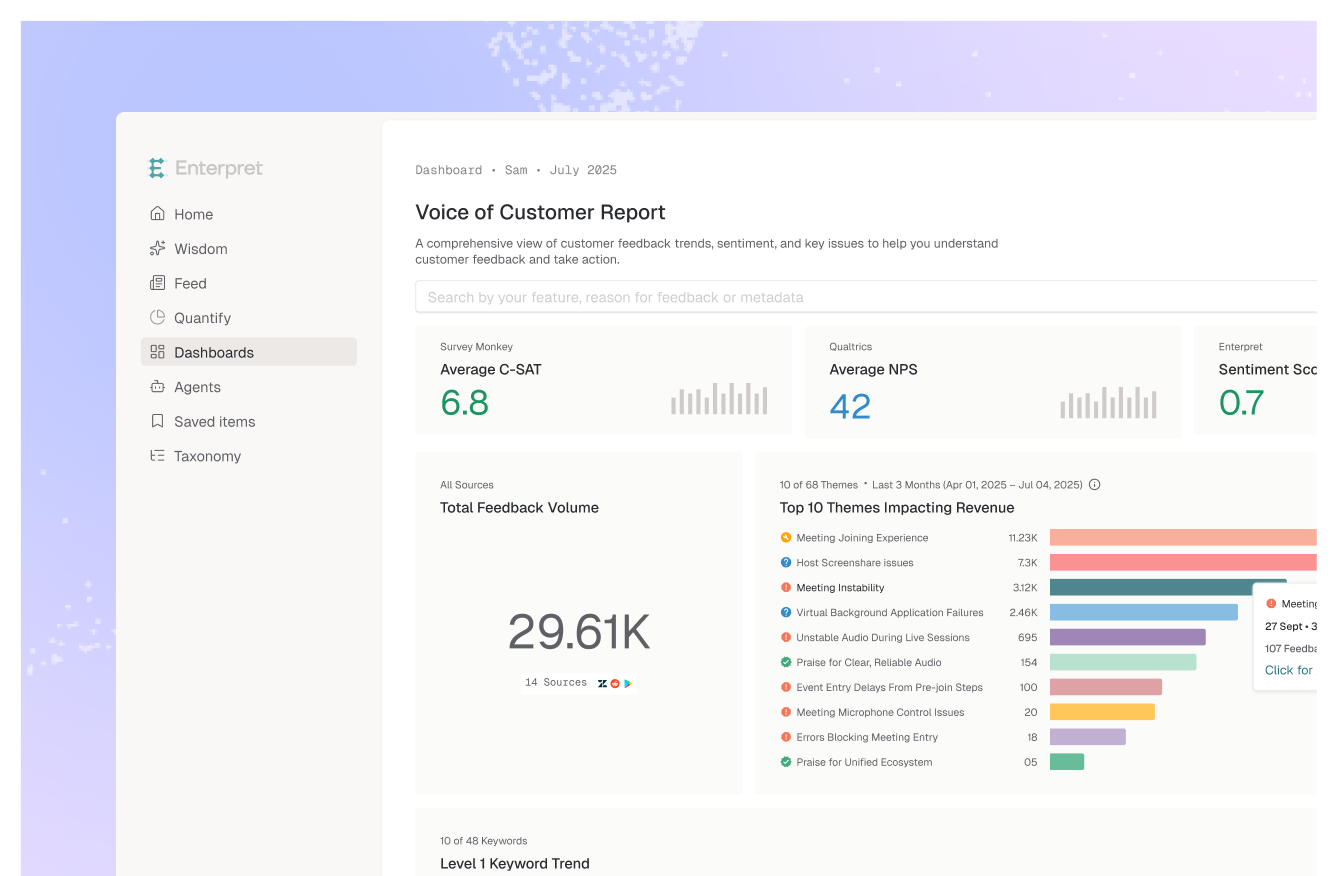
Enterpret is the modern Customer Intelligence platform that combines deep feedback analytics with experience-management capabilities through architectural integration rather than legacy XM-program tooling. The feedback analytics half is the strongest in the category — 50+ native integrations, an adaptive taxonomy that learns from data, and a customer context graph that joins every signal to the customer record.
The experience-management half shows up through different patterns than legacy XM: native workflow integrations push insights into Jira, Linear, Slack, Salesforce, and HubSpot so each team manages actions in their own tools rather than a centralized XM console; Wisdom AI lets any team query the centralized data through natural language; and the dashboards and reporting layer supports role-based views without the heavy program-governance overhead of legacy XM.
Best for: Modern mid-market and enterprise teams that want deep feedback analytics with experience management implemented through native workflow integration rather than centralized XM tooling.
Qualtrics XM is the category-defining experience-management platform, anchored in survey design and extended through XM Discover for unstructured analysis, iQ for predictive models, and XM/os for the broader operational layer. The platform combines deep feedback analytics (Text iQ for open-text analysis) with mature program-governance capabilities — survey rotation, action management, role-based dashboards, regulatory features.
The platform's strength is institutional. Large enterprises with mature XM programs and significant Qualtrics investment deploy it as their CX backbone. The limitation is at the edges: feedback ecosystems that have fragmented across product-led channels outside the Qualtrics ingestion model require custom integration or a complementary platform.
Best for: Enterprise XM programs anchored in surveys with significant existing Qualtrics investment.
Medallia's Experience Cloud is the other legacy enterprise XM platform, with particular strength in industries where Medallia has historically dominated (retail, hospitality, financial services, healthcare). The platform combines feedback analytics across surveys, conversations, social, and operational data with industry-specific program tooling — Medallia's customers often run highly structured XM programs with frontline manager dashboards, action tracking, and executive reporting tightly integrated.
Industry trained AI is the differentiator. Sentiment and theme analysis in retail, hospitality, and finance produces accurate, contextually-appropriate output; coverage of newer industries (SaaS, developer tools) is lighter.
Best for: Large enterprises in retail, hospitality, financial services, and healthcare running structured XM programs.
InMoment combines feedback analytics with experience management for mid-market and enterprise programs, with particular strength in unstructured analysis through its Lexalytics-derived NLP engine. The platform covers surveys, reviews, social, and conversational data, with role-based dashboards and action management tools that support frontline operational use cases (retail locations, branches, contact centers).
InMoment is often deployed by organizations that find Qualtrics or Medallia oversized for their needs but want more program governance than feedback-first platforms typically offer. The XM tooling is real but lighter than the largest legacy platforms.
Best for: Mid-market and large-enterprise programs that need feedback analytics plus structured XM tooling but find the largest legacy platforms oversized.
Forsta (the platform formed by the merger of FocusVision, Confirmit, and Dapresy) targets the research-led end of the XM market — combining survey-driven feedback analytics with extensive reporting, panel management, and program-governance capabilities. The platform is particularly strong for organizations whose XM programs are research-driven, with structured studies, longitudinal tracking, and analyst-led reporting.
The feedback analytics half emphasizes surveys and structured research; coverage of unstructured channels (App Store reviews, community posts, sales calls) is lighter. Forsta is typically deployed by research-led CX and insights teams rather than product-led organizations.
Best for: Research-led XM and insights teams running structured longitudinal studies with deep reporting and panel management requirements.
Five criteria help separate platforms that genuinely combine the two from platforms that lead with one and underdeliver on the other.
Enterpret was built on the hypothesis that the legacy XM workflow — centralized console, formal program governance, analyst-driven reporting — is being replaced in modern organizations by distributed workflow integration where each team handles experience management through the tools they already use. The platform ships the depth of feedback analytics that XM programs need, combined with the workflow integration patterns that modern product, CX, and success teams expect.
The result for teams running this pattern is that experience management stops being a separate program run by a dedicated CX team and becomes a continuous operational layer embedded in every team's daily work. See what is a customer intelligence platform for the broader argument.
Feedback analytics is the data-and-insight engine — collecting customer voice across channels, applying sentiment and theme analysis, surfacing patterns. Experience management is the broader operational program — running the analytics, routing insights to roles, tracking actions taken in response, governing the program at executive level. Feedback analytics is one component of XM; XM is the company-wide operating model that uses feedback analytics as its analytical core.
Closely related but distinct. XM (Experience Management) emerged in the late 2010s as a category positioned around survey-driven enterprise CX programs (Qualtrics, Medallia). Customer Intelligence (CI) emerged later as a category positioned around AI-native, multichannel feedback analysis (Enterpret, Chattermill). The categories are converging — modern XM platforms have added AI-driven analysis, and modern CI platforms have added experience-management capabilities. The buying decision usually comes down to whether the organization prioritizes program-governance tooling (XM origin) or AI-native analytical depth (CI origin).
It depends on the industry and organization size. Heavily regulated industries (financial services, healthcare) and large enterprises with structured CX organizations often still need formal XM programs with the governance tooling that comes with them. Modern product-led organizations (SaaS, fintech, consumer software) typically run lighter, more distributed XM operating models where each team handles their part of experience management through workflow tooling rather than a centralized console.
At minimum: NPS and CSAT, support tickets, App Store and Google Play reviews, G2 and TrustPilot, community forums and Reddit, Gong or Chorus call transcripts, social mentions, in-app feedback widgets, and any industry-specific channels (banking app reviews, gaming forums, etc.). Below 30 native channels, the feedback-analytics half is too thin to support a credible XM program.
Modern platforms with adaptive taxonomy and broad native integrations (Enterpret) typically reach useful output in 2-6 weeks. Legacy XM platforms (Qualtrics, Medallia, InMoment, Forsta) typically require 3-12 months of program setup, taxonomy configuration, survey rotation design, and role-based dashboard build before producing comparable insight. The deployment timeline is often the most important practical difference between modern and legacy options.
If you are evaluating platforms that combine feedback analytics with experience management, see how Enterpret works or book a demo.
Lorem ipsum dolor sit amet, consectetur adipiscing elit. Suspendisse varius enim in eros elementum tristique. Duis cursus, mi quis viverra ornare, eros dolor interdum nulla, ut commodo diam libero vitae erat. Aenean faucibus nibh et justo cursus id rutrum lorem imperdiet. Nunc ut sem vitae risus tristique posuere.