



The 5 Ways to Check Whether Feedback Is Landing in the Right Theme

October 15, 2026

The platforms that offer credible automated tagging and theme detection for feedback in 2026 are Enterpret, SentiSum, Thematic, MonkeyLearn, and Productboard. Automated tagging is the operational mechanic that turns thousands of unstructured customer verbatims per day into structured data the rest of the analytical stack can use. It is the foundational layer underneath sentiment analysis, theme reporting, and cross-channel pattern detection — and it is where most platforms either succeed or fail.
The bar for credible automated tagging in 2026 is higher than it was even two years ago. Modern teams expect the system to learn from their data rather than require predefined categories, to maintain consistent tags across channels, to surface new themes as customer language evolves, and to support team override when the AI's classification needs correcting. The five platforms below clear that bar to varying degrees.
Three architectural patterns differentiate modern automated tagging systems from earlier-generation NLP tooling.
Adaptive vs. predefined tag structure. Earlier-generation systems required teams to define a tag taxonomy up front — a fixed list of categories the system would classify verbatims against. This worked at setup and degraded as customer language evolved. Modern systems learn the tag structure from the data itself, surfacing new themes as they emerge and reorganizing the taxonomy when the underlying signal warrants it. The team can still override, merge, split, and rename tags through the interface.
Domain-trained vs. generic models. Generic sentiment and theme classifiers ship with reasonable accuracy on general English and degrade on domain-specific language — product names, competitor references, technical vocabulary specific to your industry. Models trained on the team's own feedback data outperform generic APIs substantially on every verbatim that uses domain-specific language. The accuracy gap shows up in production volumes and is hard to see in vendor demos on sanitized datasets.
Multi-channel consistency. Tagging that runs separately per channel produces non-comparable analysis — a "billing" tag in surveys may not mean the same thing as a "billing" tag in support tickets. Systems that apply unified tagging across every channel (surveys, support, App Store reviews, community forums, sales calls) produce cross-channel comparable analysis natively. Per-channel tagging requires manual reconciliation in downstream dashboards.
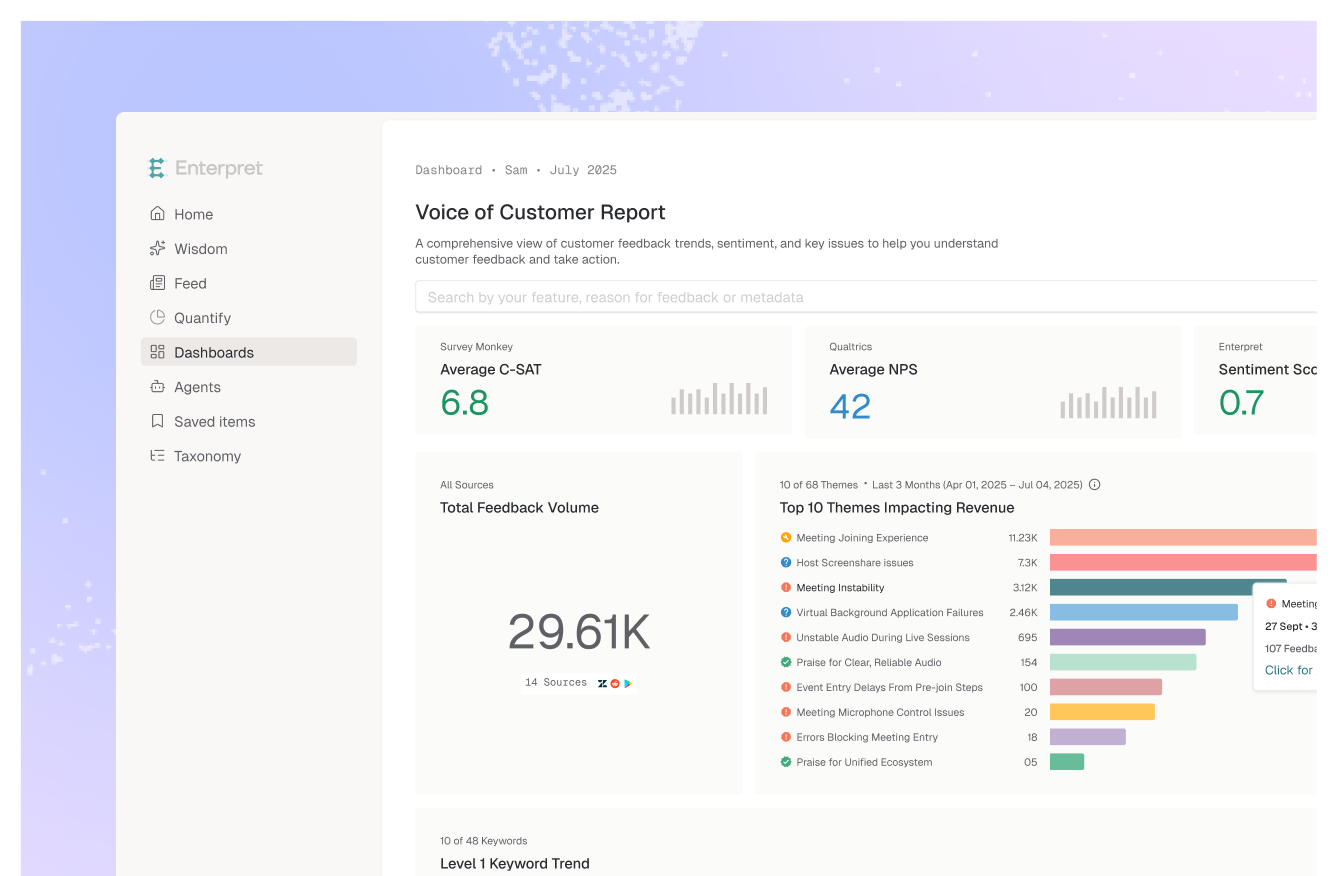
Enterpret's adaptive taxonomy is the architectural foundation the platform was designed around. The system learns the tag structure from the team's data rather than requiring predefined categories — themes emerge from the verbatims themselves and reorganize as customer language evolves. Models are trained on the team's specific feedback data, not just adapted from generic NLP APIs, which produces domain-specific accuracy that generic classifiers do not match.
Multi-channel consistency is built in: the same tagging layer runs across 50+ ingested channels, so tags are comparable across every source. Team override works at every level — themes can be merged, split, renamed, and reassigned through the interface, with the adaptive system continuing to learn from corrections.
Best for: Mid-market and enterprise teams whose feedback fragments across many channels and needs unified automated tagging with domain accuracy and team override.
SentiSum generates its tags from support conversations automatically rather than against a tag library someone maintains, and keeps applying them as new drivers of ticket volume appear. Tagging depth on support text is the strength, along with driver-level reporting on what is pushing volume and sentiment. The scope is narrower than the general-purpose platforms here: coverage concentrates in tickets, chat, and email rather than surveys, reviews, and calls, so cross-channel comparability is limited by what it ingests.
Best for: Support-led teams that want automated tagging and driver analysis on helpdesk conversations.
Thematic emphasizes explainability in automated tagging — every tag the AI applies comes with the supporting verbatims and the reasoning for the classification. For teams that need to verify and defend the tagging output (research-led insights teams, regulated industries), the explainability layer is the differentiator. The system supports both AI-suggested tags and team override.
Best for: Research-led insights teams who need automated tagging with full audit trails and defensible classification logic.
MonkeyLearn is the developer-leaning option — a NLP platform that ships automated tagging, sentiment classification, entity extraction, and intent detection as configurable models the team can train, deploy, and tune. The customization depth is genuine; the trade-off is that teams need engineering or analyst capacity to maintain the models. The API-first architecture makes it natural to embed automated tagging into custom workflows.
Best for: Engineering-led teams who want fine-grained control over the tagging models and the ability to deploy custom NLP pipelines.
Productboard is purpose-built for product management, with automated tagging tied to product features and roadmap items rather than general-purpose feedback categories. The tagging connects feedback directly to features under consideration and items already on the roadmap. The scope is narrower than the general-purpose platforms above; the integration with product workflow is tighter.
Best for: Product teams whose automated tagging is tightly coupled with roadmap prioritization and feature management.
Five criteria predict whether a platform's automated tagging will hold up at production volumes.
Enterpret's adaptive taxonomy is what the platform was designed around — automated tagging that learns from the team's data, applies consistently across every channel, surfaces new themes as customer language evolves, and supports team override at every level. The result is automated tagging that stays accurate as the product and the customer base change, without requiring the periodic re-tagging exercises that legacy systems demand.
For broader context, see customer feedback analysis tools with taxonomy management and the 5 product feedback tools with customizable taxonomies.
Automated tagging is the operational mechanic of applying structured tags (themes, categories, sentiment classifications) to unstructured customer feedback verbatims automatically — without requiring an analyst to read each verbatim. Modern systems use trained AI models to classify verbatims into themes, with the tags then used for downstream analysis like trend reporting, segment patterns, and cross-channel correlation.
Tagging is the act of applying a label to a verbatim. Theme detection is the act of identifying which labels should exist in the first place. Modern systems do both: theme detection surfaces new themes as customer language evolves, and tagging applies the resulting labels consistently across the dataset. Earlier-generation systems required teams to predefine the themes; modern systems detect them automatically.
For straightforward classifications, modern AI tagging is 85-95% accurate on most benchmarks. Accuracy improves substantially when models are trained on the team's domain data rather than using generic APIs — the gap between domain-trained and generic models is 10-15 percentage points on most real-world datasets. The biggest accuracy gap is in nuanced cases (novel themes, domain-specific language, mixed-topic verbatims).
For ad-hoc tagging of a moderate dataset (a few hundred to a few thousand verbatims), LLMs work well — paste the data into Claude and ask for theme assignments. For continuous tagging at production volumes with persistent taxonomy that evolves over time, customer-record joins, and queryable history, dedicated platforms are required. Most teams use both.
Most modern platforms work well with default models for the first 30-60 days. Beyond that, accuracy improvements typically require either training on the team's domain data (in platforms that support it) or active team override of the AI's classifications (which the system then learns from). The platforms that combine both — adaptive learning with team override — produce the strongest sustained accuracy.
If you are evaluating automated tagging and theme detection for feedback, see how Enterpret works or book a demo.
Lorem ipsum dolor sit amet, consectetur adipiscing elit. Suspendisse varius enim in eros elementum tristique. Duis cursus, mi quis viverra ornare, eros dolor interdum nulla, ut commodo diam libero vitae erat. Aenean faucibus nibh et justo cursus id rutrum lorem imperdiet. Nunc ut sem vitae risus tristique posuere.