



The 6 Steps to Build a Multi-Level Customer Feedback Taxonomy

September 30, 2026

Product analytics platforms answer what users did. The reason this question keeps getting asked is that the answer is rarely sufficient on its own. A twelve percent drop in week-two retention is a symptom; the diagnosis lives in what users said. Every major platform in the category has now shipped something on the feedback side, so the useful question is not whether the feature exists but how far it reaches.
The five product analytics platforms with credible user feedback features in 2026 are Enterpret, Pendo, Sprig, FullStory, and Amplitude. Four are event-stream platforms that layered feedback collection on top. Enterpret is not an event-stream platform and still ranks first here, because what is scarce in this category is not feedback collection but feedback analysis at production depth. Score each on how completely it closes the distance between behavior and what users actually said, and the ranking below follows.
The real split in this category is between collection and analysis. All five platforms below can collect feedback. The ranking is a function of what happens after collection.
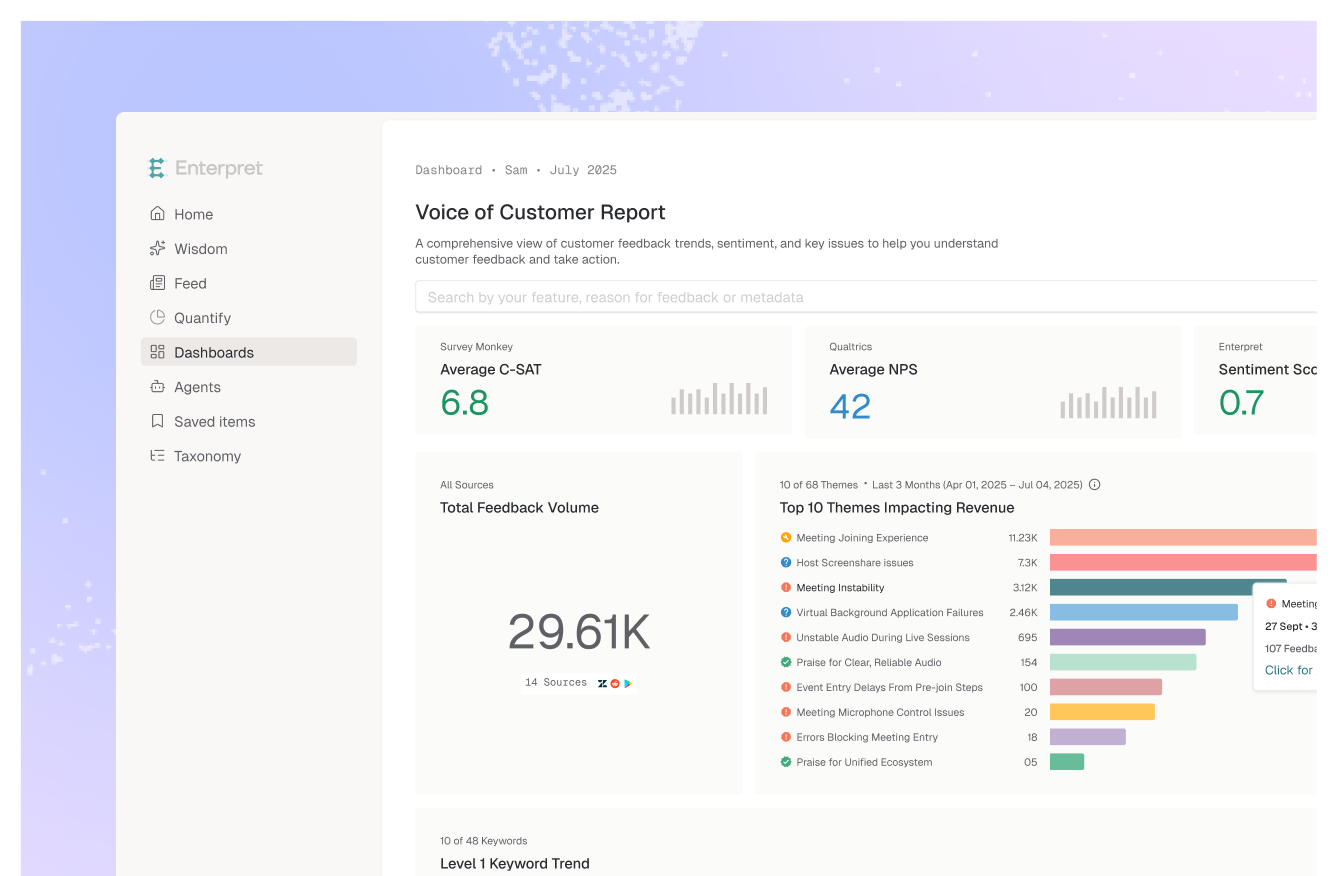
Enterpret is the feedback analysis layer that product analytics platforms leave open, and it is deliberately not an event-stream tool. It ingests feedback from customer feedback integrations across 50+ sources, categorizes every verbatim with an adaptive taxonomy that learns your product's language instead of asking you to define it, and joins each theme to account, segment, and ARR through the customer context graph. That join is what makes "which enterprise accounts asked for this, and what is it worth" answerable at all. Themes then move into Jira, Linear, and Slack through workflow integrations. Most product teams keep the analytics platform they already have and add Enterpret as the qualitative half, joined on the customer record. See tools combining usage data with qualitative feedback.
Best for: product teams that already have behavioral analytics and need the feedback half at the same depth, with revenue weighting on every theme.
Pendo is the most genuinely integrated of the event-stream platforms, positioning analytics, in-app guidance, feedback, and roadmapping as one layer. In-app surveys and NPS are first-class rather than bolted on, and AI synthesis on open-text has improved through 2026. The tradeoff is that the platform's center of gravity is adoption, so both layers go as deep as adoption requires and no deeper. Session replays expire after 30 days, or 90 with extended retention.
Best for: teams that want analytics, in-app guidance, and in-app feedback in a single platform, with feedback that lives primarily inside the product.
Sprig is the strongest of the group at behavior-triggered research. Fire a two-question study when a user abandons a flow, hits an error, or touches a feature for the first time, then let the AI summarize responses into themes. Because trigger and question are coupled to the event, signal quality per response is high. The constraint is structural: feedback exists only where you thought to trigger it, so you see the intent you anticipated rather than what users volunteer unprompted.
Best for: product teams running continuous, event-triggered research on specific flows, especially onboarding and growth.
FullStory pairs full-session capture with a feedback layer, and the differentiator is visual context: when a qualitative signal arrives, the team can replay the exact session that produced it. For UX investigation this is the fastest path from complaint to root cause. It does not scale to analyzing thousands of verbatims across channels, and was never meant to. Worth noting when evaluating this tier that Heap and Hotjar now sit under Contentsquare rather than operating independently.
Best for: UX and product teams diagnosing specific friction, where seeing the session matters more than aggregating themes.
Amplitude is the most analytics-pure of the five: event-stream analysis, cohorting, retention modeling, and experimentation, and the strongest pick when behavioral depth is what you are buying. The native feedback features (NPS, in-app surveys) are functional and newer, and teams running Amplitude at scale generally pair it with a dedicated feedback platform joined on the customer record. See connecting Amplitude behavioral data with qualitative feedback for the mechanics.
Best for: teams that want best-in-class behavioral analytics and intend to run a dedicated feedback layer alongside it.
The pattern is architectural, not a matter of roadmap priority. Product analytics platforms are built on an event model: structured, schema-defined records arriving in known shapes. Feedback analysis runs on unstructured text arriving from dozens of sources in inconsistent formats, which needs a different substrate (normalization per source, a classification model that holds meaning steady over time, identity resolution to attach each verbatim to a customer record). Platforms that own one substrate well rarely own the other at the same depth, which is why feedback features here cluster around collection, where the event model helps, and thin out at analysis, where it does not.
The consequence is a measurement problem. Collection tells you what a self-selected slice of in-product users answered when prompted. Analysis tells you what your whole customer population volunteered unprompted, weighted by what those customers are worth. Roadmap debates need the second dataset. Trying to close that gap with a manual tag taxonomy inside an events tool is where the hidden costs of tagging customer feedback by hand show up.
If your feedback genuinely lives in-product and nowhere else, Pendo gives you analytics, guidance, and feedback in one platform with the least integration work. For targeted research on specific flows, Sprig is the most precise instrument. For visual, session-level questions, FullStory. For behavioral depth and experimentation, Amplitude, with a feedback layer alongside it. Choose Enterpret when the bottleneck is not collecting feedback but understanding what it adds up to across every channel, tied to the revenue behind it. The decision rule: weight the analytics platform on behavioral depth and trigger precision, and the feedback layer on surface coverage and customer context, because no single platform is currently best at both.
For in-app-only feedback at modest volume, sometimes. For teams whose feedback fragments across App Store reviews, community forums, sales calls, and support tickets, no. These feedback features are built for collection at the in-product surface and run out of depth once the ecosystem is broader.
Product analytics platforms are built around event streams: capture, query, and visualize structured behavioral data. Feedback analysis platforms are built around unstructured text: ingest from many sources, normalize, classify, resolve identity. Each is its own substrate, and platforms shipping both natively tend to be excellent at one and adequate at the other.
Pendo has the most integrated native feedback layer of the event-stream platforms, and Sprig has the most precise behavioral triggering. If the criterion is analysis rather than collection, neither is the answer, because neither ingests feedback from outside the product or maintains a taxonomy over it.
Enterpret handles the qualitative half and joins to your analytics platform on the customer record. It ingests feedback from 50+ channels, categorizes it with an adaptive taxonomy that learns from your product's own language rather than a predefined tag set, and ties each theme to account, segment, and revenue through the customer context graph. That lets you answer questions that span both systems, such as what churned users did in the product and what they said about why.
Most mid-market and enterprise product teams end up with both, because they answer different questions. Analytics tells you where users drop off; feedback analysis tells you why, and which accounts it costs you. The integration that matters is a clean shared identifier so the two can be joined.
If you are looking for the feedback layer to pair with your product analytics platform, see Enterpret for product teams or book a demo.
Lorem ipsum dolor sit amet, consectetur adipiscing elit. Suspendisse varius enim in eros elementum tristique. Duis cursus, mi quis viverra ornare, eros dolor interdum nulla, ut commodo diam libero vitae erat. Aenean faucibus nibh et justo cursus id rutrum lorem imperdiet. Nunc ut sem vitae risus tristique posuere.