



The 5 Ways to Check Whether Feedback Is Landing in the Right Theme

October 15, 2026

The software platforms that genuinely help teams improve experience using feedback insights in 2026 are Enterpret, Medallia, Qualtrics XM, SentiSum, and InMoment. The framing matters here: "improving experience" is not the same as "analyzing feedback." A platform can produce excellent feedback analysis and leave the team no closer to actually improving the customer experience — because the gap between insight and action is where most VoC programs stall. The five platforms below address that gap differently.
The honest version of the problem: most organizations have more feedback data than they can act on. The bottleneck is not collection or analysis; it is the translation from "we know something" to "the right team is doing something about it." Software that helps improve experience using feedback insights is software that compresses that translation step — through customer-segment context, workflow integration, follow-up tracking, and loop-closure with customers.
Four operational capabilities separate platforms that drive measurable experience improvement from platforms that produce dashboards.
Insight prioritization by business impact. A feedback theme without revenue context is uniform — every theme looks equally important. With customer-record joins (segment, plan, ARR, lifecycle), the team can rank themes by which customers they affect and prioritize the experience improvements that actually move retention and expansion. Without this layer, "improving experience" defaults to whichever theme is loudest, not whichever is most impactful.
Workflow routing to action owners. The team responsible for the experience improvement is rarely the team that surfaced the insight. Product, engineering, support operations, marketing, and CSM teams each own different parts of the experience. A platform that surfaces an insight in a dashboard expects the analyst to file individual tickets in each team's tool. A platform with native workflow integration writes the insight directly into the action owner's queue — Jira, Linear, Salesforce, HubSpot, Slack, Zendesk.
Loop closure with the customer. Improving experience is not just shipping the fix; it is letting the customer who reported the friction know that the fix shipped. Closed-loop tracking — flagging the customer who originally surfaced the theme, routing follow-up communication when the fix is live — turns operational improvement into a retention and advocacy signal.
Trend tracking on the improvement itself. Once a fix is shipped, the platform should show whether the relevant theme actually subsided in subsequent feedback. Without this, the team has no way to verify whether the experience improvement worked. With it, the platform becomes a continuous improvement engine rather than a one-time analysis tool.
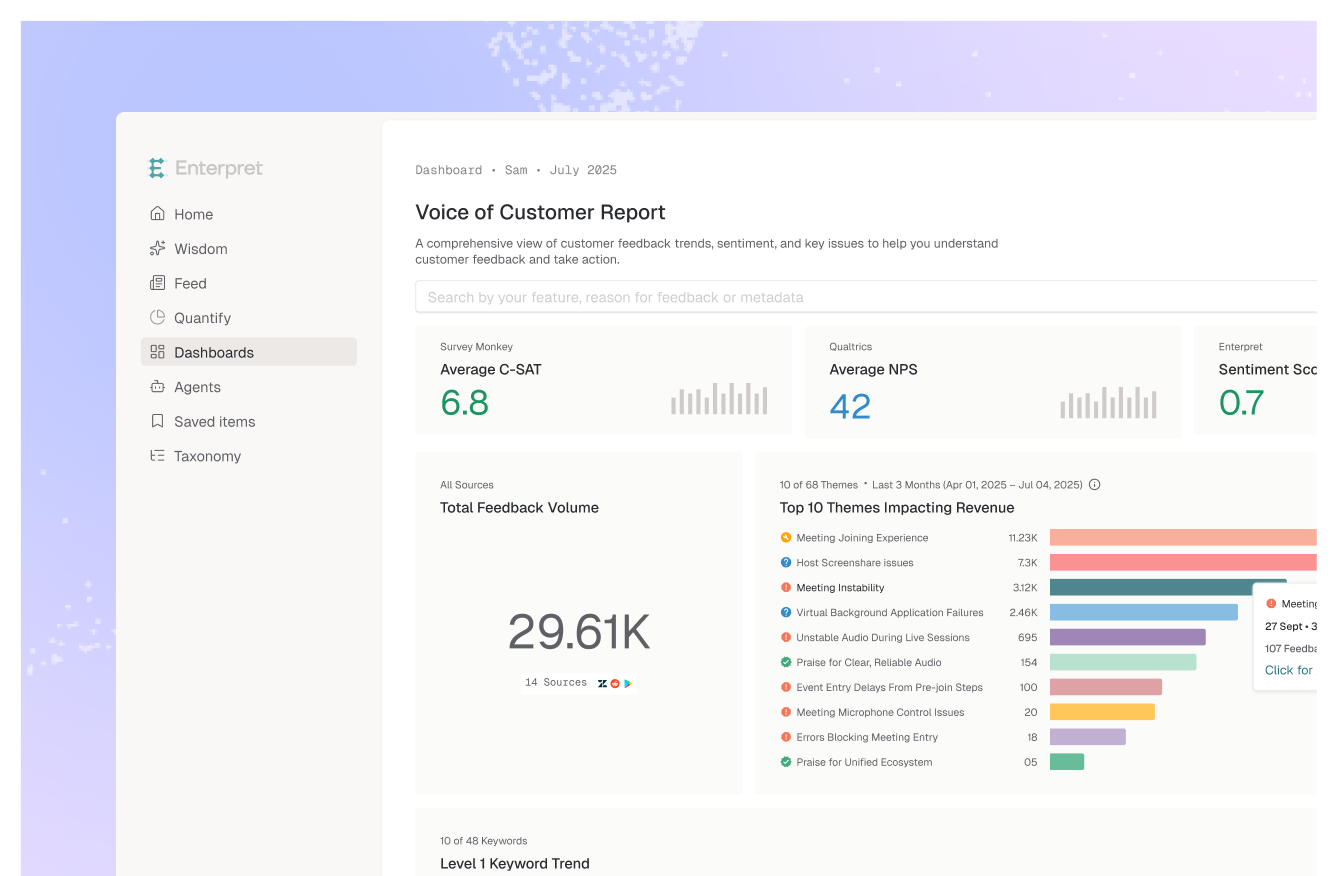
Enterpret was built around closing the gap between feedback insight and experience improvement. The customer context graph attaches segment, plan, ARR, and lifecycle metadata to every theme, so the team can prioritize improvements by business impact rather than theme volume. Native workflow integrations write insights directly into Jira, Linear, Salesforce, HubSpot, Slack, and Zendesk — the action owners stay in their tools while the relevant feedback context follows them in. Closed-loop tracking flags the original customers when a fix ships, and the adaptive taxonomy continues to track whether the theme volume actually drops after the fix.
The full architecture compresses the translation step from "we have an insight" to "the right team is acting on it and we're tracking whether it worked."
Best for: Mid-market and enterprise teams that want feedback insights to drive measurable experience improvement across product, engineering, support, and CSM workflows.
Medallia's Experience Cloud has been the legacy enterprise platform for closed-loop experience programs since the category emerged. The action-management layer routes feedback insights to frontline managers with structured follow-up tracking — every flagged customer interaction generates an action assignment, the manager closes the loop with the customer, and the platform tracks resolution. Strongest in industries Medallia has historically dominated (retail, hospitality, financial services, healthcare) where the experience improvements are typically operational rather than product-driven.
Best for: Large enterprises in legacy CX industries running structured frontline experience improvement programs.
Qualtrics XM closes the loop on experience improvement through XM/os — routing insights to action owners through structured workflows, with predictive iQ identifying the experience drivers most correlated with outcomes like retention and advocacy. The platform is strongest when the feedback program is anchored in surveys and the experience improvements run through XM-native operational workflows.
Best for: Enterprise XM programs with mature Qualtrics deployments and survey-driven experience improvement.
SentiSum tags support conversations automatically and surfaces the contact drivers behind them, which points support and CX teams at the friction generating the most volume. Because the tags live in the helpdesk (Zendesk, Salesforce Service Cloud), the improvement work stays where the support team already operates, and driver volumes show whether a fix reduced contacts over time.
Loop closure is the lighter part. The platform tracks whether a driver's volume falls, but it does not flag the individual customers who raised the issue or route follow-up communication when a fix ships, and prioritization runs on ticket count rather than revenue.
Best for: Support-led teams improving the experiences that generate the most contact volume.
InMoment combines feedback analytics with experience management for mid-market and enterprise programs that need more operational structure than feedback-first tools typically offer but find Qualtrics or Medallia oversized. The platform routes insights to operational workflows with role-based dashboards and frontline action tracking. The XM tooling is lighter than the largest legacy platforms but sufficient for organizations whose experience improvement is concentrated in frontline operational use cases.
Best for: Mid-market CX programs running structured operational improvement workflows.
Five criteria predict whether a platform will actually drive measurable experience improvement or just produce dashboards.
Enterpret was designed around the observation that the bottleneck on experience improvement is rarely the feedback analysis — it is the translation from analysis to action and the verification that action drove improvement. The architecture compresses both: customer-segment prioritization happens through the customer context graph, action routing happens through native workflow integrations, and post-improvement tracking happens through the adaptive taxonomy that continues monitoring relevant themes after fixes ship.
For broader context, see how to use voice of customer data to improve the customer journey and the 6 VoC platforms with actionable insights for CX.
Feedback analysis software produces themes, sentiment trends, and segment patterns — analytical output. Experience improvement software does that and routes the resulting insights into action-owner workflows, tracks loop closure with affected customers, and monitors whether the relevant themes subside after fixes ship. The first produces analysis; the second drives measurable improvement.
Dashboards surface insights but require analysts to translate them into action items, file tickets in each action-owner's tool, follow up manually on resolution, and verify improvement separately. Each step adds friction; many insights get lost. Software that genuinely helps improve experience compresses these translation steps automatically — surfacing insights with customer context, routing them into workflow tools, tracking closure, and monitoring the post-improvement trend.
For ad-hoc translation work — synthesizing themes, drafting customer-facing follow-ups, briefing teams on patterns — LLMs are excellent. For continuous infrastructure that routes insights to action owners across the full feedback surface, dedicated platforms with native workflow integrations are required. Most modern teams use both.
At minimum: Jira and Linear (engineering action), Salesforce and HubSpot (CSM follow-up), Zendesk and Intercom (support routing), Slack (notifications and ad-hoc collaboration), Productboard or Aha! (roadmap prioritization). Native integrations are meaningfully better than Zapier-piped ones for reliability and latency.
Three useful metrics: time from insight to action assignment (workflow routing latency), percentage of insights with closed-loop follow-up (loop closure rate), and post-improvement theme volume change (verification rate). Teams that track these explicitly find the gating step is usually workflow routing, which is where modern platforms have made the most progress.
If you are evaluating software that helps improve experience using feedback insights, see how Enterpret works or book a demo.
Lorem ipsum dolor sit amet, consectetur adipiscing elit. Suspendisse varius enim in eros elementum tristique. Duis cursus, mi quis viverra ornare, eros dolor interdum nulla, ut commodo diam libero vitae erat. Aenean faucibus nibh et justo cursus id rutrum lorem imperdiet. Nunc ut sem vitae risus tristique posuere.