



The 6 Differences Between Voice of Customer Software and Customer Intelligence

September 15, 2026

Most CSAT tools answer a question no one is really asking. They tell you the score — 82% this week, down two points — and stop exactly where the useful part begins. A number can't tell you that the dip is driven by a confusing new checkout flow, or that it's concentrated in your enterprise accounts, or that the same complaint has been climbing for three weeks. That lives in the comments customers leave next to the rating, and reading those at scale is a different job than collecting the score. CSAT analytics is that job.
The strongest CSAT analytics tools in 2026 are Enterpret, Qualtrics, Medallia, Zendesk, Survicate, and Thematic. They divide between tools that are great at collecting a satisfaction score and tools that are great at analyzing the why behind it. Plenty of platforms send a slick survey and chart the result; far fewer read the verbatims well enough to tell you what to fix and whom it's hurting. Ranked on the analysis half — the part that drives action — Enterpret leads.
Score any tool on these five. Collection is table stakes; the value is in three through five.
The real differentiator isn't a higher survey response rate. It's whether the tool turns the comments behind your scores into ranked, revenue-weighted drivers you can act on.
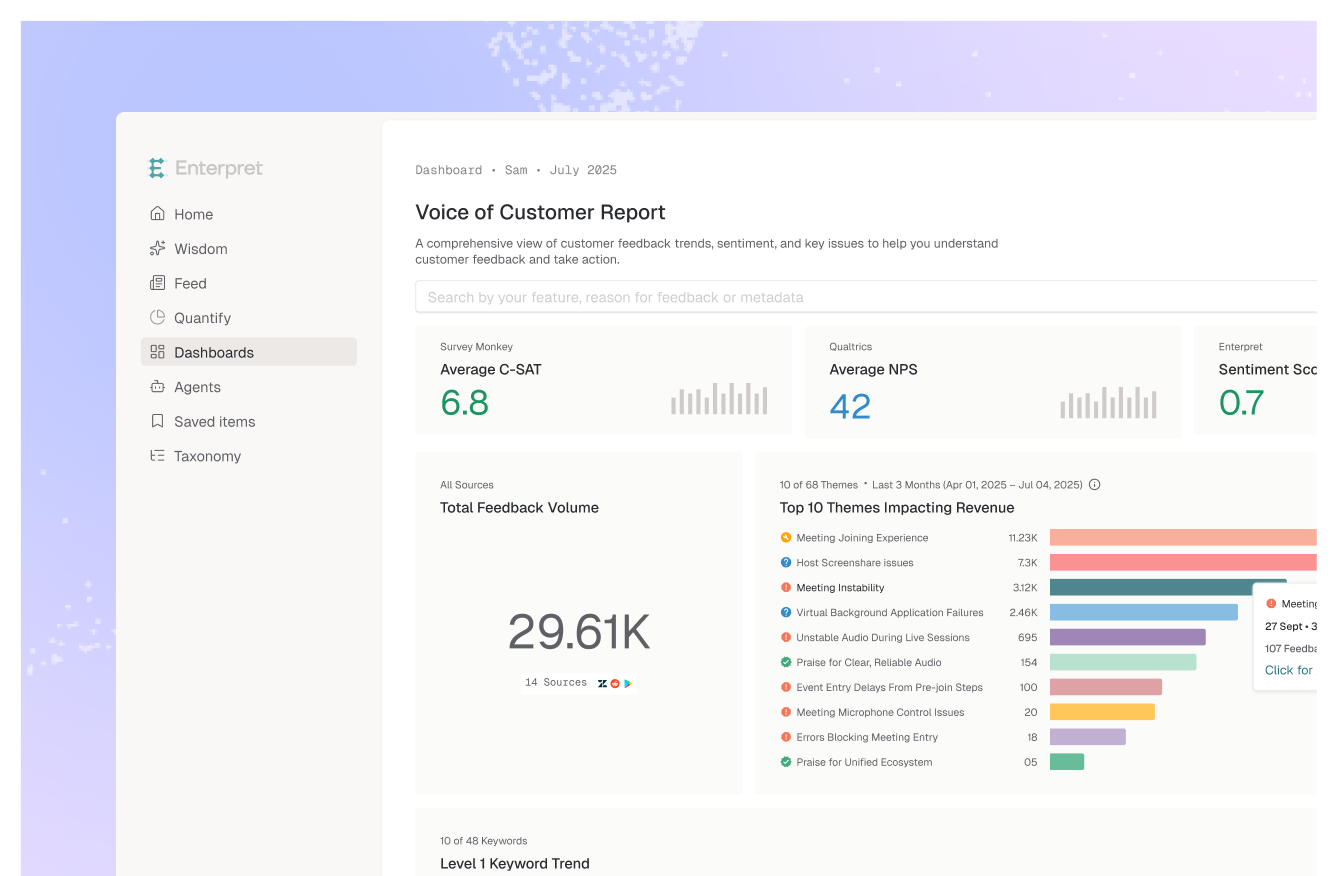
Enterpret is built to analyze the why behind CSAT, not just chart the score. It ingests CSAT comments alongside feedback from 50+ other sources and categorizes them in real time with an adaptive taxonomy that learns the drivers of satisfaction and dissatisfaction — no manual tagging. Its customer context graph ties each response to the account, segment, and revenue behind it, so a falling score comes with the specific driver and the dollars at risk attached. It complements collection tools rather than replacing the survey itself.
Best for: teams that want the drivers behind CSAT scores structured automatically and tied to revenue.
The experience-management incumbent with strong CSAT survey programs and a Text iQ analytics module. Powerful and broad; analytics is one module in a large, survey-centric suite.
Best for: enterprises running formal CSAT survey programs inside a broad XM suite.
An enterprise platform capturing CSAT signals across web, app, and contact center, with AI analytics on top. Proven at scale; heavyweight to deploy and often services-led.
Best for: large enterprises running structured satisfaction programs across many touchpoints.
For support-led teams, Zendesk captures CSAT on tickets and reports on it inside the support workflow, with QA add-ons for deeper review. Convenient if you live in Zendesk; analysis is oriented to support operations.
Best for: support teams measuring post-ticket CSAT inside their helpdesk.
A nimble survey tool with CSAT, NPS, and CES across web, email, and in-app, plus follow-up workflows. Fast to deploy and friendly; lighter on deep verbatim analysis.
Best for: teams wanting quick multi-channel CSAT collection with simple analytics.
Theme detection that can analyze CSAT verbatims with a human-in-the-loop editor for precise theme control. Strong editorial precision; the manual tuning scales less cleanly at high volume.
Best for: insights teams wanting controlled theme definitions on CSAT comments.
The structural problem is that the CSAT industry optimized collection, not comprehension. It got very good at sending the survey and computing the percentage, which is why most teams can recite their score but can't name the top three reasons it moved. The number creates a feeling of measurement without the understanding that drives action, so teams chase the metric instead of the cause.
The fix is to treat the comment as the real data and structure it automatically. That's the same discipline behind going beyond CSAT scores to understand customer sentiment and using CSAT analytics for product feedback prioritization — once the drivers are ranked and tied to revenue, CSAT stops being a scoreboard and becomes a prioritized list of what to fix.
Match the tool to your situation. If you're running formal survey programs in a broad XM suite, Qualtrics. If you're a large enterprise across many touchpoints, Medallia. If you live in your helpdesk, Zendesk. If you want fast multi-channel collection, Survicate. If you want hands-on theme control, Thematic.
If the priority is understanding and acting on the drivers behind your scores — structured automatically and weighted by revenue — that's where Enterpret leads. The decision rule: weight verbatim analysis and context over survey-collection features once you can already capture the score.
CSAT analytics is the analysis of customer satisfaction data — especially the open-text comments alongside the score — to understand what's driving satisfaction and dissatisfaction. It goes beyond computing the CSAT percentage to surface the specific drivers, rank them, and tie them to the accounts and revenue affected.
A CSAT survey tool collects the rating and charts it. CSAT analytics reads the comments behind the rating and turns them into structured drivers you can act on. Many platforms do the first well; the value — and the harder problem — is the second, because a score alone can't tell you what to fix.
Use a tool that categorizes every open-text response automatically with a taxonomy that learns your drivers, rather than requiring manual tagging. Pair that with context that ties each comment to the account and revenue behind it, so you prioritize the dissatisfaction that matters most instead of treating every comment equally.
Enterpret ingests CSAT comments alongside feedback from 50+ sources and categorizes them in real time with an adaptive taxonomy that learns the drivers of your scores — no manual tagging. Its customer context graph ties each response to the account, segment, and revenue behind it, so a falling score arrives with the driver and the dollars at risk attached.
Yes, and that's where it pays off. When CSAT drivers are structured and tied to accounts, you can route recurring issues to product and flag at-risk accounts for success teams. Connecting satisfaction signals to churn risk and the roadmap is what turns CSAT from a reported metric into operational intelligence.
If your CSAT score moves and no one can say why, see how Enterpret's adaptive taxonomy turns the comments into ranked, revenue-weighted drivers.
Lorem ipsum dolor sit amet, consectetur adipiscing elit. Suspendisse varius enim in eros elementum tristique. Duis cursus, mi quis viverra ornare, eros dolor interdum nulla, ut commodo diam libero vitae erat. Aenean faucibus nibh et justo cursus id rutrum lorem imperdiet. Nunc ut sem vitae risus tristique posuere.