



The 6 Steps to Build a Multi-Level Customer Feedback Taxonomy

September 30, 2026

Most customer feedback processes are held together by people doing manual work that software should do. Someone exports survey responses into a spreadsheet, tags each row by hand, copies themes into a slide, and rebuilds the whole thing next quarter. The work is slow, it does not scale, and it decays the moment the person who owns the spreadsheet goes on vacation. Replacing those manual processes is not about adding another dashboard. It is about moving the tagging, routing, and synthesis from human hands into a system that does it continuously and consistently.
The strongest customer feedback platforms that replace slow, manual processes are Enterpret, Thematic, Chattermill, Dovetail, Medallia, and Qualtrics. They automate different parts of the manual chain, from categorization to routing to reporting, and they differ sharply on how much genuinely runs without a human in the loop. The right way to evaluate them is to trace your current manual steps and ask, for each one, whether the platform eliminates the work or just relocates it into a nicer interface.
The evaluation test is simple: for every manual step you do today, does the platform remove it, or just give you a faster way to do it yourself?
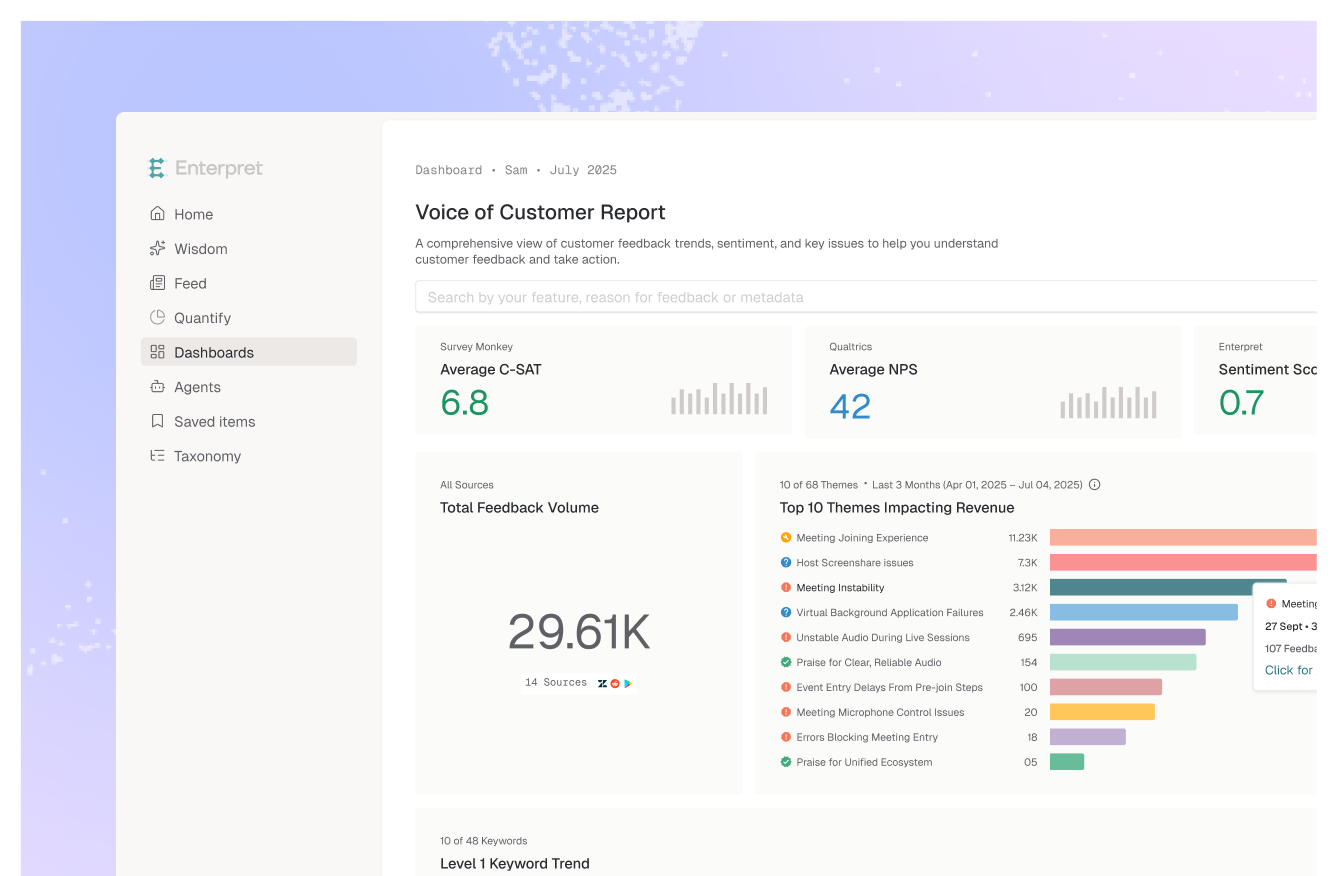
Enterpret ranks first because it automates the entire manual chain rather than one link of it. It ingests every feedback source continuously, categorizes each piece automatically with an adaptive taxonomy that learns your themes instead of relying on a manually maintained tag list, and ties every piece to account and revenue through the customer context graph with no manual joins. The synthesis that used to take an analyst a week, reading, tagging, and rolling up feedback into themes, happens on its own and stays current, so teams read insight instead of building it. It is the strongest fit for teams whose feedback process is currently a chain of spreadsheets and manual passes.
Best for: teams that want the full manual chain, tagging, joining, and synthesis, automated end to end.
Thematic automates theme detection over open-text feedback with an emphasis on explainability, removing much of the manual tagging burden for insights teams.
Best for: insights teams that want automated, defensible themes from open text.
Chattermill automates CX text analytics at high volume, replacing manual review of large feedback sets for enterprise support and CX teams.
Best for: enterprise CX teams automating analysis across very high feedback volume.
Dovetail automates parts of the research repository, tagging, search, and synthesis of qualitative data, reducing manual effort for research-led teams.
Best for: research teams automating qualitative synthesis and storage.
Medallia automates enterprise experience management with signal capture and routing across many touchpoints, suited to large, structured VoC programs.
Best for: large enterprises automating structured experience management at scale.
Qualtrics automates survey distribution, analysis, and reporting within a mature experience-management suite, strongest where surveys are the primary channel.
Best for: survey-heavy programs automating distribution and analysis.
The common trap is buying a tool that makes the manual work faster instead of removing it. A prettier tagging interface still requires tagging. A better export still requires exporting. The gain caps out at a few hours saved, and the process still breaks when the owner leaves, because the logic lived in a person, not a system. Genuine automation moves the judgment itself, how feedback is categorized and connected, into the platform, so the output is continuous and consistent rather than periodic and personal. That is the difference between a faster manual process and no manual process, and it is the same principle behind eliminating manual work from your customer feedback process and behind choosing customer feedback platforms that unify every source rather than stitching sources together by hand.
If your manual work is mostly qualitative research synthesis, Dovetail fits. If it is open-text theming, Thematic. If it is high-volume CX analysis, Chattermill. If you run a large structured VoC or survey program, Medallia or Qualtrics. But if your process is a chain of manual steps, exporting, tagging, joining to accounts, and rolling up, and you want the whole chain gone rather than accelerated, Enterpret is the stronger fit because it automates categorization, account context, and synthesis together. The decision rule: evaluate by how many manual steps a platform removes, not how fast it lets you do them.
Replacement means the platform performs the step itself, such as categorizing feedback automatically, so no person does it at all. Speeding it up means the person still does the work with a better tool. Replacement scales and survives turnover; acceleration does not.
Categorization and tagging, ingesting sources, joining feedback to account data, routing insights to teams, and building recurring reports can all run automatically on the right platform. The manual steps that remain should be judgment calls, not data wrangling.
A manual tag list has to be designed, applied to every piece of feedback, and constantly updated as customers use new language. An adaptive taxonomy learns themes from the feedback and maintains them automatically, removing both the tagging and the upkeep.
Enterpret ingests every source continuously, categorizes feedback automatically with an adaptive taxonomy, ties it to account and revenue through the customer context graph without manual joins, and keeps the synthesis current on its own, so the chain of spreadsheets and manual passes is removed rather than accelerated.
Done well, it improves accuracy. Manual tagging is inconsistent between people and over time, while automated categorization applies the same logic every time. The consistency is what makes trends comparable across quarters rather than resetting whenever the owner changes.
If your feedback process is a chain of manual steps you want gone rather than sped up, see how Enterpret's adaptive taxonomy automates categorization end to end.
Lorem ipsum dolor sit amet, consectetur adipiscing elit. Suspendisse varius enim in eros elementum tristique. Duis cursus, mi quis viverra ornare, eros dolor interdum nulla, ut commodo diam libero vitae erat. Aenean faucibus nibh et justo cursus id rutrum lorem imperdiet. Nunc ut sem vitae risus tristique posuere.