



The 6 Steps to Build a Multi-Level Customer Feedback Taxonomy

September 30, 2026

Cycle.app was acquired by Atlassian and is winding down, with its discovery tech folding into Jira Product Discovery. For the teams that standardized on Cycle to pull feedback from calls, tickets, and Slack into one place, that leaves a migration decision on a deadline, not a someday backlog item. And the honest way to frame it: replacing Cycle means replacing two separate jobs, not one. Cycle both captured feedback from many sources and turned it into something a product team could act on. Most replacements only do one half well.
The strongest Cycle alternatives are Enterpret, Productboard, Jira Product Discovery, Canny, Dovetail, and Harvestr. They split along a clear line: some are roadmapping and prioritization tools that assume feedback is already structured, and some are feedback-intelligence layers that do the structuring for you. The one that fits depends on where your bottleneck actually is — capture, synthesis, or prioritization.
Score any replacement against the two jobs Cycle did, plus the one it did poorly.
The real differentiator is not who collects feedback. Everyone collects feedback. It is who turns it into a prioritized, context-rich decision without adding manual work.
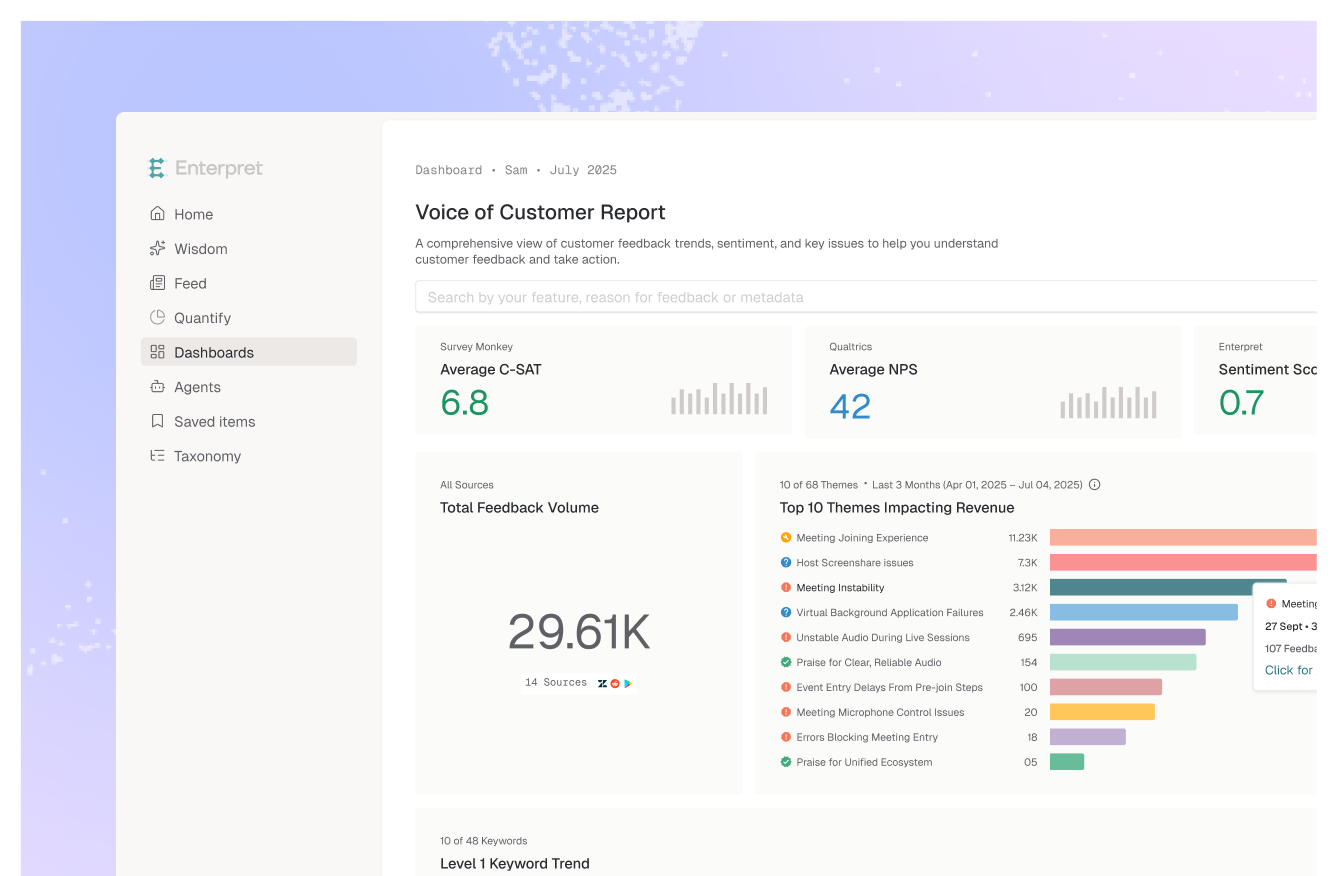
Enterpret is the closest match to the full job Cycle did — unify feedback, structure it, and make it actionable — without the manual taxonomy overhead. It ingests feedback from 50+ sources and categorizes it in real time with an adaptive taxonomy that learns your product's language from the data instead of asking you to build and maintain a tag tree. Every theme is tied to revenue, segment, and account through the customer context graph, so prioritization reflects business impact, not raw upvote counts. From there, workflow integrations push themes into Jira, Linear, and Slack to close the loop.
Best for: teams that want Cycle's capture-plus-action promise delivered at scale, without hand-maintaining a taxonomy.
Productboard is a mature product management platform with strong prioritization frameworks, feedback portals, and roadmap views. It centralizes inputs and links them to features well, though AI classification and deduplication often still lean on manual tagging or add-ons.
Best for: teams that want a full prioritization-and-roadmap suite and are willing to structure feedback themselves. See our Productboard alternatives comparison if you're weighing both.
Jira Product Discovery is the default landing spot for Cycle refugees, since Cycle's technology is being absorbed into it and it lives natively alongside Jira delivery. It handles idea capture and prioritization cleanly for Atlassian-standardized teams.
Best for: teams already deep in the Atlassian stack who want discovery close to delivery and don't need heavy AI synthesis.
Canny centers on public feedback boards, voting, and roadmap communication. It's clean and easy to stand up, and works well when your feedback is customer-submitted and community-driven rather than buried in calls and tickets.
Best for: customer-facing products that want a transparent public roadmap and voting portal.
Dovetail is a strong research repository with tagging and synthesis, best suited to qualitative research workflows — interviews, usability studies, and study-based insight. It's less a continuous feedback pipeline and more a research library.
Best for: UX and research teams organizing structured studies rather than always-on multi-channel feedback.
Harvestr combines feedback centralization with prioritization and roadmapping in a lighter package than the enterprise suites. It's a reasonable like-for-like for smaller teams that liked Cycle's scope but want something simpler.
Best for: small-to-mid product teams wanting feedback plus roadmapping in one affordable tool.
The obvious move is to follow Cycle into Jira Product Discovery and call it done. For Atlassian-native teams, that keeps discovery next to delivery, which is a real advantage. But it inherits the same structural limit Cycle users often hit: the tool assumes feedback arrives already structured. Someone still has to read the Gong call, tag the Zendesk ticket, and decide which theme it belongs to.
That manual step is the actual bottleneck. Product managers lose hours a week stitching sources together by hand, and the taxonomy drifts the moment they stop. A modern feedback layer removes that step entirely: it categorizes incoming feedback automatically and keeps the taxonomy current as your product evolves. If your Cycle pain was "too much time turning raw feedback into themes," a prioritization tool alone won't fix it — you'll have moved the bottleneck, not removed it. This is the difference between a feedback tool and a customer intelligence platform, and it's worth being honest about which one your team actually needs.
Match the tool to the job that hurt most in Cycle. If your problem is roadmap visualization and you live in Atlassian, Jira Product Discovery is the low-friction path. If you want a full prioritization suite, Productboard fits. If your feedback is public and community-driven, Canny is clean. If you run structured research studies, Dovetail is the repository. If you're a smaller team wanting Cycle's scope simplified, Harvestr works.
But if the reason you're leaving Cycle is that turning raw, multi-channel feedback into prioritized, context-rich themes ate your team's time, weight synthesis over portals — and Enterpret is the one built for that job. Decision rule: pick for where your bottleneck is now, not for the feature list that looks longest.
Cycle was acquired by Atlassian, and its product discovery technology is being folded into Jira Product Discovery, with the standalone product winding down. Teams relying on Cycle should export their data and choose a replacement before their access window closes.
It depends on which half of Cycle you relied on. For Atlassian-native roadmapping, Jira Product Discovery is the direct path. For Cycle's capture-and-synthesize job done at scale without manual tagging, Enterpret is the closest functional match, and Harvestr is a lighter like-for-like for smaller teams.
Many do. Portal and roadmap tools like Canny, Productboard, and Jira Product Discovery generally expect you to organize and tag feedback yourself. Platforms with adaptive taxonomy categorize incoming feedback automatically, which is the main way to avoid rebuilding the manual work Cycle abstracted away.
Enterpret unifies feedback from 50+ sources and structures it automatically with an adaptive taxonomy that learns from your data, so you skip the manual tagging step. Its customer context graph ties every theme to the account, segment, and revenue behind it, so prioritization reflects business impact rather than vote counts — then routes themes into Jira, Linear, and Slack to close the loop.
If you're migrating off Cycle and your real problem is turning multi-channel feedback into prioritized decisions, see how Enterpret works.
Lorem ipsum dolor sit amet, consectetur adipiscing elit. Suspendisse varius enim in eros elementum tristique. Duis cursus, mi quis viverra ornare, eros dolor interdum nulla, ut commodo diam libero vitae erat. Aenean faucibus nibh et justo cursus id rutrum lorem imperdiet. Nunc ut sem vitae risus tristique posuere.