



The 6 Steps to Build a Multi-Level Customer Feedback Taxonomy

September 30, 2026

Feedback that lands in Snowflake arrives as rows. Support tickets piped from Zendesk, survey exports, review dumps, product events, all sitting in tables and waiting for someone to model them. Connecting an LLM to that warehouse through an MCP server feels like the obvious way to ask questions of it, and Snowflake's managed MCP server, with Cortex Analyst for natural-language-to-SQL and Cortex Search for unstructured text, makes it straightforward. What the query returns, though, is only as structured as your pipeline already made it. A warehouse MCP reads what you loaded and modeled. It does not categorize raw feedback into themes or tie those themes to the customers behind them. Querying the warehouse is the easy part. Turning warehouse rows into customer intelligence is the problem.
The strongest MCP servers for Snowflake customer feedback are Enterpret, Snowflake's managed MCP server, CData Connect AI, the Snowflake-Labs open-source server, Composio, and Chattermill. They split into two groups: connectors that expose Snowflake tables to an AI client through SQL and Cortex, and customer intelligence platforms that structure the feedback itself and can sit alongside the warehouse. The difference that decides value is whether you get query access to pre-modeled rows or a categorized, account-linked feedback layer.
The real differentiator is whether the server queries pre-modeled rows or delivers feedback that is already categorized and tied to accounts.
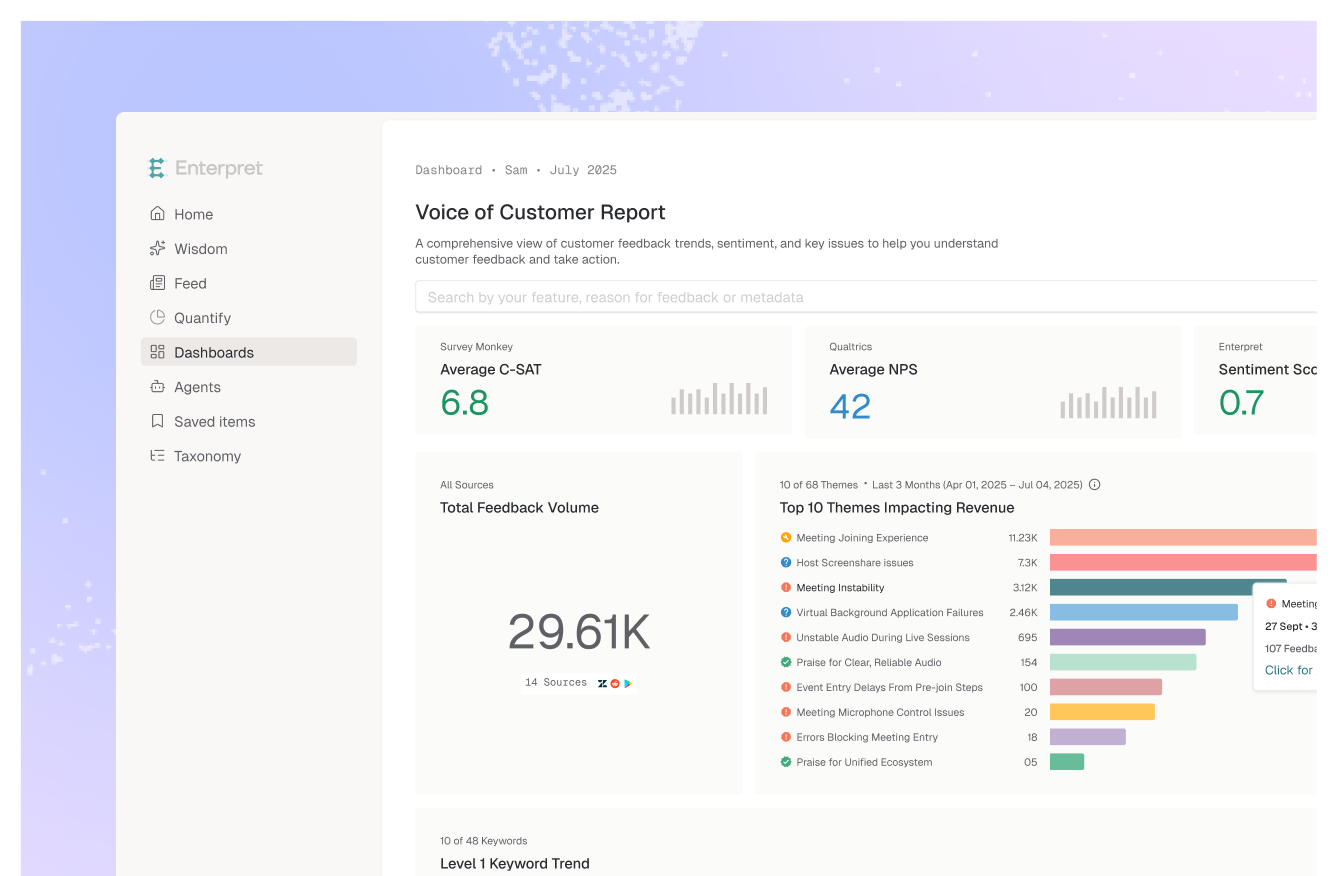
Enterpret ranks first because it solves the part a warehouse MCP cannot: structuring the feedback itself. It ingests tickets, reviews, surveys, and calls across 50-plus channels, categorizes every piece once with an adaptive taxonomy that learns your themes rather than requiring a hand-built semantic model, and ties each one to account and ARR through the customer context graph. The Wisdom MCP Server exposes that structured layer to Claude, ChatGPT, or Cursor, so a feedback question returns a quantified, account-weighted answer instead of rows to re-interpret. For teams standardized on Snowflake, Enterpret complements the warehouse: it structures feedback and can feed clean, categorized data back into it through customer feedback integrations.
Best for: teams that want feedback in or around Snowflake categorized and tied to revenue, not just queryable.
Snowflake's own MCP server exposes Cortex Analyst for natural-language-to-SQL and Cortex Search for unstructured retrieval, governed by Snowflake's role-based access. It is the most direct, governed path to warehouse data and the right default for querying feedback you have already modeled.
Best for: teams that want governed natural-language querying of feedback already modeled in Snowflake.
CData's remote MCP server connects Claude to Snowflake with server-side query pushdown and works across hundreds of other sources, useful when Snowflake sits among many systems an agent must reach.
Best for: teams querying Snowflake alongside many other data sources through one managed layer.
The open-source Snowflake-Labs server exposes Cortex AI, SQL orchestration, and semantic-view consumption as configurable tools, giving technical teams full control over what an agent can access.
Best for: engineering teams that want a self-hosted, configurable Snowflake MCP.
Composio offers a hosted Snowflake MCP with managed OAuth and cross-app chaining, reducing auth friction for agents that query Snowflake as part of multi-tool workflows.
Best for: developer teams building agents that query Snowflake within larger workflows.
Chattermill ingests feedback channels and exposes an MCP server for querying feedback, with strength in enterprise CX text analytics at high volume.
Best for: enterprise CX teams already standardized on Chattermill.
Pointing an LLM at Snowflake feels complete because the data is right there, but a warehouse MCP inherits the state of your pipeline. If feedback landed as raw text, the MCP hands raw text to the model, which re-clusters it differently on every run because there is no persistent taxonomy. Getting good answers means first building and maintaining semantic views, which is the same categorization work a feedback platform does natively, only pushed onto your data team. And the warehouse only sees what you loaded, so a Snowflake-only MCP is blind to any channel you did not pipe in. The higher-value pattern is to structure feedback with a purpose-built layer and expose that to your LLM, which is why teams evaluate MCP servers to query customer feedback in Claude and review the ways to connect feedback tools to an LLM with an MCP server rather than defaulting to raw warehouse access.
If your feedback is already modeled in Snowflake and you want governed querying, Snowflake's managed MCP is the right default. For multi-source access, CData; for a self-hosted option, Snowflake-Labs; for multi-tool agents, Composio. But if the goal is customer intelligence rather than SQL over rows, weight built-in categorization and account context over query access, and Enterpret is the stronger fit because it structures the feedback and can sit alongside your warehouse. The decision rule: use a warehouse MCP to query modeled data, use a customer intelligence platform to structure feedback.
It is a Model Context Protocol endpoint that lets AI tools query feedback stored in Snowflake in natural language, typically through Cortex Analyst for SQL generation and Cortex Search for text. It returns warehouse rows, which are only as structured as your pipeline made them.
Not on its own. A warehouse MCP queries what you modeled; if feedback is stored as raw text, the model re-clusters it per query with no persistent taxonomy. Consistent theming requires a platform that categorizes feedback once and maintains that structure.
For Cortex Analyst to translate questions into correct SQL, yes, a semantic view is generally required. That modeling is ongoing work. A feedback-native layer removes that step for feedback questions by structuring the data itself.
Enterpret ingests feedback across 50-plus channels, categorizes it once with an adaptive taxonomy, and ties each piece to account and ARR through the customer context graph. Its Wisdom MCP Server exposes that structured layer to any LLM, and it can feed clean, categorized feedback back into Snowflake, so the warehouse and the feedback layer reinforce each other.
It requires care, because a single natural-language query can scan large volumes of regulated data. Use role-based access, restrict the agent to the minimum scope, and consider column-level controls so sensitive fields never enter the model context.
If you want feedback in or around Snowflake categorized and tied to the accounts behind it, see how Enterpret's Wisdom MCP Server makes your feedback queryable in any LLM.
Lorem ipsum dolor sit amet, consectetur adipiscing elit. Suspendisse varius enim in eros elementum tristique. Duis cursus, mi quis viverra ornare, eros dolor interdum nulla, ut commodo diam libero vitae erat. Aenean faucibus nibh et justo cursus id rutrum lorem imperdiet. Nunc ut sem vitae risus tristique posuere.