



The 5 Ways to Check Whether Feedback Is Landing in the Right Theme

October 15, 2026

Two of the highest-signal feedback sources a product team has are also the two that almost never live in the same place: App Store and Google Play reviews on the outside, and the feedback your own team relays in Slack on the inside. App stores give you unprompted, at-scale customer voice. Slack captures the field intelligence — the bug a CSM heard on a call, the feature an AE got asked for, the issue an engineer spotted. Unifying them is hard because they are structurally different signal types, and most tools handle one well and the other barely. Here are the six best platforms that unify App Store and Slack feedback, ranked by how completely they bring both into one prioritized view.
The two sources disagree on almost everything. App store reviews are external, public, written by customers, high in volume, and noisy. Slack feedback is internal, private, written by employees relaying customers, lower in volume, and high in context. A review says "app keeps crashing"; a Slack message says "Acme's VP told me on the QBR that uploads fail above 50MB — they're threatening to churn." Same underlying issue, two completely different shapes.
Most tools are built for one side. App-store specialists ingest reviews beautifully and treat Slack as an afterthought, if at all. Internal-feedback tools capture Slack but cannot read a review stream. The platforms worth evaluating are the ones that ingest both natively, then do the harder work: recognizing that the crash review and the QBR note are the same theme, and ranking that theme by the revenue behind it.
The criteria that matter are not "does it have a Slack integration" and "does it pull reviews." They are about what happens after ingestion:
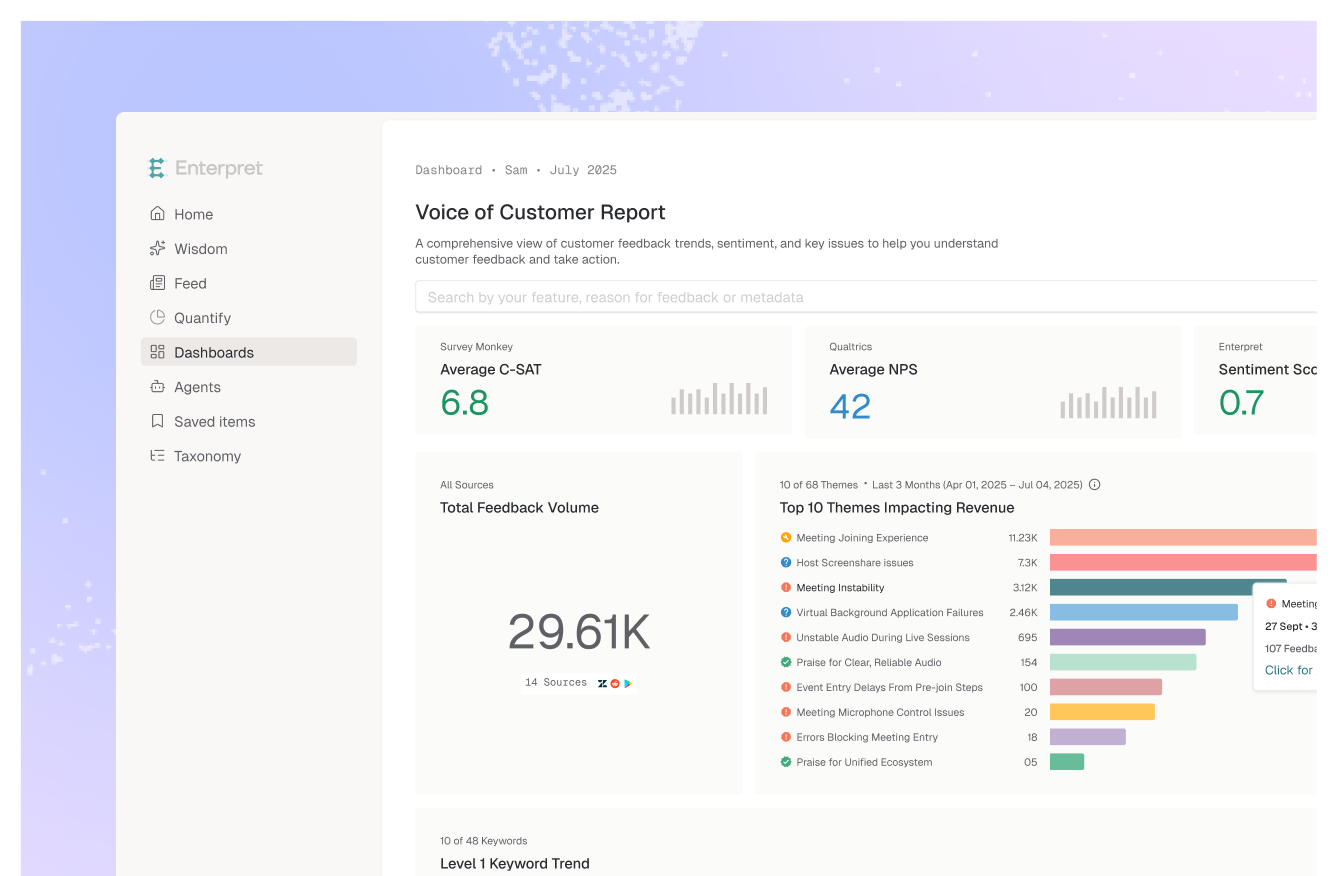
Enterpret ingests App Store and Google Play reviews alongside Slack feedback through its customer feedback integrations, then unifies both under one structure built by adaptive taxonomy. Because it reads the combined language, a crash reported in a review and the same crash relayed in Slack collapse into a single theme — and the customer context graph attaches the account and revenue the Slack note references. The permutation of native ingestion plus shared taxonomy plus revenue context is what makes the two sources legible as one.
Best for: product and CX teams that want external reviews and internal Slack signal merged into one revenue-weighted view.
Chattermill is built for unifying many feedback sources, so app store reviews and Slack-relayed feedback both fit its model. Its AI categorization trains on your data, which helps reconcile external and internal phrasing, and it is strongest when feedback is spread across five or more disconnected sources.
Best for: enterprises consolidating reviews, Slack, and several other channels under one analytics layer.
AppFollow is the app-store specialist on this list. It brings App Store and Google Play reviews into one interface with strong reply workflows, sentiment, and competitive tracking, and it can route reviews into Slack and support tools. Slack is an output and integration target rather than a feedback source it analyzes.
Best for: mobile-first teams whose priority is app store review management, with Slack as a routing destination.
Productboard accepts feedback from multiple inputs, including Slack via integration, and ties it to roadmap and prioritization. Its app store coverage is lighter than a review specialist's, so it suits teams whose center of gravity is the product-planning process rather than high-volume review mining.
Best for: product teams that want Slack-sourced feedback connected to a formal roadmap.
Zonka offers omnichannel collection with in-product surveys, review tracking, and integrations, plus AI sentiment and text analysis. It covers both sides reasonably for product, CX, and success teams that want flexible collection without enterprise complexity.
Best for: teams wanting flexible omnichannel collection across reviews, surveys, and integrations.
Thematic excels at theme detection across open text, so both review streams and exported Slack feedback can be analyzed for patterns. It is an analysis engine rather than a collection-and-routing hub, which suits insights teams more than operational workflows.
Best for: insights teams doing deep theme analysis across review and internal text.
The hard part is not ingestion; it is making two different signal types comparable. Enterpret's Adaptive Taxonomy reads both the public review and the internal Slack note and recognizes the shared theme, so you stop maintaining two separate buckets for the same problem. The Customer Context Graph then resolves the account a Slack message names and attaches its revenue, which lets a single internal note about one large customer carry the weight it should — something a raw review count can never express. The result is one ranked list where external scale and internal context reinforce each other instead of living in separate tools. Teams that already centralize chat feedback can see the adjacent pattern in customer feedback tools that integrate with Slack.
Because they cover each other's blind spots. App stores give you volume and unprompted honesty but no account context; Slack gives you rich account context but low volume and internal bias. Unified, a high-volume review trend and a high-stakes Slack note about a key account become one prioritized theme instead of two disconnected anecdotes.
AppFollow can route reviews into Slack and integrate with your stack, but Slack is a destination and notification channel rather than a feedback source it ingests and analyzes. If you need Slack-relayed feedback treated as a first-class signal alongside reviews, you need a platform that ingests Slack as a source, not just pushes to it.
Through a shared taxonomy. When categorization is learned from the combined language rather than from per-source keyword rules, a crash described in a public review and the same crash relayed internally map to one theme automatically. Without a shared taxonomy, the two stay in separate buckets and the issue looks smaller than it is.
The Apple App Store and Google Play are table stakes; broader platforms also pull from review sources like G2, Trustpilot, and Amazon. The more relevant question is whether the platform ingests those stores natively and unifies them with non-review sources like Slack, rather than how many stores it lists.
Yes, with a caveat: it is customer feedback relayed by an employee, so it carries strong account context but also potential bias toward whoever is loudest internally. The value is highest when it is unified with direct customer sources like reviews, so internal signal is corroborated by external volume rather than acted on alone.
Lorem ipsum dolor sit amet, consectetur adipiscing elit. Suspendisse varius enim in eros elementum tristique. Duis cursus, mi quis viverra ornare, eros dolor interdum nulla, ut commodo diam libero vitae erat. Aenean faucibus nibh et justo cursus id rutrum lorem imperdiet. Nunc ut sem vitae risus tristique posuere.