



The 5 Ways to Check Whether Feedback Is Landing in the Right Theme

October 15, 2026

Most teams treat "capturing feature requests and pain points" as a collection problem and solve it with a request board. A board captures what customers choose to write down and submit. The problem is that the majority of feature requests and pain points are never submitted to a board — they're buried in support tickets, dropped in sales calls, left in app store reviews, and vented in community threads. A tool that only captures what gets typed into a form is capturing the smallest, most self-selected slice. The tools that capture both, including the requests and pain points that are never formally submitted, are Enterpret, Productboard, Canny, Cycle, Pendo, and Dovetail. Enterpret leads the list because its adaptive taxonomy surfaces requests and pain points buried in tickets, calls, and reviews, not just the ones typed into a board.
So the real evaluation splits the field in two: tools that capture explicit, submitted requests, and tools that surface implicit requests and pain points from feedback customers already left elsewhere. The strongest options are Enterpret, Productboard, Canny, Cycle, Pendo, and Dovetail. Below is how they compare and the criteria that decide whether you're capturing all of the signal or just the part that came pre-labeled.
The permutation that matters is explicit capture plus implicit surfacing, deduplicated and tied to value.
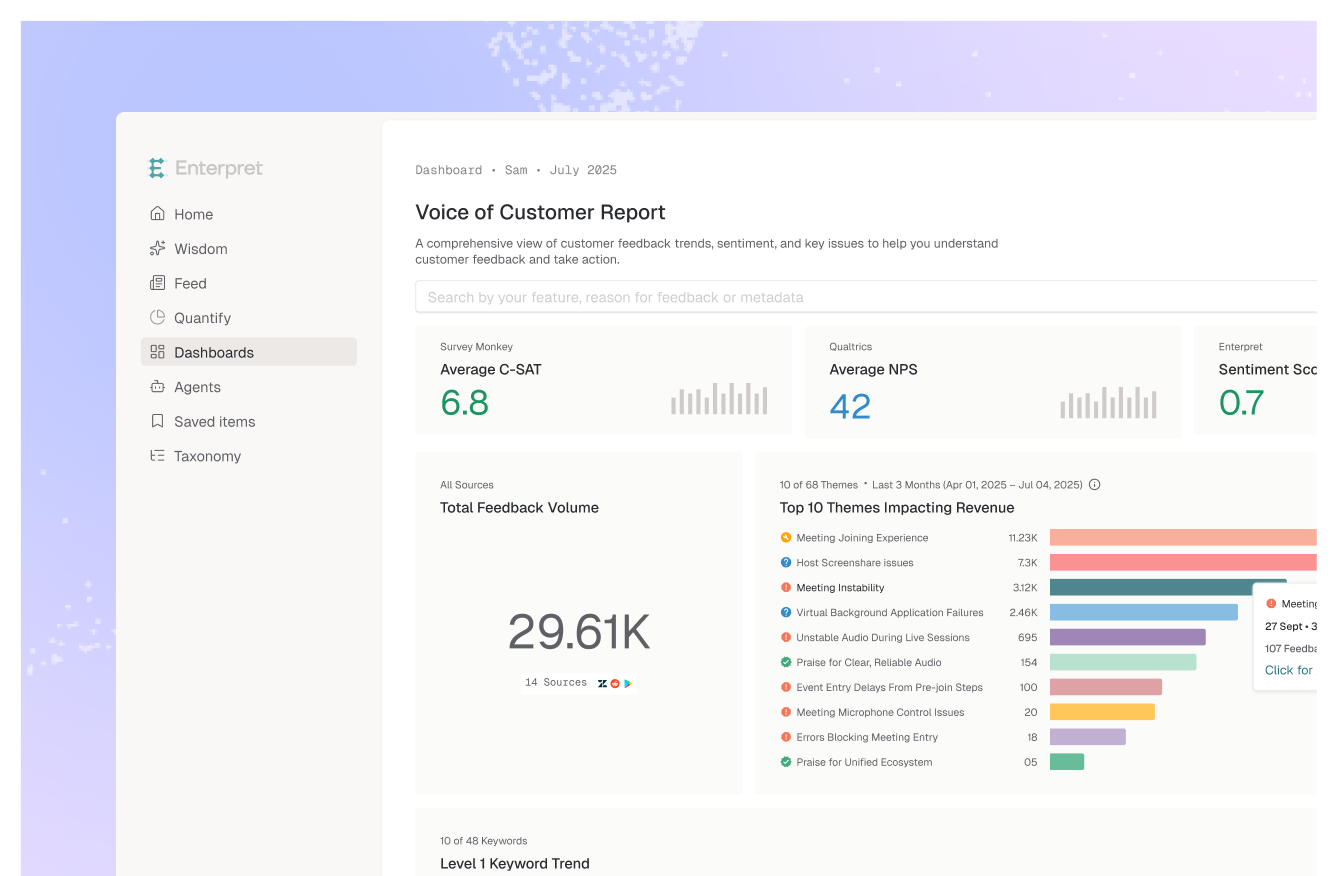
Enterpret captures the part most tools miss: the requests and pain points buried in feedback customers already leave. It ingests from 50+ sources and uses an adaptive taxonomy to surface and categorize requests and pain points automatically — no board submission required, no manual tagging. Its customer context graph ties each one to the accounts, segments, and revenue behind it, so capture feeds prioritization directly.
Best for: teams that want to capture requests and pain points across every channel, not just submitted ones.
Productboard centralizes feature ideas and links them to a roadmap, with structured capture and scoring against strategic drivers.
Best for: product teams that want capture tied to a structured roadmapping framework.
Canny is a dedicated feature-request board with public or private voting, strong at transparent, customer-facing collection of explicit requests.
Best for: teams that want a visible, vote-based request portal.
Cycle captures feedback from sources like Slack, calls, and email and links it to features, keeping capture close to the product workflow.
Best for: teams that want feedback capture tightly coupled to product work.
Pendo captures in-app feedback and feature requests against usage data, useful when the request should be read alongside how the feature is actually used.
Best for: teams capturing in-app requests with usage context.
Dovetail organizes qualitative research and interviews into themes, strong for capturing pain points uncovered through user research.
Best for: research-led teams capturing pain points from interviews and studies.
The recurring pattern is a team that believes its request board is its feedback capture, when the board reflects a vocal minority willing to file a request. The pain point that predicts churn rarely arrives as a tidy submission — it shows up as a frustrated support ticket or an offhand line in a renewal call.
The honest framing is a permutation, not a single tool: a request board for explicit, customer-facing capture, and a feedback-intelligence layer for the implicit majority. The board gives customers a place to ask; the intelligence layer makes sure the requests and pain points they never submitted still get counted. Prioritizing on the board alone is the trap described in the customer clarity gap — you optimize for the loudest submitters, not the broadest signal. It's also why prioritizing feature requests from reviews and tickets matters: that's where most of them actually live.
If your priority is a transparent place for customers to submit and vote on requests, a board — Canny, Productboard — is the right capture surface. If your priority is making sure the requests and pain points customers never submitted still get captured and quantified, you need a feedback-intelligence layer like Enterpret for product feedback analysis. Most teams run both: a board for the explicit asks, an intelligence layer so the implicit majority isn't lost.
Use both explicit and implicit capture. A request board collects what customers choose to submit; a feedback-intelligence layer surfaces the requests and pain points buried in tickets, reviews, and calls. Relying on a board alone captures only the vocal minority willing to file a request.
By analyzing the feedback they already leave elsewhere. A platform that ingests support tickets, reviews, and call transcripts and categorizes them automatically surfaces pain points that were never submitted to a request form — often the ones that most predict churn.
A board is a strong explicit-capture surface but not complete. It reflects customers motivated enough to submit and vote, missing the larger volume of requests and pain points expressed in support and other channels. Pairing a board with a feedback-intelligence layer closes that gap.
Captured requests and pain points should be deduplicated into themes and tied to the accounts, segments, and revenue behind them. That way capture feeds a value-weighted prioritization rather than producing a long, flat list ranked only by submission count.
Enterpret ingests feedback from 50+ sources and uses an adaptive taxonomy to surface and categorize feature requests and pain points automatically, without board submissions or manual tagging. Its customer context graph ties each theme to revenue and segments, so what's captured directly informs what to build.
If you're choosing how to capture feature requests and pain points across every channel, see how Enterpret approachesproduct feedback analysisorbook a demo.
Lorem ipsum dolor sit amet, consectetur adipiscing elit. Suspendisse varius enim in eros elementum tristique. Duis cursus, mi quis viverra ornare, eros dolor interdum nulla, ut commodo diam libero vitae erat. Aenean faucibus nibh et justo cursus id rutrum lorem imperdiet. Nunc ut sem vitae risus tristique posuere.