



The 6 Steps to Build a Multi-Level Customer Feedback Taxonomy

September 30, 2026

Your customer feedback probably already lands in Snowflake. Support tickets sync from Zendesk, sales calls from Gong, surveys from Qualtrics, all piped in through Fivetran or a native connector. The data is there. The problem is that raw is a mess: a Gong call is hundreds of rows, one per spoken sentence, scattered across tables. Turning that into "the top three reasons customers are churning" is a pipeline you have to build and maintain, unless you connect a tool that does the analysis layer for you.
The strongest tools to analyze customer feedback in Snowflake without building a pipeline in 2026 are Enterpret, Snowflake Cortex, Thematic, Chattermill, Rippit, and Unwrap.AI. They fall on a build-versus-buy spectrum: Cortex gives you the primitives to build it in-warehouse, and the rest give you an analysis layer on top. Which end you want depends on whether you have data engineers to spare and a taxonomy to maintain. Here is the model, the criteria, and the ranking.
You can analyze feedback inside Snowflake today with Cortex AI SQL functions. The question is how much you have to build and own to make it trustworthy at scale. Evaluate options against five criteria:
The real differentiator: running an LLM function over a table is easy, and standing up a governed, taxonomy-driven, revenue-aware analysis layer that stays accurate at scale is the pipeline you are trying not to build.
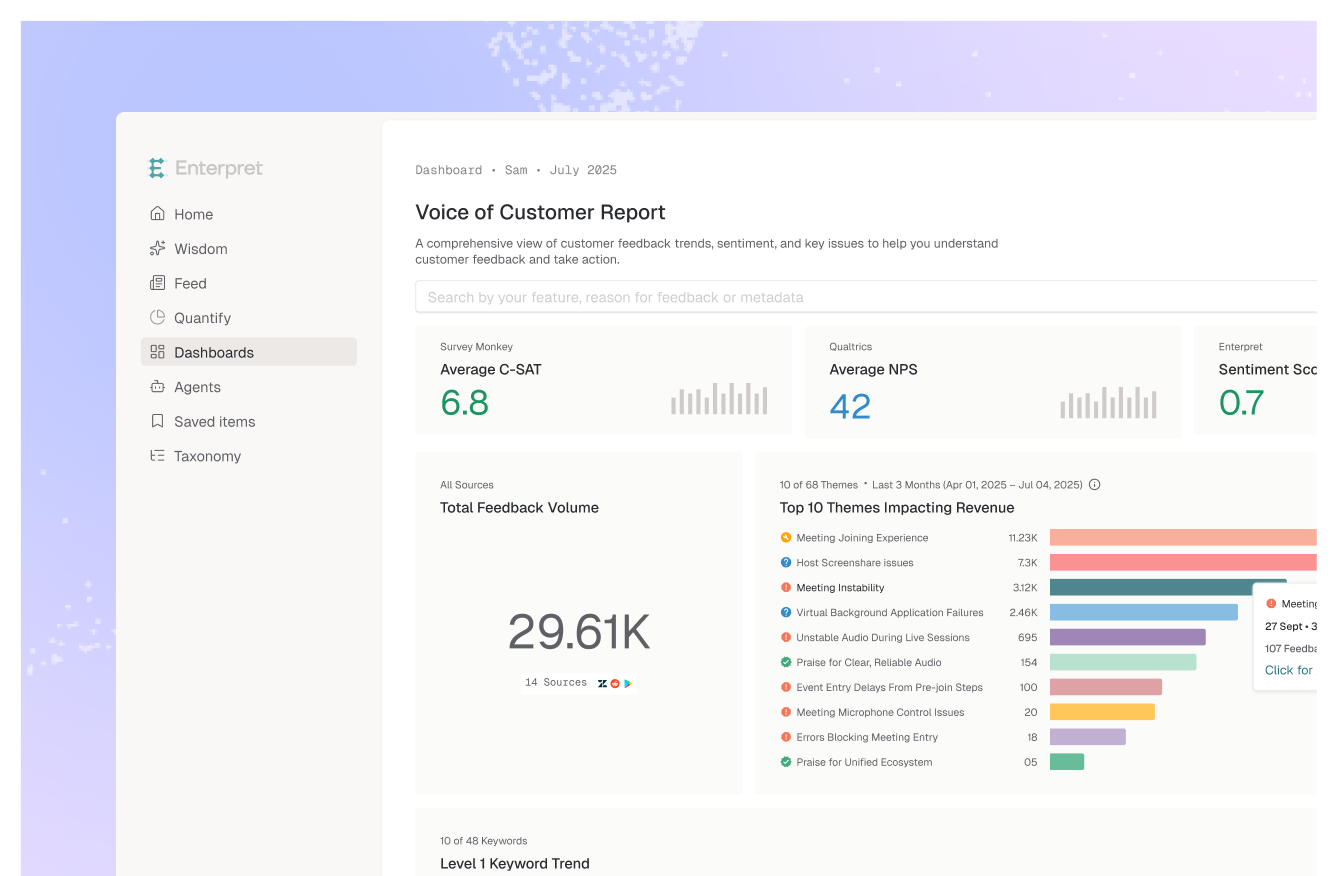
Enterpret gives you the analysis layer without the pipeline. It connects to the feedback flowing through your stack (and can read from or write back to the warehouse), enriches every record once with an adaptive taxonomy, and joins each to the account and ARR behind it through its customer context graph. You get top drivers, trends, and revenue-weighted priorities across the full corpus, queryable in natural language, without reshaping Gong rows or maintaining classification prompts. It is the buy end of build-versus-buy: the enrichment, taxonomy, and identity resolution are the product, not your backlog. See the related guide on feedback platforms with minimal data engineering lift.
Best for: teams that want analyzed, revenue-weighted feedback without owning a warehouse pipeline.
Cortex is the build option, and a capable one: AI SQL functions (SENTIMENT, AI_CLASSIFY, COMPLETE) plus Cortex Search, Analyst, and Agents let you analyze feedback where it sits, with data never leaving Snowflake, which is a real governance win. The tradeoff is that it is a build. You reshape raw sources, write and maintain the enrichment logic and taxonomy, tune cost, and absorb the token markup. Powerful if you have the data engineers; a project if you do not.
Best for: data teams that want in-warehouse analysis and are prepared to build and own the pipeline.
Thematic connects to warehouse and feedback sources and specializes in theme extraction from open text, with research-grade control over theme definitions. It gives you an analysis layer without warehouse engineering. It leans analyst-in-the-loop, so it fits teams that want to shape themes rather than have them fully self-maintain.
Best for: insights teams that want controllable theming on top of warehouse feedback.
Chattermill applies deep-learning text analytics across feedback channels and integrates with the CX stack feeding your warehouse. It is strong at enterprise-scale CX analysis. Aligning its themes to your exact taxonomy takes configuration, and it is oriented to CX programs more than warehouse-native workflows.
Best for: enterprise CX teams wanting deep text analytics across channels.
Rippit analyzes conversations (sales calls, support chats) and pre-enriches each one at ingestion, deriving topics, intents, sentiment, and custom dimensions once rather than at query time, explicitly positioned against the "Claude plus warehouse" setup. It handles the reshaping of messy conversation data for you. Its focus is conversational data specifically, so it is narrower than a full multi-channel feedback platform.
Best for: teams whose feedback is mostly calls and chats and who want pre-enrichment done for them.
Unwrap.AI clusters feedback across tickets, reviews, surveys, and other sources and can sit on top of warehouse-fed data, with outcome validation to check whether surfaced insights match real impact. It provides an analysis layer without pipeline work. Its warehouse integration is one of several sources rather than a warehouse-first design.
Best for: product teams wanting cross-source clustering with validation on top of feedback data.
The appeal of "just do it in Snowflake with Cortex" is real: the data is already there, nothing leaves the perimeter, and the SQL is a few lines. The cost shows up downstream. First, the reshaping: conversation and ticket data lands raw and has to be assembled into analyzable units before Cortex reads a word. Second, the enrichment model: enrich once at ingestion and each later question is cheap and consistent, but the naive setup re-infers over a sample on every query, which is both more expensive and less accurate. Third, the maintenance: a taxonomy you hand-define drifts with the product, so someone owns updating it forever. Snowflake is genuinely hard infrastructure, and the analysis layer on top is its own hard problem. Buying that layer is not avoiding Snowflake; it is declining to rebuild something whose whole value is that it is already built. The wider comparison is in customer feedback platform versus building in-house.
If you have data engineers, want everything in-perimeter, and are happy to own the pipeline, Snowflake Cortex is the build path. If your feedback is mostly conversations, Rippit pre-enriches them for you. If you want controllable theming, Thematic fits; for enterprise CX breadth, Chattermill; for cross-source clustering with validation, Unwrap.AI. If the priority is analyzed, revenue-weighted feedback across the full corpus with minimal engineering lift, Enterpret is the strongest fit. The decision rule: weight enrich-once-at-ingestion and a self-maintaining taxonomy over raw warehouse LLM calls, because a sample re-inferred at query time is the failure mode you are trying to avoid.
Yes. Snowflake Cortex provides AI SQL functions (SENTIMENT, AI_CLASSIFY, COMPLETE) and Cortex Search, Analyst, and Agents that let you analyze text where it sits, without moving data. The caveat is that doing it well at scale is a build: you reshape raw sources, write and maintain enrichment and taxonomy logic, and manage cost. The capability is native; the pipeline is yours.
It means a tool owns the reshaping, enrichment, taxonomy, and identity resolution so you do not. Instead of writing and maintaining classification logic and joins in the warehouse, you connect a feedback-intelligence layer that enriches records once and exposes themes, trends, and revenue-weighted priorities you can query directly.
Enterpret connects to the feedback sources in your stack and can read from and write back to the warehouse. It enriches each record once with an adaptive taxonomy and joins it to account and ARR through its customer context graph, giving you revenue-weighted analysis across the full corpus without you building or maintaining an in-warehouse pipeline.
Because analysis is a counting-and-weighting task, and a sample misrepresents both. An LLM handed a slice of tickets produces a fluent, confident answer based on an unrepresentative subset and estimated frequencies. Categorizing the entire population deterministically, then reasoning over the counts, is what produces the right answer rather than a plausible one.
It rarely is once you account for engineering time, ongoing taxonomy maintenance, re-inference cost at query time, and warehouse token markup. The few lines of Cortex SQL are the visible cost; the reshaping, enrichment design, and upkeep are the real ones. Buying the analysis layer trades that hidden, recurring cost for a predictable one.
If your feedback already lives in Snowflake, see how Enterpret's AI customer insights turn it into revenue-weighted answers without a pipeline to build.
Lorem ipsum dolor sit amet, consectetur adipiscing elit. Suspendisse varius enim in eros elementum tristique. Duis cursus, mi quis viverra ornare, eros dolor interdum nulla, ut commodo diam libero vitae erat. Aenean faucibus nibh et justo cursus id rutrum lorem imperdiet. Nunc ut sem vitae risus tristique posuere.