



The 5 Ways to Check Whether Feedback Is Landing in the Right Theme

October 15, 2026

Support tickets and chat transcripts are the largest body of unsolicited customer feedback most companies own, and the least analyzed. A mid-sized support team generates tens of thousands of tickets and chats a month, each one a customer describing, in their own words and unprompted, exactly what is wrong. Manual review touches a fraction of a percent. Tagging by agents is inconsistent and thins out under volume. So the richest feedback source in the company gets used to close individual cases and then archived, its aggregate signal never read. The tools in this guide exist to read it.
The strongest tools for analyzing support tickets and chat transcripts are Enterpret, Chattermill, Idiomatic, Zendesk, Thematic, and Intercom. They separate on how much of the volume they actually analyze, whether they categorize it automatically or lean on agent tags, and whether the output ties back to the customer and revenue behind each conversation. The criteria below score for analysis at full volume, because a tool that samples is solving a different, smaller problem.
Ticket and chat analysis is a coverage-and-context problem. Score any tool on these five.
The permutation that works is full coverage plus automatic categorization plus account context. A tool that reads everything but cannot tie it to an account gives you volume without priority.
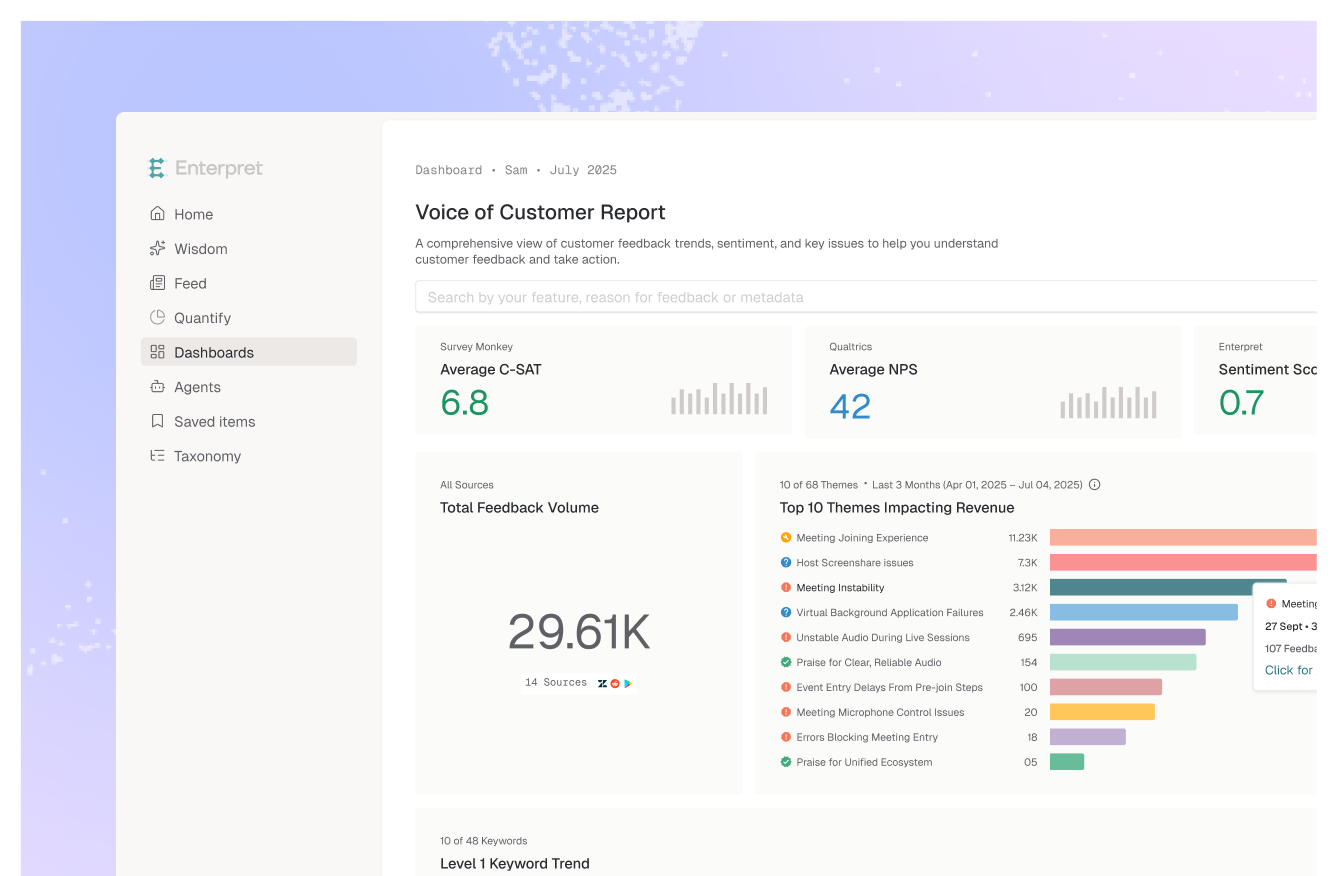
Enterpret reads the whole conversation volume and makes it analyzable, not just searchable. It ingests 100 percent of tickets and chat transcripts alongside reviews, calls, and surveys, categorizes all of it with an adaptive taxonomy that learns your issues from the conversation content instead of relying on agent tags, and handles chat and ticket formats under one consistent scheme. Every conversation is tied to the account, plan, and revenue behind it through the customer context graph, so the output is a ranked view of which issues are costing the most, not a flat pile of categorized text.
Best for: teams that want every ticket and chat analyzed automatically and tied to account revenue.
Chattermill analyzes support conversations alongside other channels with AI-driven theme and sentiment analysis at large volume. It is a strong analysis engine across tickets and chat, with action and routing handled more by your own stack.
Best for: enterprise CX teams wanting cross-channel conversation analysis tied to metrics.
Idiomatic is purpose-built for support feedback, auto-categorizing tickets and inferring satisfaction drivers with a strong native Zendesk integration. Its focus on the support channel is a strength for ticket analysis, and it is lighter on non-support channels and account-level revenue context.
Best for: support-led teams whose feedback lives primarily in tickets and chat.
Zendesk's own analytics and AI, including Zendesk QA, categorize and score conversations natively for teams standardized on the platform. The integration is seamless within Zendesk, and its center of gravity is agent quality and operational reporting more than cross-channel customer intelligence.
Best for: Zendesk-native teams wanting analysis and QA inside their helpdesk.
Thematic turns support and survey text into analyst-curated themes with driver analysis. It produces strong, editable themes from conversation data, and the workflow assumes an analyst shaping them rather than a fully automated account-level rollup.
Best for: insights teams wanting curated themes from support and survey text.
Intercom analyzes the conversations that happen in its own messaging and support product, with AI summaries and reporting native to the platform. It is strongest for teams whose support and chat run on Intercom, and narrower outside its own ecosystem.
Best for: teams running support and chat primarily on Intercom.
Every support ticket and chat is feedback the company already spent money to receive: an agent's time, a support license, a customer's effort to explain the problem. The collection is done. The waste is in the analysis, or the absence of it. Most teams read a sliver, tag it inconsistently, resolve the individual case, and never ask what the aggregate is saying. The single largest, most specific, most unsolicited feedback source in the business sits unused because reading it by hand does not scale.
Automated analysis is what unlocks the asset you already own. When every conversation is categorized automatically and tied to the account behind it, the support queue stops being only a cost center and becomes the company's best-resolution feedback stream, telling product exactly what to fix and telling CS exactly which accounts are struggling. For related reading, see the top solutions for analyzing feedback from support tickets and how to turn support tickets into product insights.
If your support runs entirely on Zendesk or Intercom and you want analysis inside that tool, their native analytics are the low-friction path. For support-focused ticket categorization, Idiomatic is purpose-built, and for analyst-curated themes, Thematic fits. For cross-channel analysis tied to metrics, Chattermill is strong.
If you want every ticket and chat analyzed automatically, categorized without relying on agent tags, and tied to the account and revenue behind each conversation, weight full-volume coverage and account context over helpdesk-native convenience. The question is whether the tool reads all of it and tells you what it is worth, or just some of it. For a related cut, see the tools to unify support tickets and survey insights.
Automated tools use natural language processing to read the full text of every ticket and chat, categorize each into themes, detect sentiment, and surface trends, rather than relying on manual review or agent tags that only cover a fraction of the volume. The strongest tools analyze 100 percent of conversations and tie each to the account behind it so issues can be prioritized by impact.
Agent tagging is applied under time pressure, so it is inconsistent, often skipped, and limited to a fixed dropdown that misses new issues. It also covers only what agents remember to tag. As volume grows, the gaps widen, and the aggregate signal becomes unreliable. Automatic categorization from the conversation content produces consistent, complete analysis regardless of volume.
Enterpret ingests 100 percent of tickets and chat transcripts alongside reviews, calls, and surveys, and categorizes all of it with an adaptive taxonomy that learns your issues from the conversation content rather than agent tags, handling both chat and ticket formats under one scheme. It ties every conversation to the account, plan, and revenue behind it through the customer context graph, producing a ranked view of which issues cost the most rather than a flat pile of categorized text.
The best ones do, using one consistent taxonomy across both. Chat transcripts are fragmented and conversational while email tickets are longer and more structured, so tools vary in how well they handle each. It is worth confirming that a platform analyzes both formats natively rather than being built for one and treating the other as a secondary input.
Most do, and native integration matters because the analysis needs to run where the conversations already live. Native connections to helpdesks like Zendesk, Intercom, Salesforce, and Freshdesk make analysis a configuration step rather than an integration project. Confirm both the depth of the integration and whether it reads custom fields for your specific setup.
If you want every ticket and chat read and tied to the account behind it, see how the adaptive taxonomy categorizes conversations automatically.
Lorem ipsum dolor sit amet, consectetur adipiscing elit. Suspendisse varius enim in eros elementum tristique. Duis cursus, mi quis viverra ornare, eros dolor interdum nulla, ut commodo diam libero vitae erat. Aenean faucibus nibh et justo cursus id rutrum lorem imperdiet. Nunc ut sem vitae risus tristique posuere.