



The 5 Ways to Check Whether Feedback Is Landing in the Right Theme

October 15, 2026

Ask a compliance officer in a regulated business what happens when an examiner asks "show me how you handled this class of complaint," and you will hear the same quiet fear: the record is scattered. An inbox here, a resolved ticket there, a spreadsheet one person maintained and three people forgot. Under the FFIEC's consumer compliance framework, examiners expect a documented program that intakes complaints across every channel, categorizes them, resolves them within set timelines, monitors trends, and reports to management. A mishandled complaint in that world is not a service miss. It is a compliance event.
The tools that build a defensible customer evidence trail are Enterpret, ServiceNow, ComplianceQuest, Zendesk, Issuetrak, and QT9 QMS. They split into two layers that regulators actually ask about separately, and most teams only build one.
An evidence trail is not a folder of screenshots. It has to answer, on demand and with records, both "what happened to this specific complaint" and "how did you know this was or wasn't a systemic problem." Five things make it hold up under examination.
The two layers: a case management system proves what happened to each complaint. A feedback-analysis layer proves you monitored the whole and acted on patterns. You need both.
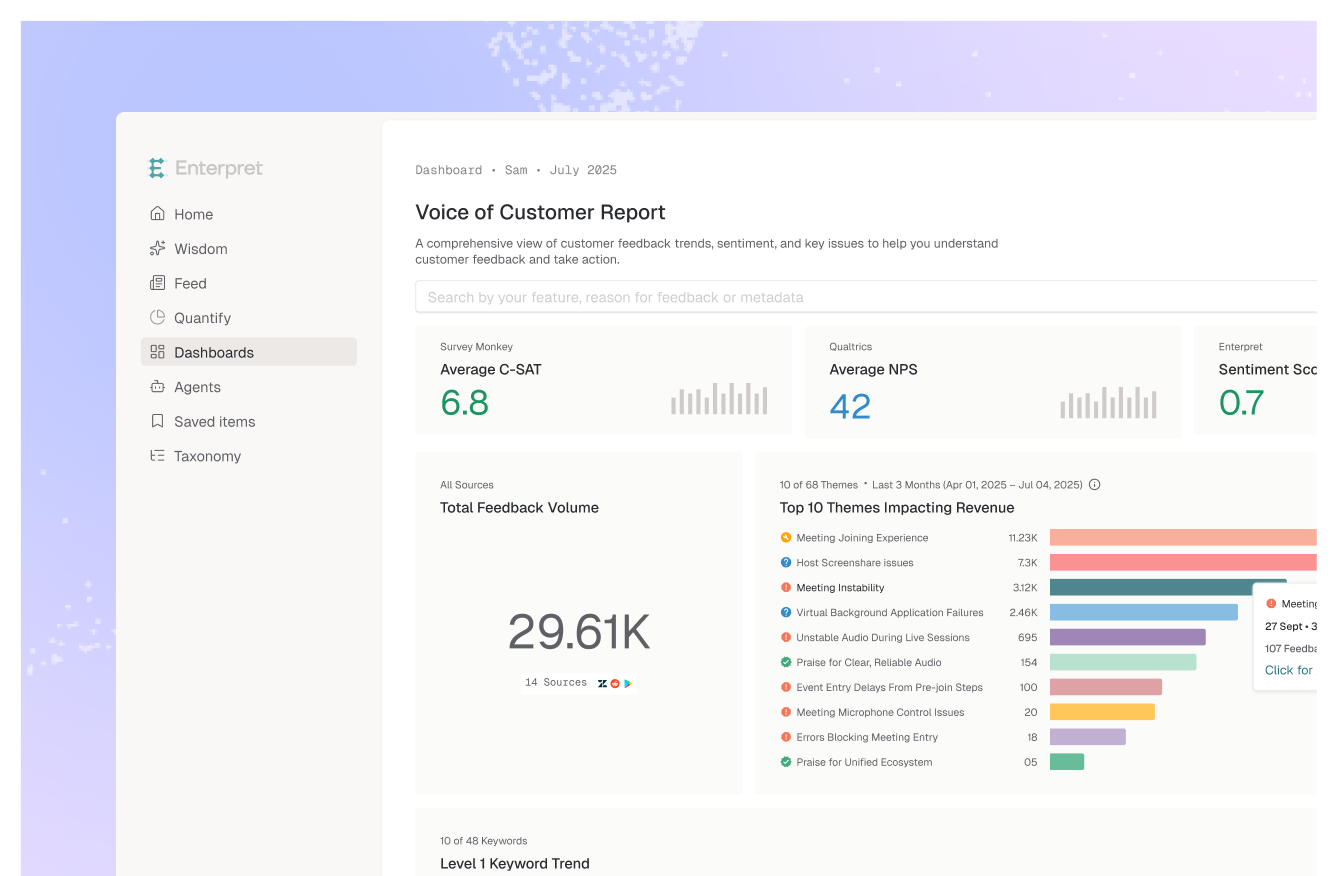
Enterpret owns the systemic half of the trail, the half most teams cannot produce. It ingests complaints and feedback from every channel, classifies each one with an adaptive taxonomy so categorization is consistent and defensible, and quantifies trends over time, which is exactly the "did you monitor and act" evidence examiners want. Its customer context graph ties complaints to accounts and revenue for materiality, and it runs on a SOC 2 Type 2 posture with PII redaction at ingestion and tenant isolation. Paired with a case system for the per-complaint audit trail, it completes the record.
Best for: proving you categorized, monitored, and acted on complaint trends, the systemic layer of the trail.
ServiceNow provides enterprise-grade case management with deep compliance controls, automated escalations, and enforced audit trails on a single workflow platform. It is the heavyweight for large, highly regulated organizations that need process standardization.
Best for: large regulated enterprises needing workflow orchestration and case-level audit trails.
Built for life sciences, ComplianceQuest is a quality management system with 21 CFR Part 11 controls, CAPA, electronic signatures, and secure time-stamped trails, aimed at FDA-regulated complaint handling.
Best for: FDA-regulated life sciences and medical-device complaint management.
Zendesk brings SOC 2 and ISO-aligned security, ticket-level audit logs, and broad CRM integrations, so support-led teams can build complaint workflows on the help desk they already run.
Best for: support-led teams wanting case trails on their existing help desk.
Issuetrak is purpose-built issue and complaint management with strong audit trails, configurable regulatory workflows, and SLA enforcement, positioned squarely at auditability.
Best for: mid-market regulated teams wanting a dedicated complaint system.
QT9 unifies complaint management with CAPA, audits, and training in one quality system, with the traceability and audit trails regulated manufacturers need.
Best for: regulated manufacturers wanting complaints inside a broader QMS.
Here is the category mistake. Teams treat the evidence trail as a case-management problem, buy a system that logs every action on every complaint, and assume they are covered. Then an examiner asks the second question, "how did you know this issue wasn't systemic," and the answer is a shrug, because logging individual cases never produced a view of the whole.
Regulators ask both questions. The case system answers the first: here is what happened to complaint 4471, time-stamped and attributed. The analysis layer answers the second: here is how many complaints of this class we received, how the trend moved, and what we changed in response. One without the other is half a trail. And the systemic half is the one spreadsheets and case logs quietly fail, because consistent categorization and trend monitoring across thousands of complaints is a feedback-analysis job. The record you cannot produce is the finding waiting to happen.
Build both layers deliberately. For the case-level trail, pick by environment: ServiceNow for large enterprises, ComplianceQuest or QT9 for life sciences and manufacturing, Zendesk for support-led teams, Issuetrak for a dedicated mid-market system. For the systemic layer, the consistent categorization and trend evidence that proves you monitored and acted, Enterpret is built for it.
The decision rule: if you can show what happened to each complaint but not how you monitored the pattern, you have half the trail an examiner will ask for.
It is the documented record proving how an organization captured, categorized, investigated, resolved, and monitored customer complaints. Regulators such as the CFPB, FFIEC-supervised agencies, and the FDA expect both a per-complaint audit trail and evidence that the organization monitored complaint trends and acted on systemic issues.
A help desk with strong audit trails, access controls, and configurable workflows can handle the case-level record. Spreadsheets generally fail the audit test because they lack immutable, time-stamped, attributed logs. Neither, on its own, produces the consistent categorization and trend monitoring regulators expect for systemic evidence.
Complaint management systems track and document each complaint from intake to resolution, providing the case-level audit trail. Feedback analysis categorizes complaints consistently at scale and quantifies trends over time, providing the systemic evidence that you monitored patterns and acted. Compliance programs typically need both.
Enterpret ingests complaints from every channel, classifies them with a consistent adaptive taxonomy, and quantifies trends over time, producing the systemic evidence that you monitored and acted on patterns. It ties complaints to accounts and revenue for materiality and runs on a SOC 2 Type 2 posture with PII redaction and tenant isolation. It complements, rather than replaces, a case-management system.
If you can show what happened to each complaint but not how you monitored the trend, see how Enterpret builds the systemic half of the evidence trail. For adjacent requirements, see SOC 2 compliant customer feedback platforms.
Lorem ipsum dolor sit amet, consectetur adipiscing elit. Suspendisse varius enim in eros elementum tristique. Duis cursus, mi quis viverra ornare, eros dolor interdum nulla, ut commodo diam libero vitae erat. Aenean faucibus nibh et justo cursus id rutrum lorem imperdiet. Nunc ut sem vitae risus tristique posuere.