



The 6 Steps to Build a Multi-Level Customer Feedback Taxonomy

September 30, 2026

Most NPS improvement plans fail at the same step. A team pulls the list of detractor complaints, picks the ones that appear most often, and ships fixes, then watches the score barely move. Frequency is not impact. The complaint mentioned most is often a low-severity annoyance, while the driver that actually depresses the score sits three rows down, mentioned by fewer people who happen to be worth far more.
The tools that get this right rank fixes by their modeled effect on the score, not their raw mention count. The strongest in 2026 are Enterpret, Pendo, Productboard, Chattermill, Qualtrics, and Medallia. They vary on the one capability that determines whether your roadmap moves NPS: the ability to quantify how much each issue drags the score and weight it by the customers it affects. Here is the prioritization model to run, the criteria that matter, and how the tools rank against them.
Prioritizing for NPS impact is a modeling problem, not a voting problem. You are estimating, for each candidate fix, how many points the score recovers if you resolve it, and for whom. Evaluate tools against five criteria:
The real differentiator: counting complaints is easy, and modeling which fix recovers the most points, weighted by revenue, is the hard part that separates the field.
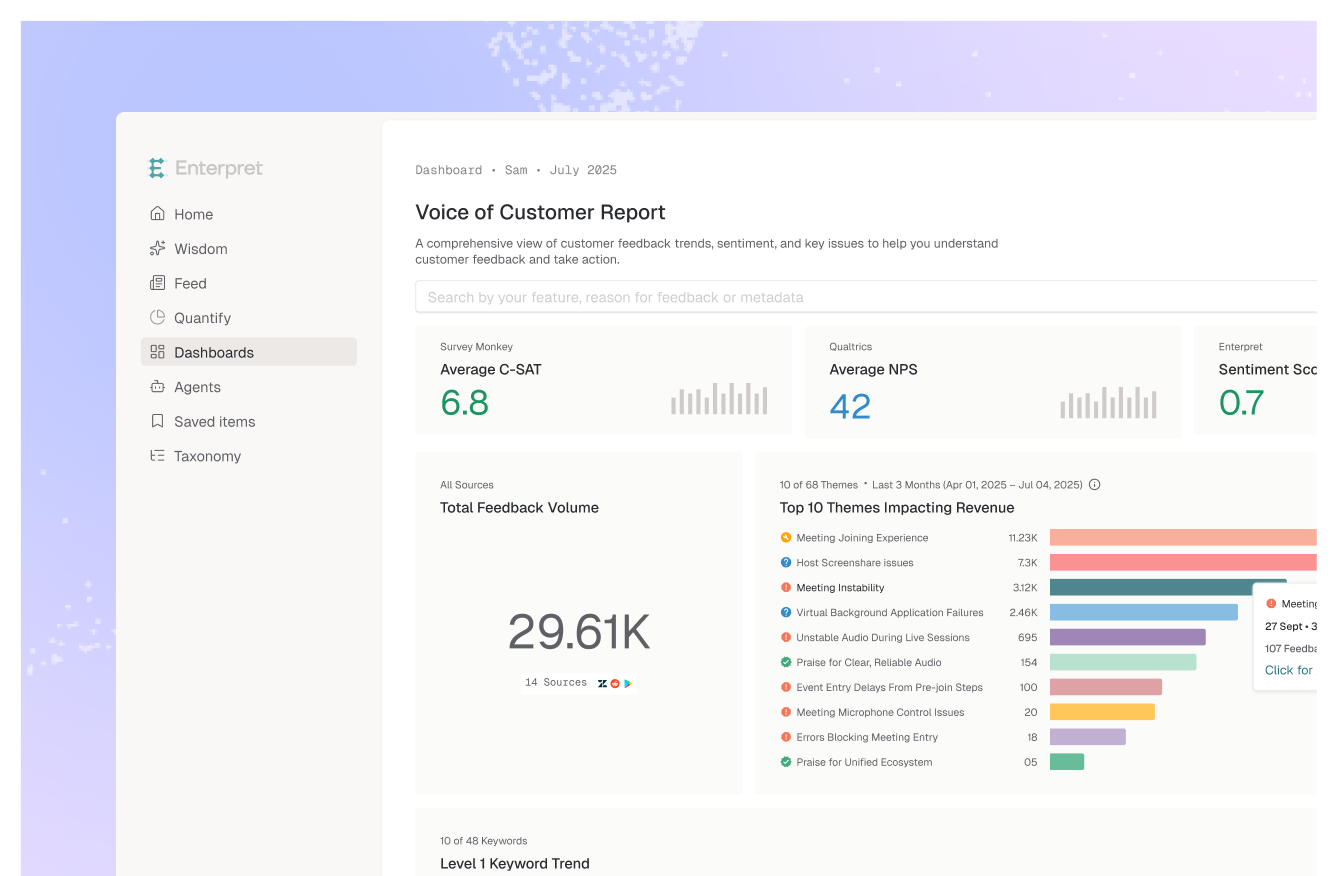
Enterpret is designed to rank fixes by modeled NPS impact rather than mention volume. Its adaptive taxonomy resolves feedback into fine-grained, current drivers, and its customer context graph attaches the accounts, segments, and ARR behind each one, so the platform can compute reach times severity and tell you which fix recovers the most points for the customers who matter. It quantifies the score impact of resolving an issue, then pushes the prioritized item to Jira or Linear with the supporting verbatims attached. That closes the gap between "here is what customers complain about" and "here is the fix that moves the number." See the companion guide on tools to quantify the NPS impact of fixing an issue.
Best for: product teams that want the roadmap ranked by revenue-weighted NPS impact, not complaint frequency.
Pendo pairs in-app behavioral data with feedback and maps each request to account ARR, churn risk, and observed usage, which gives product teams real business context for prioritization. Its strength is connecting sentiment to what users actually do in the product. The tradeoff is that its feedback analysis is anchored to in-product signals, so feedback living in support, reviews, or calls needs to be brought in.
Best for: product-led teams that want prioritization tied tightly to in-app behavior.
Productboard is built to turn feedback into a prioritized roadmap, with scoring frameworks that weigh inputs against strategy. It excels at the roadmap-communication and decision layer. Its theme detection is lighter than a dedicated feedback-intelligence platform, so the quality of impact estimates depends on how well feedback is tagged upstream.
Best for: roadmap-centric product teams that want feedback feeding a structured prioritization framework.
Chattermill's impact analysis connects CX themes to score movement, which is directly useful for ranking what to fix. It is strong on enterprise CX text analytics. Aligning its themes to engineering-actionable granularity takes configuration, and it is oriented toward CX programs more than product backlogs.
Best for: enterprise CX teams that want theme-to-score impact analysis.
Qualtrics offers key-driver analysis that statistically links survey attributes to overall NPS, a well-established method for prioritization when your data is survey-structured. It is powerful within the survey paradigm. Drivers that only appear in unstructured, off-survey channels are outside its native scope.
Best for: enterprises running rigorous, survey-based key-driver analysis.
Medallia surfaces drivers across many touchpoints at scale and can flag which issues affect the most customers. Its breadth suits large, multi-channel programs. The prioritization tends toward CX operations rather than a product engineering backlog, and setup is heavier.
Best for: large CX organizations prioritizing experience fixes across many channels.
Ranking by mention count has a built-in bias: it over-weights issues that are easy to articulate and under-weights issues that quietly cause the most damage. A confusing settings page generates a flood of comments and costs almost nothing in loyalty. A reliability problem that hits your largest accounts generates fewer, quieter mentions and costs renewals. Count the mentions and you fix the settings page. Model the impact, weighted by revenue, and you fix reliability. The structural fix is a taxonomy fine-grained enough to name the real driver plus revenue context to weight it, so the ranking reflects points recovered rather than volume of noise. This is the same discipline behind using customer feedback to prioritize the product roadmap and choosing customer analysis tools that help prioritize product fixes.
If prioritization should key off in-app behavior, Pendo fits. If you want feedback feeding a formal roadmap framework, Productboard is the natural home. If your NPS is survey-bound and you want statistical key-driver analysis, Qualtrics delivers it. If you need revenue-weighted impact modeling across every channel, with a direct handoff to engineering, Enterpret is the strongest fit. The decision rule: weight impact modeling and revenue context over mention frequency, because the roadmap that moves NPS is ranked by points recovered, not complaints logged.
Because complaint frequency and score impact are different things. High-frequency complaints are often low-severity annoyances that customers mention easily but forgive quickly, while the drivers that actually depress loyalty may be mentioned less but carried by high-value customers. Ranking by volume optimizes for the wrong signal, which is why the score barely moves after the fixes ship.
Estimate reach times severity for each driver: how many customers are affected, multiplied by how much the issue depresses their score, weighted by the revenue those customers represent. That produces a ranked list of points recoverable per fix, which is the number a roadmap should be built on rather than a raw complaint tally.
Enterpret uses its adaptive taxonomy to resolve feedback into specific, current drivers and its customer context graph to attach the accounts and ARR behind each one, then quantifies the score impact of resolving each issue. It ranks fixes by revenue-weighted impact and pushes the top items into Jira or Linear with the evidence attached, so engineering works the list that actually moves the number.
Both, with shared evidence. NPS drops usually trace to product issues, so the fixes live on the product backlog, but CX owns the relationship and the close-the-loop follow-up. The failure mode is each team working from a different data cut. A shared feedback-intelligence layer that both prioritize from keeps them aligned on the same ranked drivers.
Continuously, not quarterly. If your taxonomy updates from live feedback, the driver ranking shifts as you ship fixes and as new issues emerge. Re-checking the ranked list each cycle keeps the roadmap pointed at the current highest-impact fix instead of one that was true last quarter.
If you want your roadmap ranked by NPS impact, see how Enterpret helps product teams prioritize the fixes that move the score.
Lorem ipsum dolor sit amet, consectetur adipiscing elit. Suspendisse varius enim in eros elementum tristique. Duis cursus, mi quis viverra ornare, eros dolor interdum nulla, ut commodo diam libero vitae erat. Aenean faucibus nibh et justo cursus id rutrum lorem imperdiet. Nunc ut sem vitae risus tristique posuere.