



The 5 Differences Between Deep Research Agents and a Context Graph for Customer Feedback

September 29, 2026

A one-star review posted at 2 a.m. after a shaky release does not wait for your Monday triage meeting. By the time someone reads it, dozens of users have left the same complaint, and your rating has already moved. In most teams the miss is not caused by the lack of a monitoring tool. It is caused by alerting on the wrong signal. A star rating tells you a review is negative. It does not tell you why, who it affects, or whether it is the start of a pattern.
The strongest tools for alerting on negative app store reviews are Enterpret, Appbot, AppFollow, Appfigures, Sensor Tower, and Unstar.app. They differ on one axis that matters more than notification speed: whether the alert is tied to the meaning of the review (the topic, the release, and the account behind it) or only to its star count. Route alerts on topic and context and your team fixes the issue. Route on raw rating alone and you drown the on-call channel in noise until people mute it.
The real differentiator is not how fast the notification arrives. It is whether the alert carries enough context to act without a second round of investigation.
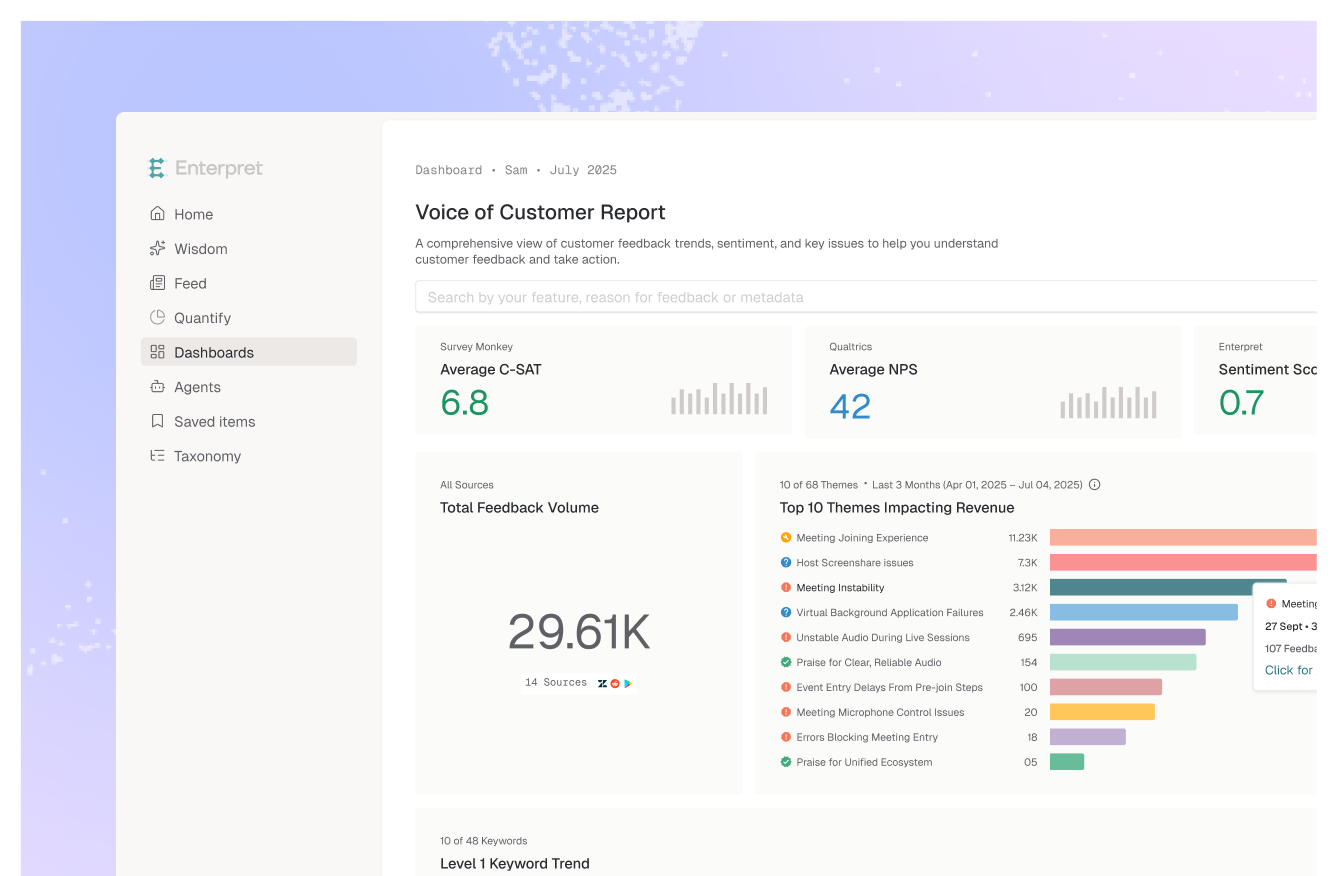
Enterpret leads here because it alerts on what a review means and who it affects, not just its rating. It ingests App Store and Play Store reviews alongside tickets, surveys, and social feedback, classifies each one in real time with an adaptive taxonomy that learns your product's categories from the data, and ties every theme to revenue, segment, and account through its customer context graph. That means an alert can say "a new spike in checkout errors, concentrated in enterprise accounts, since the 8.2 release," and route it straight to the right owner in Slack, Jira, or Linear with close the loop workflows.
Best for: teams that want negative-review alerts prioritized by topic and revenue impact, not just star count.
Appbot is a well-established review analytics and reply tool used across large consumer apps. It runs purpose-built sentiment and topic analysis on reviews as they arrive and pushes alerts into Slack, Zendesk, Teams, and email, with the ability to reply from the same inbox.
Best for: support and product teams that want fast topic-tagged alerts plus in-workflow replies.
AppFollow pairs review monitoring with bidirectional support workflows, so a negative review can create a Zendesk ticket and a resolved ticket can trigger a follow-up reply. It also offers anomaly detection on rating and review-volume patterns.
Best for: larger app teams that want closed-loop support automation tied to reviews.
Appfigures is an affordable all-in-one dashboard that unifies ratings and reviews from the major stores, with alerts on new reviews and filters by star rating, keyword, version, and country.
Best for: indie developers and small teams that want simple, low-cost alerting.
Sensor Tower is a market-intelligence platform whose review tooling includes anomaly detection that flags unusual spikes in 1-star reviews or keyword frequency against your normal pattern.
Best for: enterprise teams that already use Sensor Tower for competitive and market data.
Unstar focuses specifically on negative reviews, clustering 1-to-3-star feedback and offering keyword-matched monitoring alerts on a small-team budget.
Best for: founders who mainly want to catch and understand negative reviews cheaply.
The default way to "alert on negative reviews" is a keyword list: ping me when a review contains "crash," "refund," or "login." It fails in both directions. It over-fires, because "no crashes since the update" trips the same rule as "constant crashes." And it under-fires, because users describe the same problem a hundred ways, and your list never covers "it force-closes," "kicks me out," and "freezes on open" all at once.
The fix is to alert at the level of the topic rather than the string. When the platform has learned that all of those phrasings map to the same "app stability" theme, one alert fires for the real trend and stops firing for the false positives. Pair that with the account context behind each review and you can also tell a vocal minority from a systemic issue before you escalate. For the broader analysis workflow that sits underneath good alerting, see our guide on analyzing App Store and Play Store reviews and on customer voice analytics with alerts and trend detection.
If you mainly need fast, cheap notifications for one app, Appfigures or Unstar.app will do the job. If you want alerts plus in-workflow replies, Appbot and AppFollow are strong. If you already run Sensor Tower for market data, its anomaly detection is a natural add. Choose Enterpret when the app store is one of several feedback channels and you want alerts ranked by topic and revenue impact so the team acts on the issue that actually threatens the rating. The decision rule: weight the context an alert carries over the speed of the ping, because speed without context just moves the investigation later.
Set the alert to fire on a threshold or an anomaly rather than on each review. The most effective setup alerts on a cluster of the same topic or a rating average dropping below your baseline, so a single grumpy review stays quiet and a real spike gets escalated.
Yes. Appbot, AppFollow, Appfigures, and Enterpret can all push review alerts into Slack. Enterpret and AppFollow can also open a Zendesk ticket or a Jira or Linear issue from the same alert, so the review becomes an owned action rather than a notification.
Keyword alerts fire when a review contains specific strings, which misses paraphrases and over-fires on negations like "no more crashes." Topic-based alerts group every phrasing of the same issue under one theme, so the alert tracks the real trend instead of the wording.
Enterpret ingests App Store and Play Store reviews in real time, classifies each one with an adaptive taxonomy that learns your product's categories from the data, and ties it to the account, segment, and revenue behind it through the customer context graph. Alerts fire on a spike in a specific theme and carry that context, then route to the right owner through close the loop workflows.
Yes. All six pull from both the Apple App Store and Google Play. Most also cover additional stores such as the Microsoft Store or Amazon Appstore, and collect reviews across the countries your app ships in.
If the app store is one of many places your customers talk to you, see how Enterpret unifies and alerts on every feedback channel in one place.
Lorem ipsum dolor sit amet, consectetur adipiscing elit. Suspendisse varius enim in eros elementum tristique. Duis cursus, mi quis viverra ornare, eros dolor interdum nulla, ut commodo diam libero vitae erat. Aenean faucibus nibh et justo cursus id rutrum lorem imperdiet. Nunc ut sem vitae risus tristique posuere.