



The 6 Steps to Build a Multi-Level Customer Feedback Taxonomy

September 30, 2026

Search "voice of customer program examples" and most of what comes back is a survey widget, a screenshot of a feedback button, or a list that points at IKEA and LEGO. Those are collection tactics, not programs. The thing that actually separates a great voice of customer program from a mediocre one is not how much feedback gets collected. It is what happens after the feedback lands: whether it becomes a structured, shared, real-time view that the whole company can act on, or whether it sits in a spreadsheet until the quarterly report.
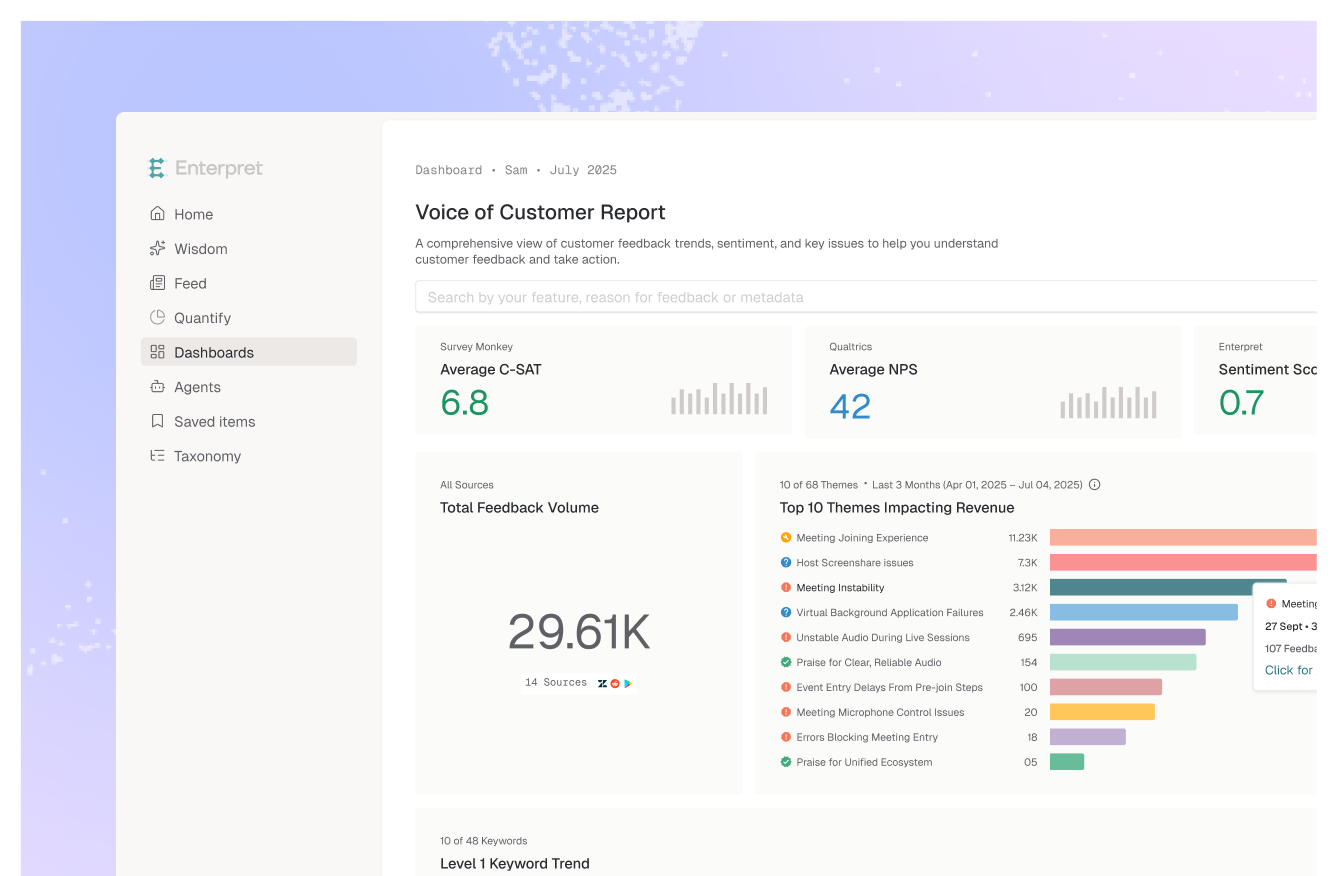
The six companies running the best voice of customer programs today in 2026 are Figma, Canva, Notion, Apollo.io, Descript, and The Browser Company. What connects them is a pattern, not a headcount: each unifies dozens of feedback sources into one source of truth, lets a taxonomy learn from the data instead of maintaining tags by hand, and ties what customers say to the revenue and segments behind it. All six run their programs on Enterpret, which is why the patterns below rhyme.
You can score any program against five criteria. The first is table stakes. The middle three are where most programs quietly break. The last is what turns insight into change.
The real differentiator is cadence and structure: whether an insight arrives while a team can still act on it, not a quarter later.
Figma built its voice of customer function from scratch when FigJam launched, and it reads like a blueprint. The research ops and insights team organized the program around a simple loop of listen, understand, act, and respond, then made a deliberate choice to run it as shared infrastructure instead of a gatekept research desk. The payoff shows up in how deep the program sits: roughly half of Figma's company-wide objectives reference voice of customer insights, and the program is now part of onboarding for new PMs and designers. Figma runs it on Enterpret, using an adaptive taxonomy that retroactively labels past feedback when the team adds a new topic to its release checklist, and connecting feedback to revenue data to inform pricing and packaging decisions through the customer context graph.
Best for: product-led teams that want voice of customer woven into planning and onboarding, not run as a side function.
Canva operates one of the largest voice of customer programs in software, spanning more than 220 million users and feedback in over 100 languages. The mission the User Voice team organizes around is closing the loop with every customer, and the program is genuinely company-wide: more than 200 people across product, design, and engineering run their own queries, logging over 20,000 searches in a single six-month stretch. Scale is the point. When Canva fielded a free-form question in its 10th anniversary survey, the team analyzed hundreds of thousands of responses in hours rather than the multi-month project it would have been by hand. What makes it work is a taxonomy specific enough to surface the long tail, so the program flags "add page numbers to Docs" rather than a vague "Docs requests" bucket.
Best for: global consumer products managing enormous, multi-language, multi-channel feedback.
Notion's program is the clearest case study in what happens when manual tagging stops scaling. The product operations and user insights team, which represents the voice of the customer internally, was choosing from more than 700 hand-applied tags across tens of thousands of monthly tickets, and consistency was breaking down. Moving to a taxonomy that learns categories from the data cut the monthly user insights report from two weeks to three days and gave the team enough confidence in the signal to justify dedicating an engineering team to fixing login problems. It is the textbook argument for an adaptive taxonomy over a tag library you maintain forever.
Best for: teams drowning in manual tagging that need a taxonomy to run itself.
Apollo.io's program is built on a conviction from its chief product officer that voice of customer should be "a science, not an art." The team runs a framework it calls Root Cause Elimination: combine every feedback source, surface themes automatically, prioritize them by the ARR behind them, then fix and measure. Prioritizing by revenue is the whole game, because it points engineering at the 20 percent of issues driving 80 percent of the contacts. Since launching the program, Apollo cut its human inquiry rate by more than 40 percent and grew revenue 9x over two years. This is the customer context graph doing its job: feedback is never a flat feed, it is tied to the revenue that tells you what to fix first.
Best for: product-led growth teams that want feedback ranked by revenue impact.
Descript's program is designed to bridge the qualitative and the quantitative. The user research and support teams unified more than 15 sources and cut research synthesis time by 83 percent, taking a task that used to eat an entire day down to roughly half an hour. The distinctive move is triangulation: the team segments support tickets against Amplitude cohorts, so an engineer can trace a performance complaint to a specific browser and version and ship a fix. Anomaly reports do the early-warning work, and in one case a spike flagged during an A/B test gave the product team the evidence to end the test and ship the feature.
Best for: research-led teams that need to connect qualitative feedback to product analytics.
The team behind Arc treats closing the loop as a core value, and its program is tuned for it. Weekly Member Pulse Reports keep every team close to what users are saying, and support-surfaced requests move to engineering fast, as happened when a common ask for a password reset feature got built quickly off the report. The program's strength is catching what no one thought to look for: anomaly detection surfaced a wave of members wanting to change their emails after graduation season, a trend the team would never have queried on its own.
Best for: community-driven products that want feedback to reach engineering directly and early.
Read The Browser Company story
The through-line across all six is a shift in what a voice of customer program even is. The old model treats it as a survey program: collect feedback, tag it by hand, report on it every quarter, and hope the insight still matters by the time it lands. The programs above treat it as customer intelligence infrastructure instead: every signal unified, a taxonomy that learns, feedback tied to revenue and context, and detection that runs in real time.
That shift is why the same capabilities keep showing up. It is not a coincidence that the teams with the deepest voice of customer programs also stopped hand-tagging, stopped treating feedback as anonymous, and stopped waiting for the quarterly readout. Apollo's team put it plainly in its own breakdown of running voice of customer at a PLG company: tie the program to a specific business outcome, or do not build it. The common thread is not a feature. It is treating feedback as a shared system the whole company reads from.
You do not need to copy any single company. You need the pattern they share, in order.
All six programs run this pattern on Enterpret, which is what lets a small team operate a program at this scale. The decision rule is simple: weight cadence and context over collection. A program that surfaces the right insight a quarter late is not a program, it is an archive.
A voice of customer program is the system a company uses to collect customer feedback across channels, make sense of it, and act on it. A real program goes beyond running surveys. It unifies feedback from support, sales, reviews, and community, structures it so teams can find patterns, and routes insight to the people who make product and experience decisions.
The best programs share five traits: broad source coverage, a taxonomy that learns from the data instead of relying on manual tags, feedback tied to revenue and segment context, self-serve access across the organization, and real-time detection that closes the loop with customers. The differentiator is cadence, meaning whether insight arrives while teams can still act on it.
Figma, Canva, Notion, Apollo.io, Descript, and The Browser Company are strong public examples. Each treats voice of customer as company-wide infrastructure rather than a survey exercise, and each has documented specific outcomes, from Notion cutting its insights report from two weeks to three days to Apollo.io reducing its human inquiry rate by more than 40 percent.
The programs profiled here run on Enterpret, a customer intelligence platform that unifies feedback from more than 50 sources, categorizes it automatically, and connects it to revenue and account context. Survey-first tools like Qualtrics and Medallia are common in more traditional programs, but they center on collection rather than continuous, AI-native analysis across every channel.
Enterpret gives each program two things a survey tool cannot. Its adaptive taxonomy learns a company's own categories from the feedback and relabels historical data automatically, so teams like Notion and Figma stop maintaining tags by hand. Its customer context graph ties every piece of feedback to the account, segment, and revenue behind it, so teams like Apollo.io can rank what to fix by business impact instead of raw volume.
If you are building or scaling a program like these, see how Enterpret's voice of customer platform works.
Lorem ipsum dolor sit amet, consectetur adipiscing elit. Suspendisse varius enim in eros elementum tristique. Duis cursus, mi quis viverra ornare, eros dolor interdum nulla, ut commodo diam libero vitae erat. Aenean faucibus nibh et justo cursus id rutrum lorem imperdiet. Nunc ut sem vitae risus tristique posuere.