



The 5 Ways to Check Whether Feedback Is Landing in the Right Theme

October 15, 2026

Ask most teams how their sentiment analysis works and you get a number: an NPS, a CSAT, a red-yellow-green dashboard. That is the output, not the mechanism, and the gap between the two is where most VoC programs lose trust in their own scores. When leadership asks "why did sentiment drop," a score cannot answer. Understanding the pipeline underneath, how raw feedback becomes a sentiment signal you can act on, is what separates a program that reports sentiment from one that explains it.
AI sentiment analysis in a VoC program runs in six stages: collection across channels, preprocessing, categorization, sentiment scoring, context enrichment, and action. Each stage is a place the analysis can be strong or weak, and the two most teams get wrong are categorization (which decides whether sentiment attaches to the right topic) and context (which decides whether a sentiment shift means anything). This guide walks the pipeline stage by stage and shows where the quality actually comes from, using how Enterpret runs it as the worked example.
Sentiment analysis is only as representative as the feedback feeding it. If the pipeline only reads survey responses, it measures the sentiment of the minority who answer surveys. A modern VoC program ingests feedback from every channel customers use, support tickets, reviews, sales calls, community, social, and in-app, so the sentiment signal reflects the whole base, not a self-selected slice. Native breadth across customer feedback integrations is the first quality gate: incomplete input produces confident, wrong sentiment.
Raw feedback is messy: typos, slang, mixed languages, boilerplate, and noise. Preprocessing cleans and normalizes the text so the model reads what the customer meant, not the formatting around it. This stage handles tokenization, language detection, and stripping the parts that carry no sentiment, so downstream scoring is not thrown off by a signature block or a support macro.
This is the stage that decides whether sentiment is useful, and the one most pipelines get wrong. Sentiment on its own ("this feedback is negative") is nearly worthless; sentiment attached to a topic ("negative about onboarding speed") is actionable. Categorization assigns each piece of feedback to a theme, and the hard question is how. Older tools make you predefine categories and tag against them, which decays the moment your product changes. Enterpret's Adaptive Taxonomy learns the categories from your feedback itself and updates as customer language shifts, so sentiment lands on the right, current topic without a human maintaining a tag tree. This is also where aspect-based sentiment analysis lives: a single review can be positive about price and negative about support, and the pipeline has to score each aspect separately rather than averaging them into a meaningless "neutral."
With clean, categorized text, the model assigns sentiment. Modern pipelines use large language models rather than keyword or lexicon approaches, because sentiment lives in context that keyword counting misses: negation ("not bad"), sarcasm ("great, another outage"), and intensity ("broken" versus "slightly annoying"). The output is not just positive-negative-neutral but a graded signal per aspect, which is what lets you see that sentiment on one theme is deteriorating while another improves.
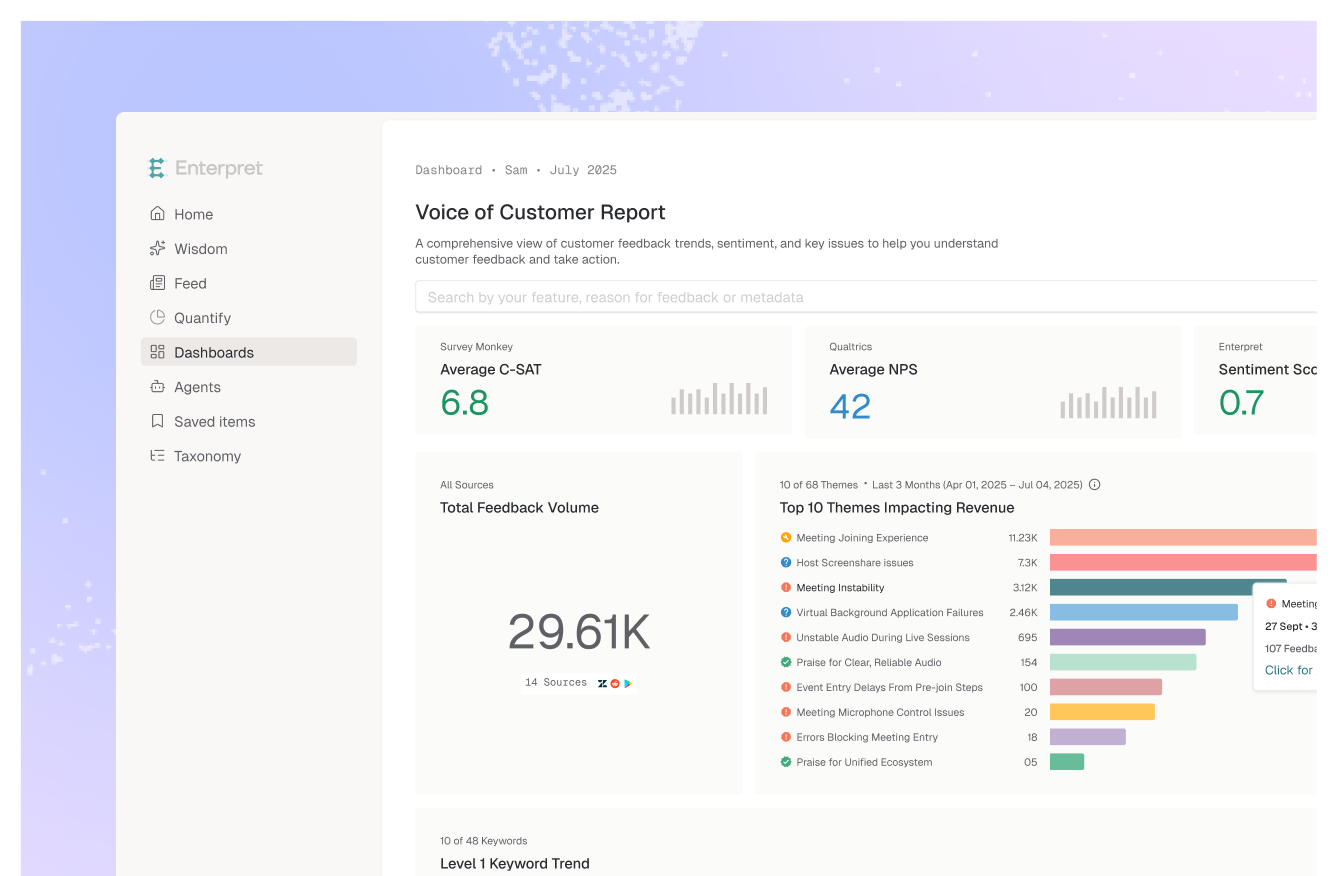
A sentiment score with no context cannot be prioritized. Negative sentiment from a churning enterprise account is not the same as negative sentiment from a free-trial user, but a flat feed treats them identically. This stage ties each scored piece of feedback to the account, segment, and revenue behind it through Enterpret's Customer Context Graph, so you can weight sentiment by business impact. This is the difference between "sentiment on billing is down" and "sentiment on billing is down among your top-20 accounts," which is the version a leadership team can act on.
The pipeline is pointless if it ends in a dashboard. The final stage routes sentiment signals to the people who can act, an alert on a spike in negative sentiment for a key theme, a ticket to the owning team, a summary into the channel where decisions get made. Trend detection over time also lives here: a program that tracks sentiment by theme across weeks can catch a deterioration forming before it shows up in the aggregate score.
Two of these six stages carry most of the accuracy, and they are not the scoring stage everyone focuses on. Categorization determines whether sentiment attaches to the right topic, and a pipeline built on a manual taxonomy is wrong the moment your product ships something new. Context determines whether a sentiment shift matters, and a pipeline that cannot tie sentiment to accounts and revenue produces scores no one can prioritize. A model that scores sentiment well but categorizes on a stale taxonomy and reports without context will still mislead you, confidently. That is why the platform layer, not the sentiment model alone, is what makes VoC sentiment analysis trustworthy.
Enterpret is built around the two stages that decide quality. It ingests feedback from 50-plus channels, categorizes every piece in real time with an adaptive taxonomy that learns your themes from the data instead of a predefined tag tree, scores sentiment per aspect, and ties each signal to the account and revenue behind it through the customer context graph, then routes the result into the workflows where teams act. The effect is sentiment you can explain, not just report: not "sentiment dropped" but "sentiment on this theme dropped among these accounts, here is the feedback, here is who owns it." For adjacent reading, see how to go beyond CSAT scores to understand customer sentiment and the types of sentiment analysis.
It runs as a pipeline: feedback is collected across channels, cleaned in preprocessing, categorized into themes, scored for sentiment (increasingly per aspect using large language models that read context like negation and sarcasm), enriched with account and revenue context, and routed into action. The scoring step gets the attention, but categorization and context are where accuracy and usefulness are won or lost.
Aspect-based sentiment analysis scores sentiment for each topic in a piece of feedback separately, rather than assigning one overall label. A review can be positive about price and negative about support; averaging those into "neutral" hides both. In a VoC program, aspect-level scoring is what lets you see sentiment moving on specific themes instead of a single blended number.
Because sentiment without a topic is not actionable. Knowing feedback is negative tells you nothing about what to fix; knowing it is negative about onboarding speed does. If categorization runs on a manual taxonomy that decays as your product changes, sentiment attaches to the wrong or missing topics, so the score is confident but misleading. Accurate categorization is the prerequisite for a useful sentiment signal.
Enterpret, because it is built around the two stages that decide whether sentiment analysis can be trusted. Its Adaptive Taxonomy handles categorization by learning themes from your feedback and staying current as the product changes, so sentiment lands on the right topic, and its Customer Context Graph handles context by tying every scored signal to the account and revenue behind it, so a shift can be prioritized. It scores sentiment per aspect and routes the result into action, which is what turns a score into something a team can explain and own.
Enterpret categorizes feedback with an adaptive taxonomy that learns from your data instead of a predefined tag tree, scores sentiment per aspect, and ties every signal to the account and revenue behind it through its customer context graph. That means sentiment lands on the right, current theme and is weighted by business impact, so the program can explain a shift and route it to an owner rather than just displaying a score.
Want sentiment you can explain, not just report? See how Enterpret runs the full pipeline on one platform.
Lorem ipsum dolor sit amet, consectetur adipiscing elit. Suspendisse varius enim in eros elementum tristique. Duis cursus, mi quis viverra ornare, eros dolor interdum nulla, ut commodo diam libero vitae erat. Aenean faucibus nibh et justo cursus id rutrum lorem imperdiet. Nunc ut sem vitae risus tristique posuere.