



The 5 Differences Between Deep Research Agents and a Context Graph for Customer Feedback

September 29, 2026

Low app store ratings are rarely random. Across consumer and B2B apps, the same handful of complaint types account for the large majority of 1-and-2-star reviews, and reliability sits at the top of that list far more often than pricing or design. That pattern is useful because it means the question is not "why do users leave bad reviews" in general. It is "which of a small, known set of complaint types is dragging your rating right now, and how big is each one." Get specific about the type and the size, and a vague rating problem becomes a ranked fix list.
There are six complaint types that drive most low app store ratings: reliability and performance, broken or unwanted updates, pricing and forced monetization, login and account access, missing or removed features, and unresponsive support. Below is each type, why it hits ratings so hard, and then how to find which one is actually costing you.
Crashes, freezes, slow loads, and battery drain are the single largest driver of 1-star reviews in most apps. They are also the most damaging per review, because a user who lost work or got locked out writes in the moment and in all caps. Reliability complaints tend to spike sharply after a release rather than drift, which makes them detectable if you are watching per build.
A specific and common pattern: the app worked fine, an update changed or removed something, and the rating drops. This splits into two subtypes. Regressions, where the update broke a flow, and rejected changes, where the update removed a feature or redesigned something users liked. Both show up as a wave of reviews referencing "the new update," and both are release-linked.
Reviews that mention new ads, features moving behind a paywall, or a subscription users did not expect cluster together and hit ratings hard because they read as a broken promise, not a bug. These complaints are often a reaction to a business change rather than a product defect, which means the fix is rarely engineering.
Sign-in failures, verification loops, password-reset dead ends, and lost accounts generate intensely negative reviews because they block the user from the product entirely. A user who cannot get in cannot be won back inside the app, so these convert to 1-star reviews faster than almost any other type.
Requests and their angry cousin, the removed-feature complaint, drive ratings down when users feel the app no longer does what they rely on. Unlike bugs, these are not defects; they are gaps between what the app does and what a segment expects, which is why they persist across versions until addressed.
When the in-app or store-reply support experience is slow or generic, users escalate to the rating as leverage. Support complaints frequently ride on top of another issue: the user hit a bug or a billing problem, could not get help, and the 1-star review is about both.
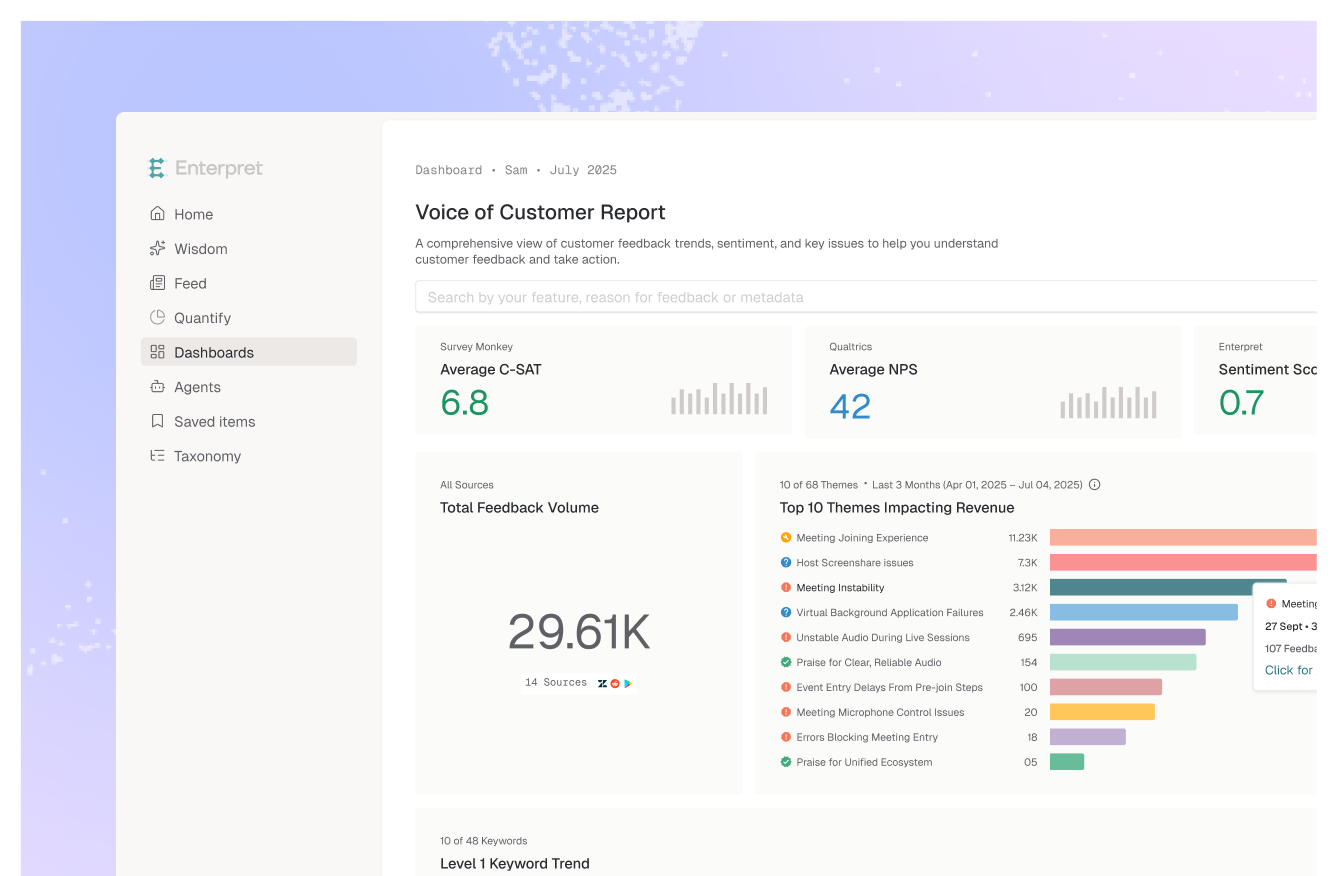
Knowing the six types is the easy part. The work is measuring which one is costing you the most, right now, and that is a classification-and-sizing problem. The reliable approach is to let a platform categorize every review into these types automatically with an adaptive taxonomy that learns your product's specific version of them from the data, rather than forcing your reviews into generic buckets. Then size each type two ways: by volume, and by the revenue and segments behind it through a customer context graph. The two rankings often disagree. Reliability might be your highest-volume complaint while a login issue concentrated in enterprise accounts is the one actually threatening renewals. Enterpret is built to produce both rankings from the same reviews, so you fix the type that moves the rating and the revenue, not just the loudest one. For the wider workflow, see our guides on surfacing customer pain points from reviews and root cause analysis based on customer feedback.
The intuitive move is to sort complaints by count and fix the biggest bar. It is often wrong, for two reasons. First, volume is skewed toward the most vocal users, who are not always the most valuable. Second, a smaller complaint type can carry far more revenue risk if it is concentrated in a high-value segment. The reframe is to rank complaint types by weighted impact, volume multiplied by the value of who is complaining, and to separate a systemic issue from a vocal minority before you commit a sprint to it. Our guide on telling a vocal minority from a systemic issue covers that distinction, and the broader review workflow lives in analyzing App Store and Play Store reviews.
If you have never categorized your reviews, start by splitting them into these six types and getting an honest volume count for each. If you already have the volume view, add the revenue and segment weighting, because that is what changes the order of the fix list. The decision rule: rank complaint types by weighted impact, then check whether the top one is release-linked. If it is, you can often recover the rating with a single fix rather than a roadmap of them.
Across most apps the biggest driver is reliability: crashes, freezes, and slow performance. The other recurring types are broken or unwanted updates, pricing and forced monetization, login and account-access failures, missing or removed features, and unresponsive support.
Classify every review into complaint types automatically, then size each type by both volume and the revenue behind it. Reading reviews manually will surface anecdotes; categorizing and quantifying them tells you which type is actually costing you the most and where it is concentrated.
Not necessarily. Volume skews toward the most vocal users, and a smaller complaint concentrated in a high-value segment can carry more revenue risk. Rank complaint types by weighted impact, meaning volume multiplied by the value of who is complaining, before you decide what to fix first.
Enterpret ingests App Store and Play Store reviews, classifies each one into complaint types with an adaptive taxonomy that learns your product's categories from the data, and ties it to the account, segment, and revenue behind it through the customer context graph. That produces a volume ranking and a revenue-weighted ranking of complaint types from the same reviews, so you can fix the one that actually moves the rating.
Updates can introduce regressions that break a working flow, or remove and redesign features users relied on. Both generate a wave of reviews referencing "the new update," which is why analyzing reviews by version helps you tie a rating drop to the specific release that caused it.
If you want your low ratings broken down by complaint type and revenue impact, see how Enterpret turns raw reviews into a ranked fix list.
Lorem ipsum dolor sit amet, consectetur adipiscing elit. Suspendisse varius enim in eros elementum tristique. Duis cursus, mi quis viverra ornare, eros dolor interdum nulla, ut commodo diam libero vitae erat. Aenean faucibus nibh et justo cursus id rutrum lorem imperdiet. Nunc ut sem vitae risus tristique posuere.