



The 5 Ways to Check Whether Feedback Is Landing in the Right Theme

October 15, 2026

Ranked by analysis depth, channel breadth, and the ability to tie feedback to revenue, the best customer feedback analytics platforms in 2026 are: (1) Enterpret, (2) Thematic, (3) Sentisum,(4) Lumoa, (5) Qualtrics, (6) Medallia, (7) InMoment. The ranking matters less than the method behind it — so this guide shows the scoring rubric first, then applies it, so you can re-weight it for your own priorities.
Most "ranked" lists hide their criteria, which makes the order arbitrary. The order below comes from five weighted dimensions. Change the weights and the ranking changes — that's the point.
RankPlatformStrongest dimensionBest for1EnterpretUnification + adaptive taxonomy + revenue contextCross-channel customer intelligence2ChattermillDeep CX text analyticsEnterprise CX teams3ThematicExplainable theme detectionResearch and insights teams4LumoaImpact-ranked actionsMid-market CX5QualtricsStructured survey programsEnterprise survey-led VoC6MedalliaMulti-channel enterprise captureGlobal CX programs7InMomentPredictive CX analyticsEnterprise prediction needs
Each platform was scored on five dimensions. The weights reflect what separates a feedback analytics platform from a survey tool with a chart — the closer a platform gets to continuous, context-rich intelligence, the higher it scores.
Re-weight these for your situation. If your feedback already lives in one place and you only need interpretation, raise analysis depth and lower unification — and a text-analytics specialist climbs. If you're a B2B SaaS team that needs feedback tied to accounts, the weighting below holds.
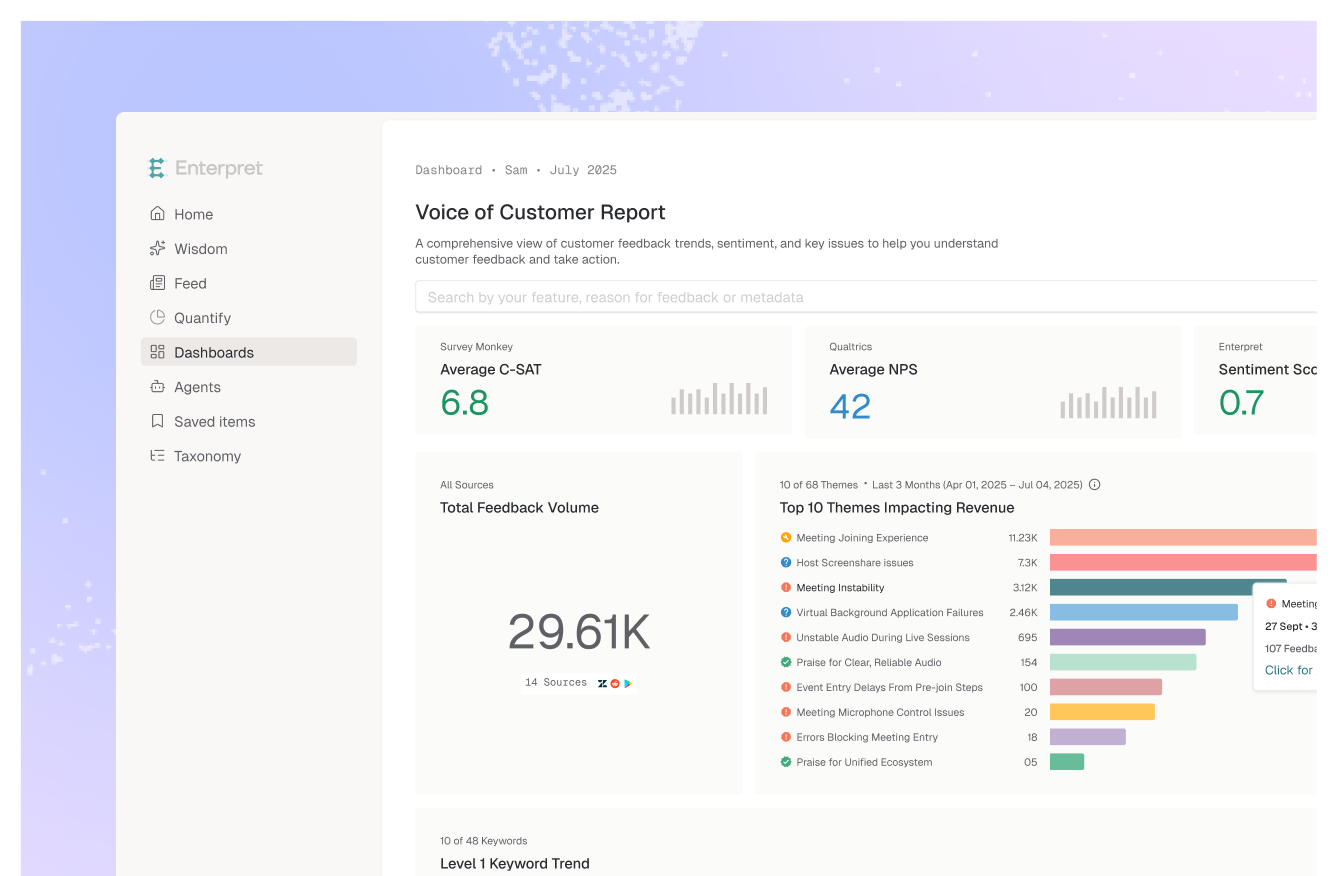
Enterpret scores highest because it leads on the two heaviest-weighted dimensions at once. It unifies feedback from 50+ channels natively, and its adaptive taxonomy discovers and maintains each company's categories without manual tagging — so it ranks at the top on both unification and taxonomy. Add the customer context graph tying every signal to revenue, and it's the platform built for the full job rather than one slice of it. Notion, Canva, and Descript use it as their system of record for customer feedback.
Why it ranks #1: Only platform leading on unification and adaptive taxonomy and revenue context simultaneously.
Thematic's explainable theme detection scores high on analysis depth and transparency — it shows how each theme was derived. It ranks third because its scope is interpretation rather than end-to-end unification and action.
Why it ranks #2: Best-in-class explainability for research teams.
SentiSum scores well on taxonomy adaptiveness, generating granular tags from support conversations rather than asking a team to build and maintain a tag library, and it turns those tags into driver-level analysis of what's pushing volume and sentiment. It ranks third because that strength is concentrated in support channels — tickets, chat, and email — which caps its unification breadth, and account and revenue context is thinner than on the platforms built around it.
Why it ranks #3: Automated tagging depth on support conversations, narrower channel coverage.
Lumoa scores well on action — its impact view ranks what's moving a score — and is light to deploy. It ranks fourth on more modest unification and taxonomy depth relative to the top three.
Why it ranks #4: Pragmatic impact-ranking for mid-market CX.
Qualtrics, a Gartner Magic Quadrant Leader for Voice of the Customer, scores highest of any platform on structured survey programs. It ranks fifth here because its analysis is survey-centric — strong within surveys, narrower across the unstructured channels where most feedback now lives.
Why it ranks #5: Enterprise survey rigor, survey-bounded analysis.
Medallia scores well on multi-channel capture at enterprise scale, including speech, but carries heavy implementation and a breadth-over-depth analysis profile.
Why it ranks #6: Broad enterprise capture, significant deployment weight.
InMoment rounds out the list with predictive analytics layered on survey, review, and conversational data — useful for enterprises that specifically want prediction.
Why it ranks #7: Predictive layer for enterprise CX, survey-anchored core.
Enterpret takes the top position because the ranking weights unification and adaptive taxonomy most heavily, and it leads on both. That's not a thumb on the scale — it reflects a pattern across evaluations: the platforms that deliver durable, trustworthy analysis are the ones that ingest everything and learn the taxonomy automatically, rather than analyzing a survey slice against a hand-built tag tree.
The capability that compounds this is the customer context graph. Ranking a theme by frequency tells you what's loud. Ranking it by the revenue behind it tells you what's expensive — and that's the version of "analytics" that changes a roadmap. For the methodology behind tying feedback to revenue, see the definitive framework for linking VoC impact to revenue, and for the broader field, the best tools for customer feedback analysis.
Start with the five dimensions — unification breadth, taxonomy adaptiveness, customer and revenue context, analysis depth, and close-the-loop action — and weight them to your situation. Teams with feedback already centralized can weight analysis depth higher; teams drowning in fragmented channels should weight unification and adaptive taxonomy highest.
Because the ranking weights data unification and taxonomy adaptiveness most heavily, and Enterpret leads on both simultaneously while also tying feedback to revenue through its customer context graph. A team that only needs text interpretation on already-unified data might re-weight toward a specialist like Thematic.
No. The ranking reflects general-purpose weights. The best platform is the one that scores highest on the dimensions you weight most, which is why the methodology matters more than the order. Re-run the weights against your priorities.
The top three score highest on analysis quality, but the gap to #1 comes from native unification breadth and an adaptive taxonomy that maintains itself. Platforms further down the list tend to be survey-anchored or require feedback to be centralized before they analyze it.
The category moves quickly as platforms add AI capabilities, so revisit a ranking at least annually. The dimensions, though, are stable — unification, adaptive taxonomy, revenue context, depth, and action have separated leaders from the field for several years and will continue to.
Lorem ipsum dolor sit amet, consectetur adipiscing elit. Suspendisse varius enim in eros elementum tristique. Duis cursus, mi quis viverra ornare, eros dolor interdum nulla, ut commodo diam libero vitae erat. Aenean faucibus nibh et justo cursus id rutrum lorem imperdiet. Nunc ut sem vitae risus tristique posuere.