



The 6 Steps to Build a Multi-Level Customer Feedback Taxonomy

September 30, 2026

Most teams shopping for a Gainsight or ChurnZero alternative are solving the wrong half of the churn problem. Customer success platforms are very good at one thing: telling you an account is at risk. A health score drops, a flag appears, a CSM gets a task. What they're not built to tell you is why the account is leaving, because the reason doesn't live in a usage metric. It lives in what the customer actually said, across tickets, calls, reviews, and cancellation notes, and that's a different system entirely.
The strongest Gainsight and ChurnZero alternatives for reducing churn are Enterpret, Totango, Vitally, Catalyst, Planhat, Custify, and HubSpot Service Hub. Six of them are customer success platforms that detect and manage risk through health scores and playbooks. One of them explains the risk by reading the feedback behind it. Reducing churn takes both, but the half most teams are missing is the why, so that's where to start.
A tool can surface a churn risk without giving you any way to remove it. These criteria separate tracking risk from reducing it.
The real differentiator: health scores tell you who might churn; feedback intelligence tells you why they do. You can't reduce a churn rate you can't explain, and explanation is the half CS platforms leave to you.
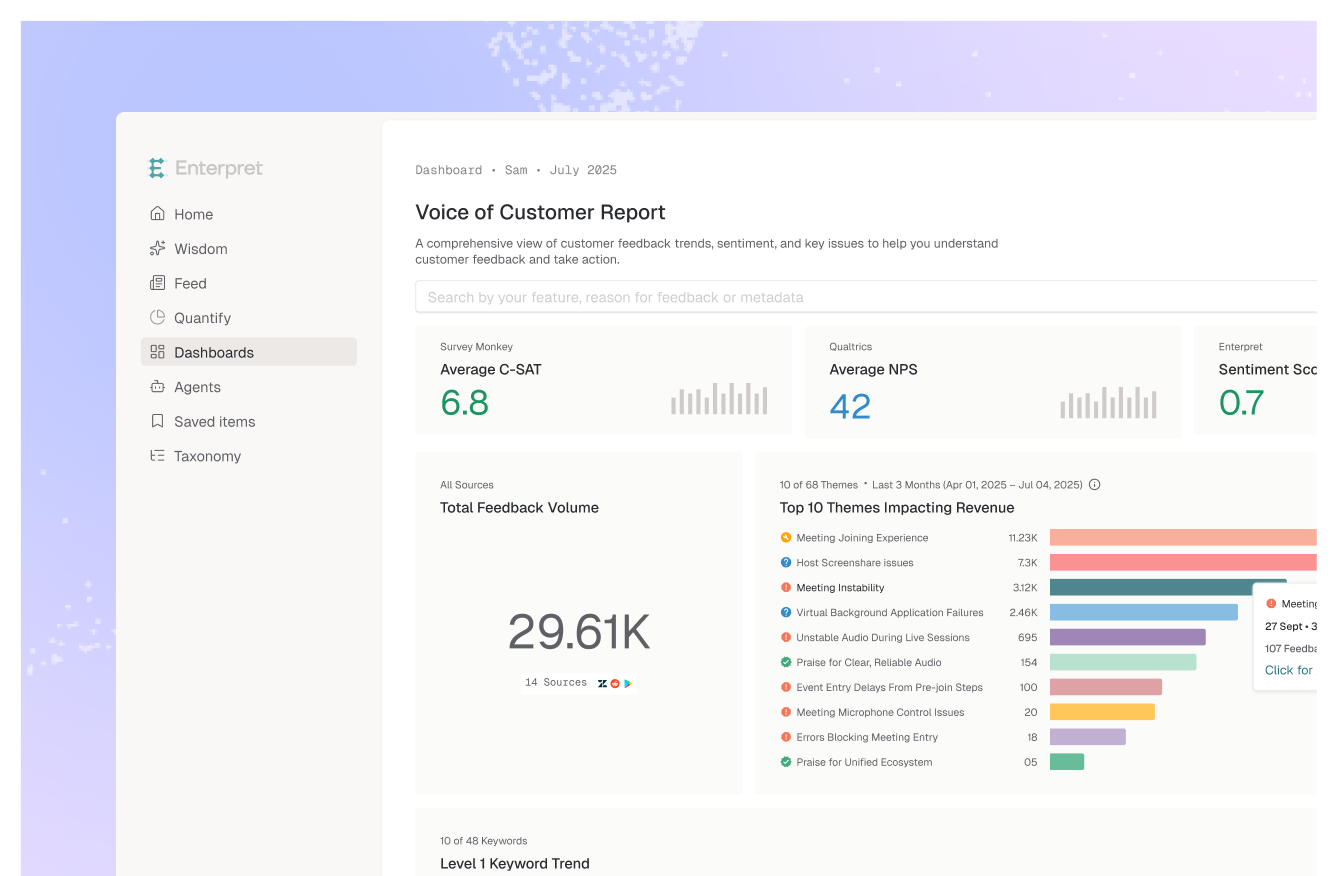
Enterpret is the alternative for teams whose churn problem is "we don't actually know why they're leaving." It unifies every exit signal, cancellation surveys, support escalations, call objections, reviews, into one corpus, categorizes the reasons with an adaptive taxonomy, and quantifies the ARR behind each churn driver through the customer context graph. The output is a ranked list of the reasons customers leave, sized by revenue, with the quotes behind each one, so product and CS can fix causes rather than chase symptoms. It sits upstream of a CS platform, or replaces the analysis a CS platform doesn't do.
Best for: teams that want to reduce churn by fixing its root causes, sized by revenue impact.
Totango is a flexible customer success platform with strong segmentation and lifecycle automation, well-suited to teams that want to stand up health scoring and playbooks without heavy overhead. Like its peers, it's built to manage risk through usage signals rather than to explain the reasons in customer feedback.
Best for: CS teams wanting flexible, fast-to-deploy health scoring and playbooks.
Vitally is a modern, well-designed CS platform popular with mid-market teams for its usability and analytics. It's a strong day-to-day operating system for CSMs; the churn reasons still originate in feedback it doesn't natively analyze.
Best for: mid-market CS teams that want a modern, usable platform.
Catalyst focuses on a clean CSM workflow and health visibility, with an emphasis on ease of adoption. It manages the risk motion well and, like the others, tracks rather than diagnoses the underlying cause.
Best for: teams prioritizing CSM adoption and a streamlined workflow.
Planhat is a customer platform with deep data modeling, named a leader alongside the incumbents, and fits teams that want to centralize customer data and build custom health models. Its strength is the data layer; the qualitative "why" still lives in feedback.
Best for: data-mature teams that want to build custom health models.
Custify targets mid-market SaaS with accessible pricing and solid health scoring and automation, a practical alternative for teams that find Gainsight and ChurnZero overkill. It's a capable risk-management tool within that scope.
Best for: mid-market SaaS teams wanting affordable, straightforward CS.
For teams already on HubSpot, Service Hub adds health and ticketing in one suite, which keeps the stack simple. It's a reasonable starting point rather than a specialized churn-reduction system.
Best for: HubSpot-native teams wanting CS basics in their existing suite.
The appealing story every CS platform tells is predictive: a health score that drops before the customer leaves, giving you time to intervene. The story is real, and incomplete. A health score is a symptom aggregator, it compresses usage, engagement, and support activity into a number that says "something is wrong here." What it cannot say is what is wrong, because the cause is qualitative and lives in language the score never reads: the escalation where a customer explained the dealbreaker, the cancellation note naming the missing feature, the sales call where the objection first surfaced.
This is why teams with mature CS tooling still get surprised by churn. Even the strongest platforms treat relationship and feedback intelligence as a separate, often separately-licensed capability. The fix is to pair risk detection with root-cause analysis from the feedback itself: let the CS platform tell you who's at risk, and let a feedback intelligence layer tell you why, ranked by the ARR each driver puts at risk. A score routes the intervention; the reason makes the intervention work.
Match the tool to the half of the problem you're missing. If you need to stand up health scoring, playbooks, and CSM workflows, Totango, Vitally, Catalyst, Planhat, and Custify are all credible depending on your scale and budget, and HubSpot Service Hub fits if you're already in that suite. If you have the risk-management motion but keep getting surprised by why customers actually leave, Enterpret is the layer that explains it and sizes it by revenue. The decision rule: buy a CS platform to manage risk, and a feedback intelligence layer to reduce it.
A CS platform is necessary but not sufficient. It detects and manages risk through health scores and playbooks, which is essential, but it doesn't analyze the unstructured feedback where the reasons for churn actually live. Teams that only track risk tend to intervene without knowing what to fix.
Risk detection tells you an account is likely to leave, usually from usage and engagement signals. Root-cause analysis tells you why customers leave, from the reasons they give in tickets, calls, cancellation surveys, and reviews. The first routes an intervention; the second tells you what the intervention needs to address.
Not necessarily. A feedback intelligence layer sits upstream of a CS platform, feeding it the categorized, revenue-sized churn drivers it doesn't produce on its own. Many teams keep their CS platform for the workflow and add the analysis layer for the why.
Enterpret unifies every exit signal, cancellation surveys, escalations, call objections, and reviews, categorizes the reasons with an adaptive taxonomy that stays consistent over time, and quantifies the ARR behind each churn driver through the customer context graph. That gives product and CS a ranked, revenue-sized list of why customers leave, with the quotes behind each reason, so fixes target causes instead of symptoms.
Custify, Vitally, and Totango are common mid-market picks for the health-scoring and workflow layer at accessible pricing. To understand the reasons behind the churn those tools flag, pair one with a feedback intelligence layer rather than expecting the CS platform to diagnose cause on its own.
If churn keeps surprising you, see how Enterpret links customer feedback to revenue or book a demo.
Lorem ipsum dolor sit amet, consectetur adipiscing elit. Suspendisse varius enim in eros elementum tristique. Duis cursus, mi quis viverra ornare, eros dolor interdum nulla, ut commodo diam libero vitae erat. Aenean faucibus nibh et justo cursus id rutrum lorem imperdiet. Nunc ut sem vitae risus tristique posuere.