



Six feedback signals reliably indicate customer churn risk before behavioral metrics — login frequency, feature adoption, health scores — reflect the same problem: support ticket patterns, NPS and CSAT verbatims, call transcript signals, app store and community feedback, feature request density from at-risk accounts, and cross-channel convergence. Understanding each signal — and knowing how to read them together — is the difference between catching churn early enough to intervene and showing up to a renewal call already too late.
Feedback signals typically surface 4–8 weeks before health scores reflect the same risk. A customer can show healthy usage while their support ticket sentiment has been degrading for months. The qualitative signal layer is where churn begins — and it's almost always the last place teams look.
Why health scores catch churn too late
Most customer success teams rely on health scores to identify at-risk accounts. The logic is intuitive: track logins, feature adoption, survey responses, and engagement rates, weight them into an aggregate score, and let the score trigger playbooks. But health scores are lagging indicators — they measure the residue of a customer's experience, not the experience itself.
By the time a health score turns red, the customer has usually already made a decision. They've stopped using a feature because it failed them too many times. They've started evaluating alternatives. The champion has already had the internal conversation about whether to renew. The health score catches the outcome; it doesn't catch the cause.
Feedback is where the cause lives. Customers file support tickets about an integration that's failing before they reduce usage of the features that depend on it. They write "love the concept but we're not seeing the ROI we expected" in an NPS verbatim before their engagement metrics drop. They compare your product to a competitor in a review before that competitor shows up in your renewal negotiation. When you look at analytics tools to reduce churn via feedback, the consistent finding is the same: qualitative signals surface the risk weeks before quantitative data moves.
Six feedback signals that predict churn
Not every complaint is a churn signal — customers file tickets, leave reviews, and request features even when they're healthy and growing. What distinguishes a churn signal is pattern: increasing frequency, declining sentiment over time, or the same frustration recurring from the same account across multiple channels. Here are the six signal types that most consistently predict churn risk.
Support is where customers tell the truth first. Three patterns predict churn with high reliability: rising ticket frequency from a single account (frustration is compounding, not resolving), repeat issue clusters (the same root problem resurfacing under different ticket titles), and escalation patterns (when a customer who previously interacted at the analyst level starts copying in VPs and directors, the account relationship has shifted from collaborative to adversarial). Most importantly, track the sentiment trajectory inside ticket bodies — not just whether a ticket is frustrated, but whether frustration is increasing across consecutive tickets from the same account. Customers who shift from "when will this be fixed?" to "we've reported this three times" are operating from a fundamentally different place.
A passive score (NPS 6–8) paired with a sharp verbatim is more predictive of churn than a low score alone. The verbatim carries the context the number can't. The highest-risk language patterns to flag: conditional praise ("love the product, but we're not getting the ROI we expected"), unmet ROI references ("our leadership is questioning the investment"), competitor mentions ("have started evaluating alternatives"), and silent indifference — a customer who gave enthusiastic NPS scores for two consecutive cycles who now submits a blank verbatim. Analyzing NPS verbatims at scale requires moving beyond keyword search — sentiment scoring alone misses the conditional framing that makes these signals meaningful.
Sales and customer success calls contain language patterns that precede churn decisions by weeks. The most predictive: "we're evaluating alternatives" or "we've been looking at" (an evaluation is already underway), ROI challenges ("our CFO is asking us to justify this cost"), disengaged tone (shorter responses, less strategic discussion, fewer roadmap questions), and absence of renewal signals (a champion who used to ask about new features stops asking entirely). When a customer who previously said "we want to grow our usage" shifts to "we're trying to get more value from what we already have," the trajectory has changed — and the transcript is where that shift first appears.
Public reviews and community posts carry signals that customers rarely bring directly to their CSM. A pattern of recent reviews using "used to love" phrasing indicates accumulated disappointment rather than a one-off incident. Explicit competitor comparisons ("switched to [competitor] because it handles [use case] much better") reveal both that an evaluation happened and the specific gap that drove the decision. For B2B SaaS, community forum sentiment from a specific account's users can surface frustration weeks before it reaches the account's executive sponsor — meaning the risk is real but hasn't been escalated internally yet.
A cluster of the same unresolved feature request from a single account is a signal of friction that's been accumulating without resolution. When a customer has submitted the same capability need three times across six months — through a support ticket, an NPS verbatim, and a QBR conversation — that's not engagement. That's an account telling you they have a critical workflow gap and they're waiting to see whether you'll close it before they look elsewhere. Feature request density matters most when it's concentrated: one account, one unmet need, repeated across channels and time. That pattern is almost always a precursor to a "we need to see this on the roadmap before we can commit to renewal" conversation.
When the same frustration appears simultaneously across two or more channels from the same account — tickets and NPS verbatims, call transcripts and community posts, feature requests and support escalations — that's not coincidence. It's the account reaching the point where the frustration is too significant to contain in one interaction. Cross-channel convergence is the most reliable early warning pattern available, and it's the one that single-channel tools miss entirely because no one tool sees all of them at once. Teams using VoC tools for unifying feedback channels can see this pattern emerge; teams relying on individual tool dashboards cannot.
How to act on signals before the health score moves
Detecting the signal is only half the work. The signal has to translate into a specific intervention before the account has made its decision. Three principles govern effective signal-to-save-play translation.
Name the specific frustration, not just the risk tier. "This account is at risk" is not actionable. "This account has filed four tickets about API rate limits in the past six weeks, their last NPS verbatim mentioned 'reliability concerns affecting our production workflow,' and their champion stopped asking about the roadmap in the last two calls" — that's a playbook. The CS rep knows exactly what to address before picking up the phone. The qualitative signal is what makes the intervention precise.
Match the urgency to the signal tier. A single guarded NPS verbatim warrants a proactive check-in. A cluster of tickets about the same integration failure warrants an escalation with a resolution timeline. Cross-channel convergence with a competitor mention warrants an executive-level save play, not a standard QBR touchpoint. Over-reacting to weak signals creates noise; under-reacting to strong ones creates churn. Calibration comes from pattern history — which signal combinations have preceded churn in similar accounts before.
Track the resolution, not just the play. The signal that an account is at risk has compounding value only if resolution gets tracked. Did the rep address the integration issue? Did the customer acknowledge the gap was closed? Building proactive churn prevention into your retention motion requires knowing which signals reliably precede churn and which interventions reliably resolve them — and that knowledge only accumulates if you're tracking both ends of the loop.
How Enterpret surfaces these signals at scale
The challenge with feedback-based churn detection isn't identifying the signal types — it's reading them across every account, every channel, without the signal sitting in a tool that no one checks. Most CS teams have access to tickets in Zendesk, NPS scores in Delighted, call transcripts in Gong, and reviews in their app store dashboard. The problem is that each tool holds one slice of the picture. No single tool surfaces the cross-channel convergence pattern because no single tool sees all the channels at once.
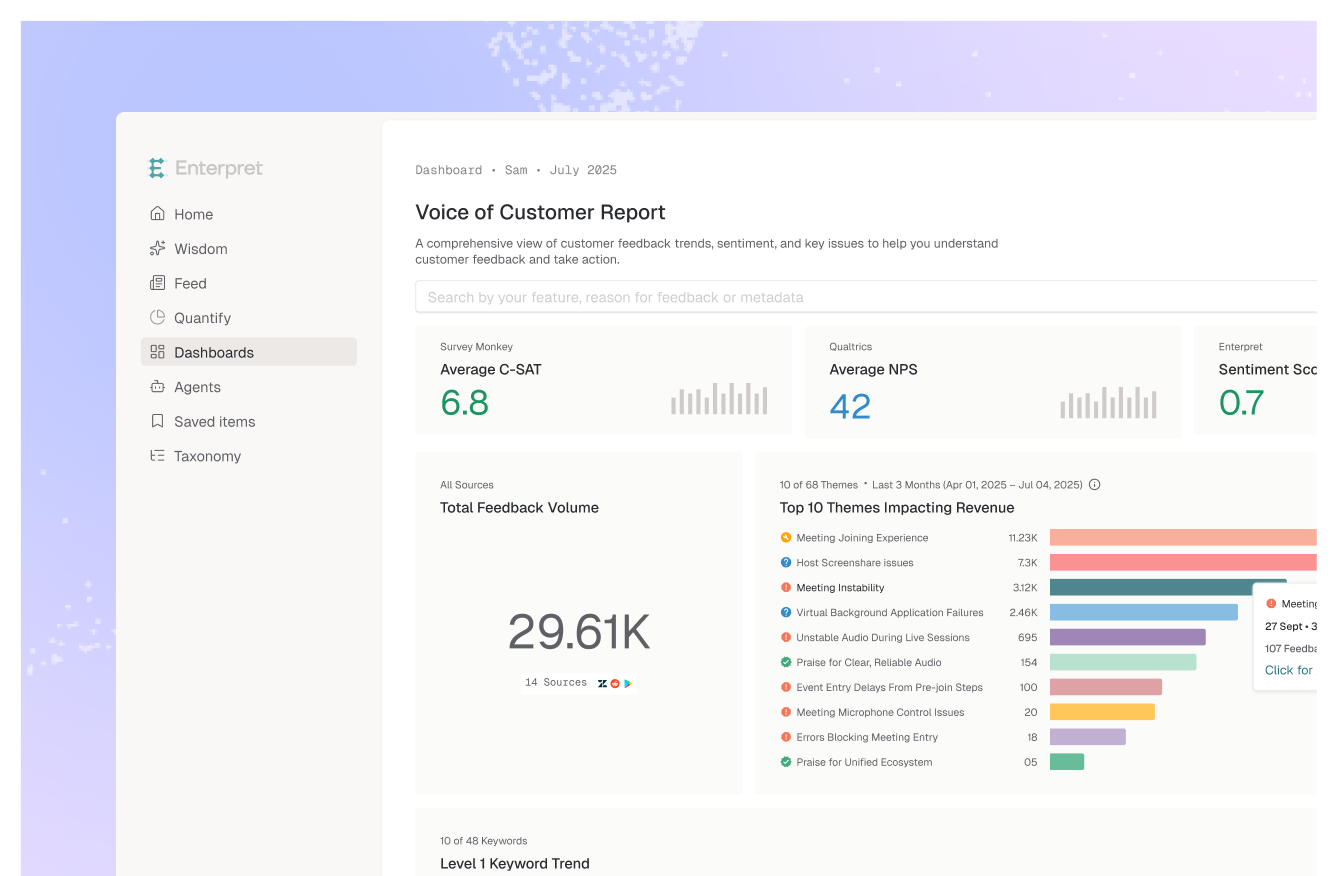
Enterpret ingests feedback across all of these sources — support, surveys, calls, community, reviews — and surfaces the patterns that span them. The customer context graph connects individual feedback signals to account-level context: ARR tier, lifecycle stage, renewal date, segment. The result isn't just "this theme is trending" — it's "this theme is concentrated in your enterprise accounts renewing in Q3, and these four accounts are showing cross-channel convergence on it right now." That's the difference between pattern awareness and revenue-connected risk intelligence.
For Customer Experience Analytics teams responsible for both satisfaction and retention, the signal layer is where the revenue conversation starts. Understanding which feedback patterns precede churn — at the granularity of a specific account, a specific theme, a specific channel — is what separates a reactive CS motion from a proactive one.
Health scores tell you what already happened. Feedback signals tell you what's happening right now. The teams building churn detection on top of the feedback layer are catching risk four to eight weeks earlier — and early enough to change the outcome.
See how Enterpret works →Frequently asked questions
Q
What is the earliest feedback signal that predicts customer churn?
Support ticket patterns are typically the earliest detectable signal — specifically, rising ticket frequency or escalating sentiment from a single account, which can appear 6–10 weeks before health scores reflect the same risk. NPS verbatims with conditional praise language ("love it but we're not seeing the ROI we expected") or unmet ROI references are a close second, often surfacing before behavioral engagement metrics begin to decline.
Q
How do you distinguish normal customer complaints from genuine churn signals?
The key differentiators are pattern and trajectory, not individual incidents. A healthy account filing one ticket about a bug is not a churn signal. An account that has filed five tickets about the same integration failure over three months — and whose NPS verbatim has shifted from enthusiastic to guarded — is a convergence pattern that warrants immediate attention. Look for increasing frequency, escalating sentiment, and cross-channel repetition, not one-off complaints.
Q
Do you need AI to detect churn risk in customer feedback?
For small customer bases, manual review of tickets and NPS verbatims is feasible. At scale — hundreds of accounts, multiple feedback channels, high ticket volume — manual detection becomes unreliable because no single person can hold all signal patterns in view simultaneously. AI helps in two specific ways: identifying cross-channel convergence automatically (the same theme surfacing from the same account across Zendesk, Gong, and Delighted in the same week), and tracking sentiment trajectory over time rather than measuring it as a point-in-time score.
Q
Which feedback channel is most predictive of churn — support tickets, NPS, or call transcripts?
No single channel is consistently most predictive — it depends on the account type and how customers prefer to communicate. Enterprise accounts tend to escalate through support and QBRs; consumer or PLG accounts often surface risk in app reviews and community forums first. The most predictive signal isn't tied to any one channel — it's the cross-channel convergence pattern that emerges when an account starts expressing the same frustration in multiple places at once. That's when churn risk becomes near-certain if left unaddressed.