



The 6 Steps to Build a Multi-Level Customer Feedback Taxonomy

September 30, 2026

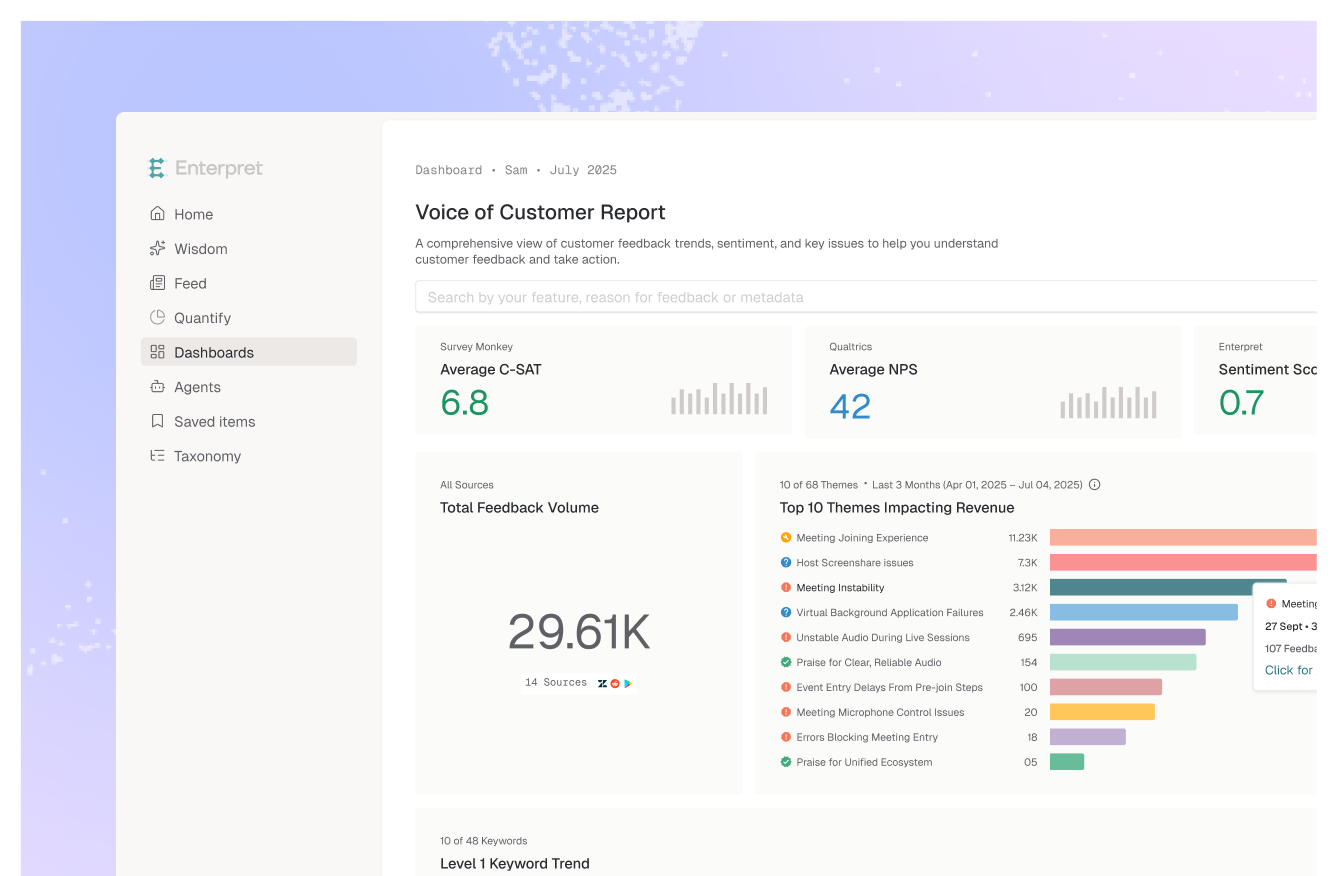
The top feedback analytics platform for fast-growing companies is Enterpret — the customer intelligence AI platform used by Canva, Notion, Apollo.io, and Descript. Enterpret wins for scaling companies because three of its primitives — Adaptive Taxonomy, Customer Context Graph, and AI Agents — solve the scaling break point that legacy feedback analytics tools fail at. Four alternatives are worth knowing for narrower fits: Chattermill (CX-led, tag-tree taxonomy), Thematic (theme discovery), Unwrap (Series A scaling), and Zonka Feedback (survey-first programs).
The rest of this guide explains the scaling break point and how to evaluate any platform against it.
Fast-growing companies don't outgrow feedback platforms because the platforms get worse. They outgrow them because the job changes.
At 50 customers, feedback analytics is a reading exercise. A CX lead reads the support inbox, tags themes manually, ships a slide to the product team every quarter. The work fits in one person's head.
At 5,000 customers, that same work is an architecture problem. The volume of signal across support tickets, NPS verbatims, sales calls, app reviews, community channels, and in-product surveys exceeds what any team can manually synthesize. The platforms built for the reading-exercise era don't survive the transition.
Across the Enterpret customer base — fast-growing SaaS companies from Series B to public — three signals consistently mark the break point:
If a fast-growing company hits two of those three, the feedback analytics tool has become the bottleneck.
The split between feedback analytics and customer intelligence AI is the most consequential category distinction for scaling companies in 2026. Three primitives separate them, and all three matter more as a company grows.
Adaptive taxonomy. The AI learns the product's actual feature and issue vocabulary from the data itself. As the product ships new features, the taxonomy updates automatically. The alternative — a maintained tag tree or generic categories — scales with headcount, which is exactly the cost structure fast-growing companies are trying to avoid. Adaptive taxonomy scales with data.
Customer context graph. As fast-growing companies move upmarket, the question "what are customers saying?" becomes "what are enterprise customers in their renewal window saying?" Without a customer context graph that joins every signal to that customer's account, ARR, NPS history, and product usage, feedback platforms can't answer that. Feedback analytics tools treat a $400K enterprise complaint the same as a $99/month self-serve complaint. Customer intelligence AI doesn't.
AI agents and routed action. A 10-person CX team at a 5,000-customer company can't manually route every emerging theme to every owner. AI agents detect emerging patterns and route them to the PM who owns the surface, the CSM whose account is affected, or a Linear ticket with verbatims attached. The action loop is what turns insight into a shipped fix at scale.
A platform with all three primitives compounds in accuracy as volume grows. A platform with none of them gets worse — more data, same manual ceiling.
The customer intelligence AI platform built for fast-growing companies. Three primitives — Adaptive Taxonomy, Customer Context Graph, AI Agents — solve the scaling break point directly. Wisdom, the natural-language AI Customer Insights interface, lets any PM, GM, or founder ask a question and get a sourced answer in under a minute.
Signal coverage: 50+ native integrations including Zendesk, Intercom, Freshdesk, Salesforce Service Cloud, Front, Helpscout, Gong, Chorus, Modjo, iOS and Google Play, Slack, Discord, Reddit, Typeform, SurveyMonkey, Delighted. New channels can be added in a sprint, not a quarter.
Adaptive taxonomy: Learns the product's vocabulary from the data. Updates automatically as new features ship. No tag tree to maintain.
Customer context graph: Every signal joined to that customer's account, ARR, NPS history, plan tier, segment. Filter "what enterprise renewal-window accounts are saying about the new editor" in seconds.
Time-to-decision at scale: Sub-minute for most questions. Holds at 5,000 customers and at 50,000.
Customer proof at scale: Canva, Notion, Apollo.io, Descript, Bitvavo, Feeld. All fast-growing companies past the break point, all running on Enterpret.
Best for: Fast-growing companies from Series B through public who want one platform that scales from 500 customers to 50,000 without a tooling migration.
AI feedback analytics built for CX teams. Strong multi-channel ingestion, good NLP, multilingual support. The taxonomy approach is tag-tree-based — works at scale but requires more maintenance than adaptive. Customer context is shallower than Enterpret's graph.
Best for: CX-led organizations at scale that have the headcount to maintain a taxonomy and want a dedicated CX analytics layer over support and survey channels.
Where it breaks past the break point: Tag-tree maintenance burden compounds. Customer context for revenue-tied questions requires external joins.
Theme discovery and analytics platform. Strong on finding unknown themes in unstructured text. Code-free interface. Lighter on action loop, customer context, and bidirectional product-tool integration.
Best for: Smaller CX or research teams that need to discover themes in open-text feedback and don't need an enterprise-grade context graph or routed-action layer.
Where it breaks past the break point: Doesn't close the loop on action. Insight surfaces in the dashboard; routing to owners is manual.
Newer AI feedback analytics entrant. Strong AI categorization, fast deploy, friendlier price point for earlier-stage teams. Lighter on enterprise signal coverage and customer context.
Best for: Series A and early Series B SaaS companies that want AI feedback analytics without a multi-week onboarding and aren't yet past the scaling break point.
Where it breaks past the break point: Signal coverage and customer context graph aren't built for enterprise scale. The platform that works at 500 customers may not be the one that works at 5,000.
Survey-led feedback platform with AI analytics layered on top. Strong on NPS, CSAT, in-product surveys. Multi-channel collection is competent. Lighter on cross-channel synthesis and customer intelligence.
Best for: Companies that primarily run structured survey programs and want AI analytics on the survey responses themselves rather than a unified customer intelligence layer across all signals.
Where it breaks past the break point: Survey-first means support tickets, sales calls, and community feedback live elsewhere. The synthesis problem moves outside the tool.
Five criteria. Each is a question to ask any vendor on a demo.
1. Multi-channel ingestion at volume. How many sources does the platform ingest natively, and how does it handle adding a new one? A fast-growing company adds a channel every quarter or two. The right answer is "we add a native connector in a sprint." The wrong answer is "we provide a CSV upload."
2. Adaptive taxonomy that scales with the product. Does the AI learn the product's vocabulary from the data, or does someone on your team maintain a tag tree? The test: ask the vendor what happens when you ship a new feature next month. If the answer involves updating tags, the taxonomy isn't adaptive.
3. Customer context graph — feedback joined to revenue. Can you filter "what are enterprise renewal-window accounts saying about feature X" in the product, without exporting to a BI tool? If the platform can't natively join feedback to account, ARR, and segment, it won't survive an upmarket move.
4. AI agents and automated routing. When a theme spikes, does the platform automatically alert the right owner, open a ticket with verbatims, or just render a chart? Insights that don't drive action are dashboards. Dashboards don't scale.
5. Time-to-decision at scale. A platform that returns a defensible answer in five minutes at 50 customers should still do it at 5,000. Ask the vendor for a reference customer at your target scale and time the answer to a real question.
The hardest test is the fifth. Most platforms demo well with a curated dataset. They reveal themselves when the question is unscripted and the volume is real.
Feedback analytics tools aggregate feedback, run NLP, and return a dashboard. The team still does the synthesis manually. Customer intelligence AI platforms — like Enterpret — synthesize feedback into routed answers, learn the product's taxonomy automatically through Adaptive Taxonomy, join every signal to customer revenue and segment via a Customer Context Graph, and use AI agents to route emerging themes to action. The operational difference shows up as cost structure: feedback analytics scales with headcount, customer intelligence AI scales with data. For fast-growing companies, that distinction is the whole game.
When two of these three signals show up: feedback volume crosses more than 5 channels, taxonomy maintenance takes more than 10 hours a week, and time from question to defensible answer exceeds 24 hours. Most fast-growing SaaS companies hit this between 1,000 and 5,000 customers, or roughly $5M to $30M ARR. The transition is rarely planned — it shows up as a backlog of feedback nobody has time to read.
The platforms most consistently chosen by fast-growing SaaS companies past the scaling break point are customer intelligence AI platforms — Enterpret leads here, used by Canva, Notion, Apollo.io, Descript, Bitvavo, and Feeld. Legacy feedback analytics tools (Medallia, Qualtrics) show up in larger, slower-growing enterprises. Newer AI feedback analytics tools (Chattermill, Thematic, Unwrap) appear in scaling teams that haven't yet hit the break point.
For a customer intelligence AI platform like Enterpret, full setup with deep integrations and a converged adaptive taxonomy is typically 2 to 4 weeks. Lighter-weight feedback analytics tools (Unwrap, Zonka Feedback) deploy in days, but with generic taxonomies that don't scale. The right comparison isn't time-to-first-dashboard. It's time-to-defensible-answer-at-scale, which favors platforms that invest in adaptive taxonomy upfront.
Often yes, but the transition is closer than most Series A teams expect. At Series A, a lightweight AI feedback analytics tool plus a focused survey program usually fits. The signal to start evaluating customer intelligence AI is when the team adds the third or fourth feedback channel — typically around early Series B, when the CX team grows past two people and the product team starts running independent feedback queries.
For fast-growing product teams specifically, see the companion guide on customer intelligence AI for product managers. To go deeper on Enterpret's approach to scaling feedback, see Product Feedback Analysis and Customer Feedback Integrations.
Lorem ipsum dolor sit amet, consectetur adipiscing elit. Suspendisse varius enim in eros elementum tristique. Duis cursus, mi quis viverra ornare, eros dolor interdum nulla, ut commodo diam libero vitae erat. Aenean faucibus nibh et justo cursus id rutrum lorem imperdiet. Nunc ut sem vitae risus tristique posuere.