







Your Team Will Tell You They Can Build It. That's Not The Question.

The question isn't whether your team can build it. AI made every team a builder. The question is whether the part they'll build is the part where their time actually compounds, or the part anyone could ship.
Most teams I watch never ask it. They scope the build in week one, ship the first cycle, and discover in month seven that the sprint became a year of maintenance nobody planned for. Gartner is forecasting that more than 40% of agentic AI projects will be killed by end of 2027, and the casualties cluster in that exact failure mode: a team that picked a lever before they scored the workflow.
Nate B. Jones's five-lever framework is the cleanest way I've heard to score the workflow before week one. Jones publishes AI News & Strategy Daily and runs the Nate B Jones YouTube channel. In his recent video When to Automate, Build, Buy, Hire, or Wait on AI — with the full briefing on Substack — he lays out a framework for AI investment strategy that runs on five levers (Automate, Build, Buy, Hire, or Wait) scored against seven evaluation inputs. I watched it twice. Then I ran customer intelligence through it.
Here's what the framework forces you to admit.
Three admissions most teams duck
Build doesn't mean build everything. It means choose the layer where build pays. For customer intelligence, that's the workflow on top, where your taste actually shows up. Building the layer underneath is building the part anyone could build, which is the part where your time stops compounding.
Buy isn't surrender. Vercel runs on AWS. Linear runs on Postgres. Nobody calls that surrender. They call it a choice about where the team's effort actually accrues. A Senior PMM at Abnormal AI put it directly:
I've never been swayed by the argument that "we've built AI for one thing, therefore we could build it for everything." If you have a build versus buy deck, that would be helpful.— Senior PMM, Abnormal AI
The instinct she's expressing is the instinct most teams talk themselves out of.
Hire isn't headcount theater. The hire is for the taste that makes the workflow specific to your customers. Not for "an AI person." A buyer on a recent Gong call said the quiet part out loud:
We know what we want out of a tool like this, but I don't think we want to maintain it.— Buyer, recent Gong call
That's not a procurement objection. That's a builder telling you which lever they actually need.
Nobody forges their own oven
A kitchen makes the sequence obvious. You buy the appliances. You build the recipes. You hire the chef. Nobody opens a restaurant by forging their own oven. Nobody hires a chef before they've decided what kind of restaurant they're running. The order is load-bearing, not stylistic. Swap it and the kitchen doesn't open.
The appliances are the layer (ingest, taxonomy, provenance, revenue tie). The recipes are the workflow (your themes, your segments, your retention motion). The chef is the taste that makes a recipe yours instead of a chain restaurant's.
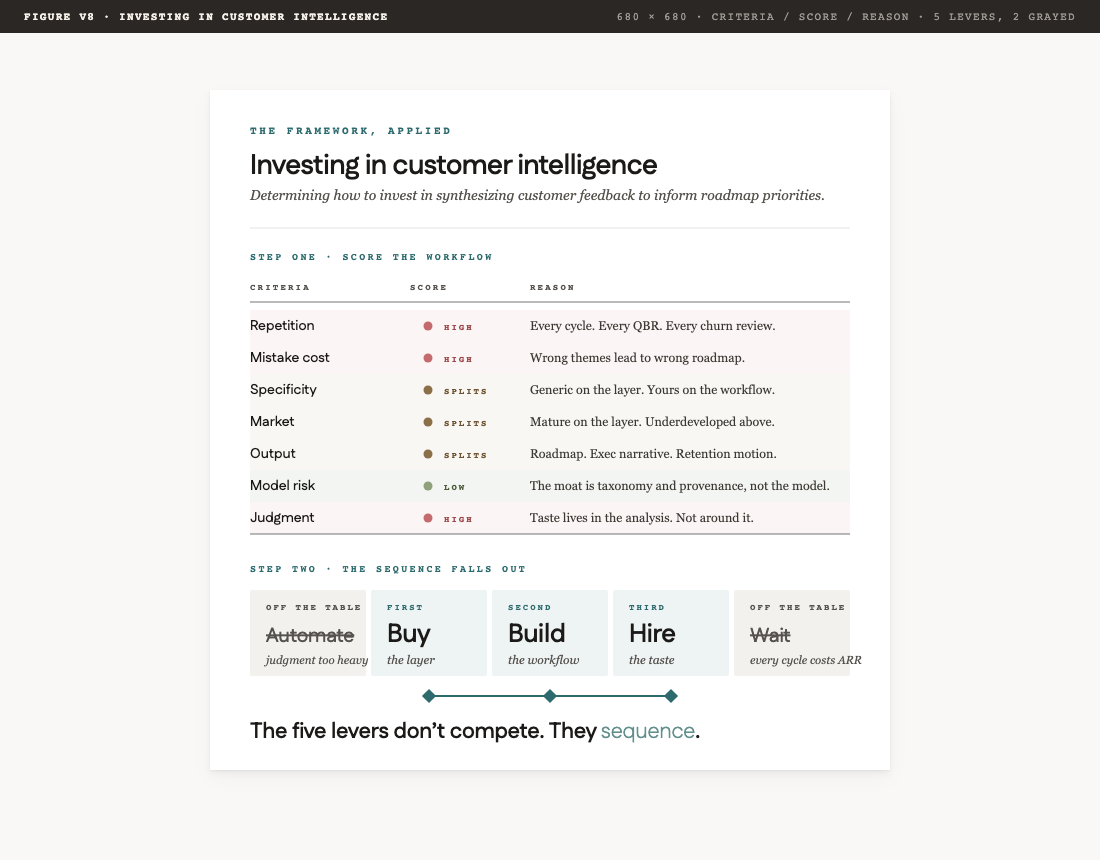
Buy. Build. Hire. In that sequence.
Why the fastest-moving teams build on, not from scratch
For customer intelligence, the five levers don't compete. They sequence.
Buy the layer first, because the 70% you weren't planning to build was always going to eat the calendar. The ingest, the taxonomy that adapts as your product ships, the provenance tying every quote to who said it and what they pay, that's the layer. It's not where your taste lives. It's where your time goes if you decide to build it.
Build the workflow on top, because the part that's specific to you is the part nobody else can ship. Your themes, your segments, your retention motion, the way you tie a feature decision back to ARR at risk, that's the workflow. That's where build pays.
Hire the taste, because a workflow without taste is generic, and a taste without a workflow is a hire looking for a job.
Notion's customer intelligence team got to 80% faster insight time on top of this layer. Not by rebuilding it. By building the workflow that was specific to how Notion's PMs actually make decisions. That's what "build on" looks like when the layer is already there.
Run the diagnostic
Here's what to do on your next AI investment call.
Score the workflow on Jones's seven inputs before anyone picks a lever. Then ask his question for each: do you Automate, Build, Buy, Hire, or Wait? For customer intelligence, the sequence falls out of the answers.
Buy the layer. Build the workflow. Hire the taste.
That's not a build-versus-buy answer. That's a build-versus-buy sequence. And it's the one most teams figure out in month seven, after they've already shipped the part anyone could ship.
Credit where it's due
Thanks to Nate B. Jones for the vocabulary. The sequencing rule is what I extracted from running customer intelligence through his framework — the framework holds even when you point it at yourself, which is the test most frameworks fail.Jones publishes more of this on AI News & Strategy Daily and the Nate B Jones YouTube channel. Both are worth subscribing to if you're making AI investment calls right now.


