



Enterpret Alternatives and Competitors in 2026: How the Top Platforms Compare

September 25, 2026

Trial-to-paid conversion is where a lot of growth quietly leaks. A trial user signs up, hits something confusing or missing in the first session, and never comes back, and the funnel just records a non-conversion. Product analytics will show you where they dropped, the step they abandoned, the feature they never reached, but not why. The why lives in what trial users say: the support chat, the in-app note, the review, the "I couldn't figure out how to" message. Reducing trial churn means reading that signal and fixing the activation blockers it names.
The strongest tools for reducing trial churn and improving trial-to-paid conversion with feedback are Enterpret, Pendo, Amplitude, Userpilot, Mixpanel, and Appcues. Most are product analytics and onboarding tools strong on behavioral data; what separates the field is whether the tool reads the qualitative feedback that explains the drop-off, keeps those activation blockers accurate, and ties them to the conversion they are costing.
These criteria separate seeing where trial users drop from understanding why and fixing it. Score any tool against them.
The real differentiator is explaining the drop-off, not just charting it: reading the activation blockers trial users name and ranking them by the conversion they cost.
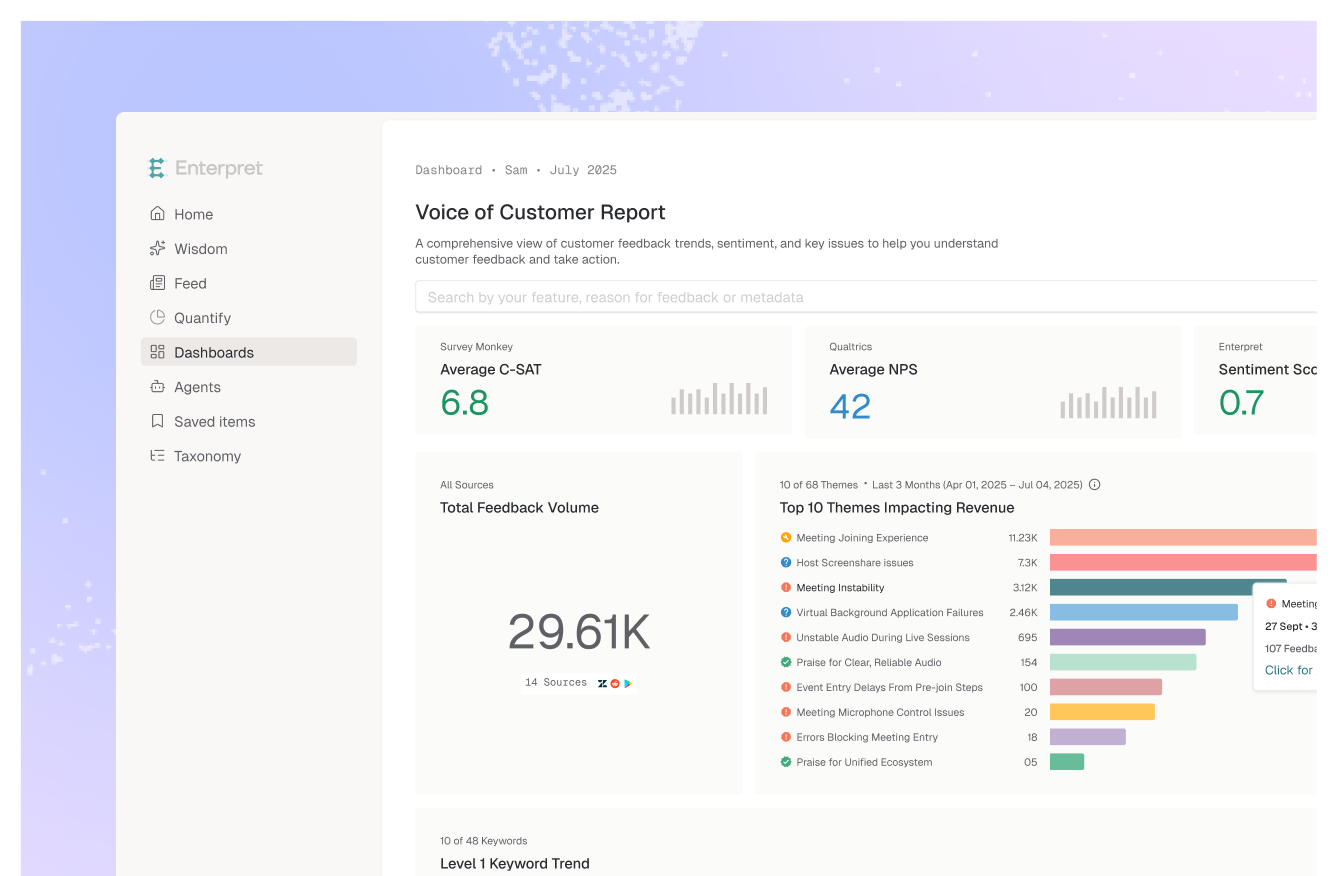
Enterpret leads on the half of the problem analytics cannot answer: why trial users do not convert. Its adaptive taxonomy reads trial-user feedback from support chats, in-app messages, reviews, and onboarding surveys and surfaces the activation blockers behind the drop-off, learning them from the data so a new onboarding friction is caught as it appears. Its customer context graph ties each blocker to trial cohorts and conversion outcomes, so you can rank the issues by the conversion they cost. Used alongside product analytics that show where trial users drop, it explains why and what to fix.
Best for: product and growth teams that want the qualitative reasons behind trial drop-off, ranked by conversion impact.
Pendo combines product analytics with in-app guides, showing where trial users drop and letting you intervene with onboarding flows. Strong on the behavioral side and in-app guidance, lighter on deep qualitative analysis.
Best for: product teams pairing trial analytics with in-app onboarding.
Amplitude is a deep product analytics platform for mapping trial funnels and identifying where conversion breaks. It excels at behavioral analysis, with the why coming from feedback layered on top.
Best for: teams doing rigorous behavioral funnel analysis of trials.
Userpilot focuses on onboarding flows and in-app experiences to drive activation, with analytics to measure their effect on conversion. A fit for teams iterating on the trial onboarding experience.
Best for: teams optimizing onboarding flows to lift activation.
Mixpanel provides event-based product analytics for tracking trial activation and conversion funnels. Strong on behavioral measurement and cohort analysis, with feedback handled by other tools.
Best for: teams tracking trial activation with event analytics.
Appcues delivers onboarding flows and in-app messaging to guide trial users toward activation without engineering lift. It suits teams that want to ship onboarding experiences quickly.
Best for: teams shipping onboarding experiences to improve trials.
Product analytics are necessary for trial conversion and insufficient on their own. They are excellent at showing where trial users drop, which step they abandon, which feature they never reach, but the drop point is a symptom, not a diagnosis. Two trial users can abandon at the same step for opposite reasons: one because the feature was confusing, one because it was missing entirely. The funnel renders both as the same red bar, and the fix for each is completely different. Optimizing the step without knowing the reason is guesswork, and a redesigned onboarding flow that solves the wrong problem moves nothing.
The reason sits in the qualitative signal, and trial users produce plenty of it: the support chat where they ask how to do something the product does not do, the in-app message expressing confusion, the review explaining why they did not stick. Reading that at scale turns the funnel's "where" into an actionable "why," which is what lets a product team fix the actual activation blocker. That depends on unifying trial feedback across channels so chats, surveys, and reviews form one view, and routing the blockers to the product team that can resolve them. It also connects to catching disengagement early, since a trial going quiet is its own signal, related to how teams detect silent churn before customers cancel. The conversion lift comes from fixing the named blocker, not from another funnel chart.
If you need rigorous behavioral funnel analysis, Amplitude and Mixpanel are the analytics depth; for in-app onboarding to drive activation, Pendo, Userpilot, and Appcues ship guided experiences. What those tools show is where trial users drop; what they are thinner on is why. For teams that want the activation blockers behind the drop-off, read from trial feedback and ranked by the conversion they cost, Enterpret is built for that and pairs with product analytics rather than replacing them.
The decision rule: weight the qualitative reason behind the drop-off alongside the behavioral data, because you cannot fix an activation blocker you cannot see.
Pair behavioral analytics with feedback. Use product analytics to find where trial users drop, then read the qualitative signal, support chats, in-app messages, reviews, onboarding surveys, to understand why they dropped there. Rank the activation blockers by the conversion they cost, fix the highest-impact ones, and confirm the trial-to-paid rate improves. The drop point tells you where; the feedback tells you what to fix.
Because the drop point is a symptom, not a cause. Two trial users can abandon the same step for opposite reasons, one because a feature was confusing, one because it was missing, and the funnel shows both as the same drop. Without the qualitative reason, optimizing the step is guesswork, and redesigning onboarding to solve the wrong problem does not move conversion.
Enterpret's adaptive taxonomy reads trial-user feedback from support chats, in-app messages, reviews, and onboarding surveys and surfaces the activation blockers behind the drop-off, learning them from the data. Its customer context graph ties each blocker to trial cohorts and conversion outcomes, so you can rank issues by the conversion they cost. Used with product analytics that show where users drop, it explains why and what to fix.
Common causes are activation blockers in the first sessions: confusing onboarding, a setup step that is too hard, a missing capability the user expected, an unanswered question, or simply not reaching the product's core value quickly enough. Many of these are visible only in what trial users say, not in usage data alone, which is why reading trial feedback is central to improving conversion.
Yes, and it is what makes the analysis actionable. When trial feedback is categorized into activation blockers and tied to whether the trial converted, you can see which blockers most depress trial-to-paid conversion rather than just which are mentioned most. That lets a product team prioritize the fixes likely to lift conversion the most, and verify the lift after shipping them.
If you want the activation blockers behind trial drop-off, read from feedback and ranked by impact, see Enterpret for product teams or book a demo.
Lorem ipsum dolor sit amet, consectetur adipiscing elit. Suspendisse varius enim in eros elementum tristique. Duis cursus, mi quis viverra ornare, eros dolor interdum nulla, ut commodo diam libero vitae erat. Aenean faucibus nibh et justo cursus id rutrum lorem imperdiet. Nunc ut sem vitae risus tristique posuere.