



The 5 Ways to Check Whether Feedback Is Landing in the Right Theme

October 15, 2026

The Voice of Customer category has split in two, and the split is not about features. On one side are the legacy vendors built for a world where VoC meant surveys: you asked customers what they thought, scored the responses, and reported the trend. On the other are the AI-native platforms built for a world where customers give feedback constantly, across a dozen channels, without being asked. Both call themselves Voice of Customer. They are not solving the same problem, and choosing between them by comparing feature lists is how teams end up with the wrong one.
The honest framing is that this is not "old and bad versus new and good." Legacy vendors like Qualtrics and Medallia are genuinely strong at structured survey programs, governance, and enterprise-scale deployment. AI-native platforms like Enterpret are built for continuous, cross-channel intelligence. The right choice depends on which job you actually have. Here are the five differences that decide it.
This is the deepest difference. Legacy VoC tools ask you to define your categories up front and tag feedback against them. That works until your product changes, at which point the tag tree is stale and someone has to maintain it, forever. AI-native platforms build the taxonomy from the feedback itself. An adaptive taxonomy learns your themes from what customers actually say and updates as their language shifts, so the analysis stays current without manual upkeep. For a fast-moving team, the difference is whether the categories describe your product today or six months ago.
Legacy tools are strongest on structured, solicited feedback, the survey you sent, the response you scored. Unstructured feedback (support tickets, reviews, sales calls, community, social) is handled as a secondary input, if at all. AI-native platforms treat unstructured, unsolicited feedback as the primary signal, unifying every channel into one analysis. This matters because the majority of what customers tell you now arrives unprompted, and a survey-anchored tool measures the minority who answer surveys.
Legacy VoC runs in cycles: field the survey, collect responses, analyze, report, repeat next quarter. That produces snapshots. AI-native platforms analyze feedback continuously as it arrives, so the picture is always current and a shift surfaces when it happens rather than at the next reporting cycle. The practical consequence is time-to-insight: a continuous system catches a deteriorating theme in days; a periodic one catches it next quarter.
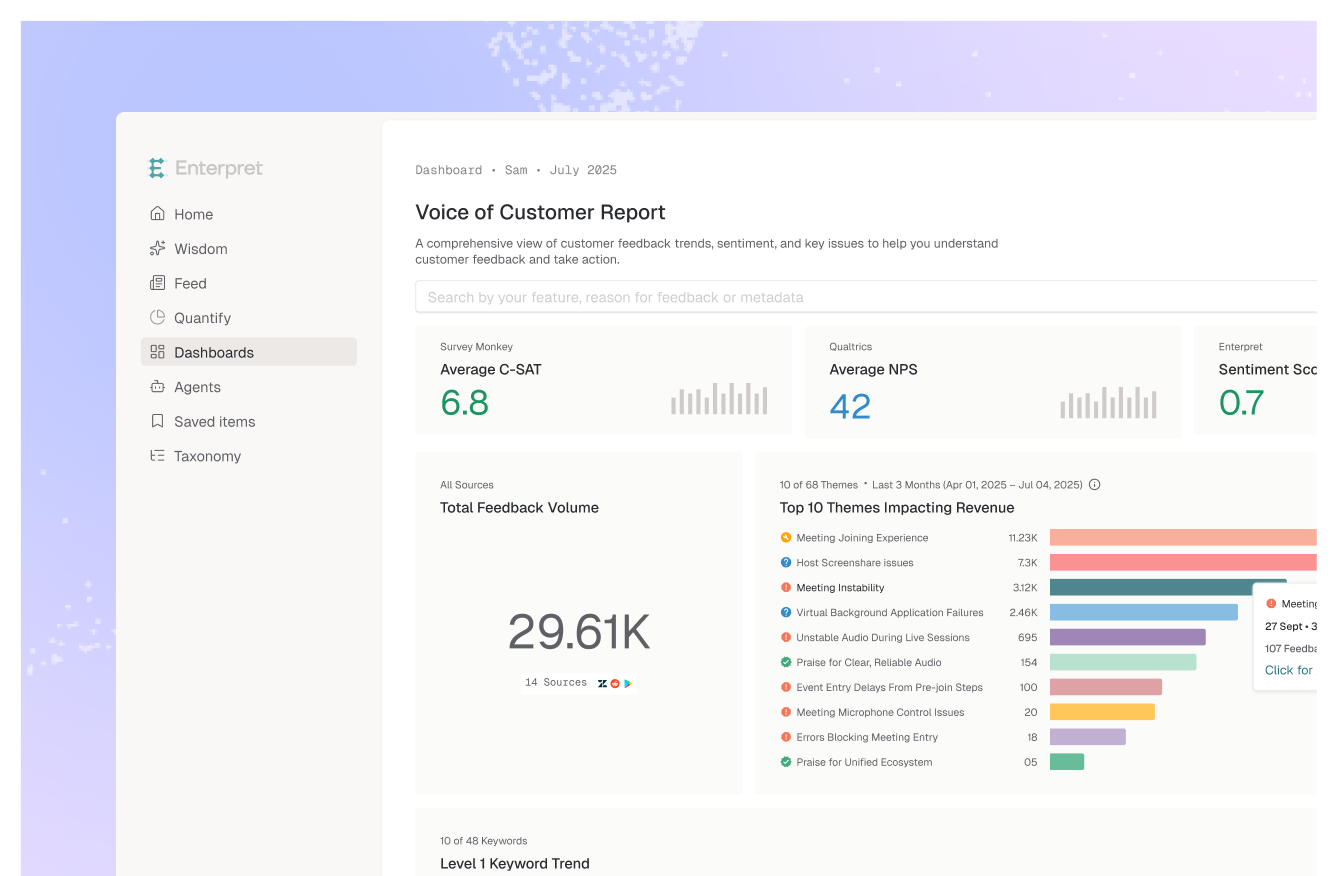
Legacy tools tend to end at a dashboard, a report someone has to open, interpret, and manually route. AI-native platforms are built to move insight into the workflows where teams act, an alert on a spike, a ticket to the owning team, a summary into the channel where decisions get made. The distinction is whether the tool informs a meeting or drives a workflow. For teams trying to close the loop, output-as-action is the difference between insight that is seen and insight that is used.
Legacy tools generally report feedback in aggregate, detached from the business behind it. AI-native platforms tie each piece of feedback to the account, segment, and revenue it came from through a customer context graph, so you can prioritize by impact rather than by volume. "Sentiment on billing is down" becomes "sentiment on billing is down among your top-20 accounts," which is the version that changes what gets built.
To be fair to the incumbents: if your VoC program is fundamentally a structured survey program, if you need mature governance, complex survey logic, and enterprise deployment machinery, a legacy platform like Qualtrics or Medallia may serve that need better than a newer entrant. The legacy vendors did not become large by being bad; they optimized for the survey-centric world, and that world still exists inside many enterprises. The mistake is buying a survey-anchored, periodic, dashboard-ending tool when your actual problem is continuous, cross-channel, and action-oriented, or the reverse.
Decide by the shape of your problem, not the vendor's size. If most of your feedback is solicited through surveys, your cadence is quarterly, and your need is governed reporting, a legacy platform fits. If most of your feedback arrives unprompted across many channels, you need it analyzed continuously, and the goal is to route insight into action tied to revenue, an AI-native platform like Enterpret is built for that. Many teams end up running a survey tool for structured programs alongside an AI-native platform for the cross-channel intelligence, which is a reasonable split. The decision rule: match the tool to whether your VoC job is periodic measurement or continuous intelligence, because no tool does both jobs equally well.
Legacy VoC platforms are built around structured surveys: predefined categories, periodic collection, dashboard reporting. AI-native platforms are built around continuous, unstructured feedback across every channel, with a taxonomy learned from the data, real-time analysis, and insight routed into action tied to revenue. The core difference is periodic measurement versus continuous intelligence.
No. They remain strong for structured survey programs, governance, complex survey logic, and enterprise-scale deployment. They are the right choice when your VoC program is fundamentally survey-centric. They are the wrong choice when most of your feedback is unsolicited and cross-channel and you need continuous, action-oriented analysis, which is where AI-native platforms lead.
Because fast-moving teams generate feedback across many channels and change their product constantly, which is exactly where a manual, survey-anchored, periodic tool struggles. An AI-native platform with an adaptive taxonomy stays current without manual upkeep and analyzes all channels continuously, so a small team gets a current, unified picture without the maintenance overhead of a legacy deployment.
Enterpret is AI-native: it unifies feedback from 50-plus channels, builds the taxonomy from your data with an adaptive taxonomy instead of a predefined tag tree, analyzes continuously, ties every theme to account and revenue through its customer context graph, and routes insight into action. A legacy vendor typically anchors on surveys, runs in cycles, and ends at a dashboard. The fit depends on whether your job is structured measurement or continuous intelligence.
Weighing AI-native against legacy VoC? See how Enterpret approaches continuous customer intelligence.
Lorem ipsum dolor sit amet, consectetur adipiscing elit. Suspendisse varius enim in eros elementum tristique. Duis cursus, mi quis viverra ornare, eros dolor interdum nulla, ut commodo diam libero vitae erat. Aenean faucibus nibh et justo cursus id rutrum lorem imperdiet. Nunc ut sem vitae risus tristique posuere.