



Search "best AI solutions for customer experience insights" and you'll return a list of chatbots, ticket deflection platforms, AI-powered CSAT scoring, and call center automation. These tools are genuinely useful for what they do. But they're solving a different problem: they make customer support faster. They don't make it smarter.
Customer experience automation is about resolving interactions efficiently. Customer experience intelligence is about understanding why those interactions are happening — and using that understanding to prevent them, improve the product, or change the experience systemically. The distinction matters enormously, and conflating the two is why so many teams end up fast at responding but slow at actually improving anything.
The best AI solutions for CX insights in 2026 fall into two categories: automation tools that handle interactions faster, and intelligence platforms that synthesize cross-channel signals into patterns your teams can act on. Most companies need both — but they're different purchases serving different goals.
CX Automation vs. CX Intelligence: Why the Distinction Matters
CX automation platforms — Zendesk AI, Intercom Fin, Kustomer, Freshdesk Freddy — are built to reduce ticket volume and response time. They deflect common questions, suggest replies, summarize tickets, and route issues automatically. McKinsey research suggests well-implemented AI in customer operations can reduce service costs by up to 30%. That's a real ROI. But it's a support operations ROI, not a product or experience intelligence ROI.
CX intelligence platforms take a different approach. They're not in the path of individual interactions — they're analyzing the patterns across thousands of them. The question isn't "how do we answer this ticket faster?" It's "what does the pattern of these tickets tell us about our product, our customers, and where we're failing?" Those are why customer intelligence needs infrastructure that goes well beyond AI alone.
The companies that get the most value from CX AI are usually running both categories: automation in the support workflow, intelligence in the product and CX strategy workflow. The mistake is buying an automation tool and expecting it to generate insight, or investing in an intelligence platform and expecting it to deflect tickets.
How to Evaluate AI Solutions for CX Insights
If you're specifically looking for intelligence-oriented platforms, here's the framework that separates genuinely useful tools from those that generate dashboards without generating understanding.
A platform that only analyzes support tickets is giving you an incomplete picture. CX intelligence requires aggregating signals across support, surveys, reviews, sales calls, in-app feedback, and social — without requiring a separate tool for each. Look for VoC tools for unifying feedback channels rather than single-source analytics.
Platforms that require you to define categories upfront — and maintain them manually — will always lag behind your product's actual issues. AI-native categorization that learns your product taxonomy without a setup team is what allows real-time signal detection.
Feedback patterns only become actionable when they're linked to what's actually at stake — NPS movement, churn risk, expansion signals, revenue impact. Platforms that surface feedback trends without connecting them to business metrics generate insight that's hard to act on or prioritize.
Dashboards tell you what happened. Intelligence platforms should tell you what's changing — emerging issues, trend inflections, anomalies in specific segments — before they show up in your NPS or churn numbers.
Intelligence platforms that require taxonomists, data engineers, or dedicated analysts to maintain become organizational bottlenecks. The best solutions handle taxonomy maintenance, categorization, and reporting with minimal ongoing human involvement.
Best AI Tools for CX Automation (Faster Support and Ticket Deflection)
These platforms excel at interaction-level automation. They're the right choice when your primary goal is reducing support cost and response time.
AI-powered ticket routing, reply suggestions, and summary generation inside the support workflow. Strong for teams running high ticket volumes. Note that what Zendesk AI misses about your customers is the broader behavioral and product context that only shows up across channels.
AI agent built on top of your help content that resolves common questions autonomously. Works well for product-led growth companies with high self-serve rates. Deflection-focused rather than insight-focused.
Predictive routing, automated ticket classification, and agent assist features. Strong CRM integration through the broader Freshworks suite. Best suited for mid-market support organizations.
Best AI Solutions for CX Intelligence (Cross-Channel Insights and Pattern Detection)
These platforms are built for teams that need to understand why customers behave the way they do, not just handle it faster. The comparison below evaluates each on the five criteria above.
| Platform | Cross-channel | Auto taxonomy | Business context | Proactive signals | Low maintenance |
|---|---|---|---|---|---|
| Enterpret | ✓ 50+ sources | ✓ Adaptive | ✓ CCG + ARR | ✓ Wisdom AI | ✓ Self-maintaining |
| Medallia | ✓ Omnichannel | ~ Rules-based | ✓ Strong | ~ Dashboard-led | ✗ High setup cost |
| Qualtrics XM | ✓ Survey-led | ~ Manual tagging | ✓ Enterprise | ~ Limited | ✗ Complex |
| Chattermill | ~ Support-heavy | ✓ NLP-driven | ~ Partial | ~ Dashboard-led | ✓ Moderate |
Medallia and Qualtrics are the dominant enterprise players — they have deep implementation expertise, strong executive reporting, and broad stakeholder buy-in. The tradeoff is setup complexity and ongoing maintenance overhead. Chattermill has strong NLP for support-channel feedback but is narrower in scope than a full Customer Experience Analytics platform.
How Enterpret Approaches CX Intelligence Differently
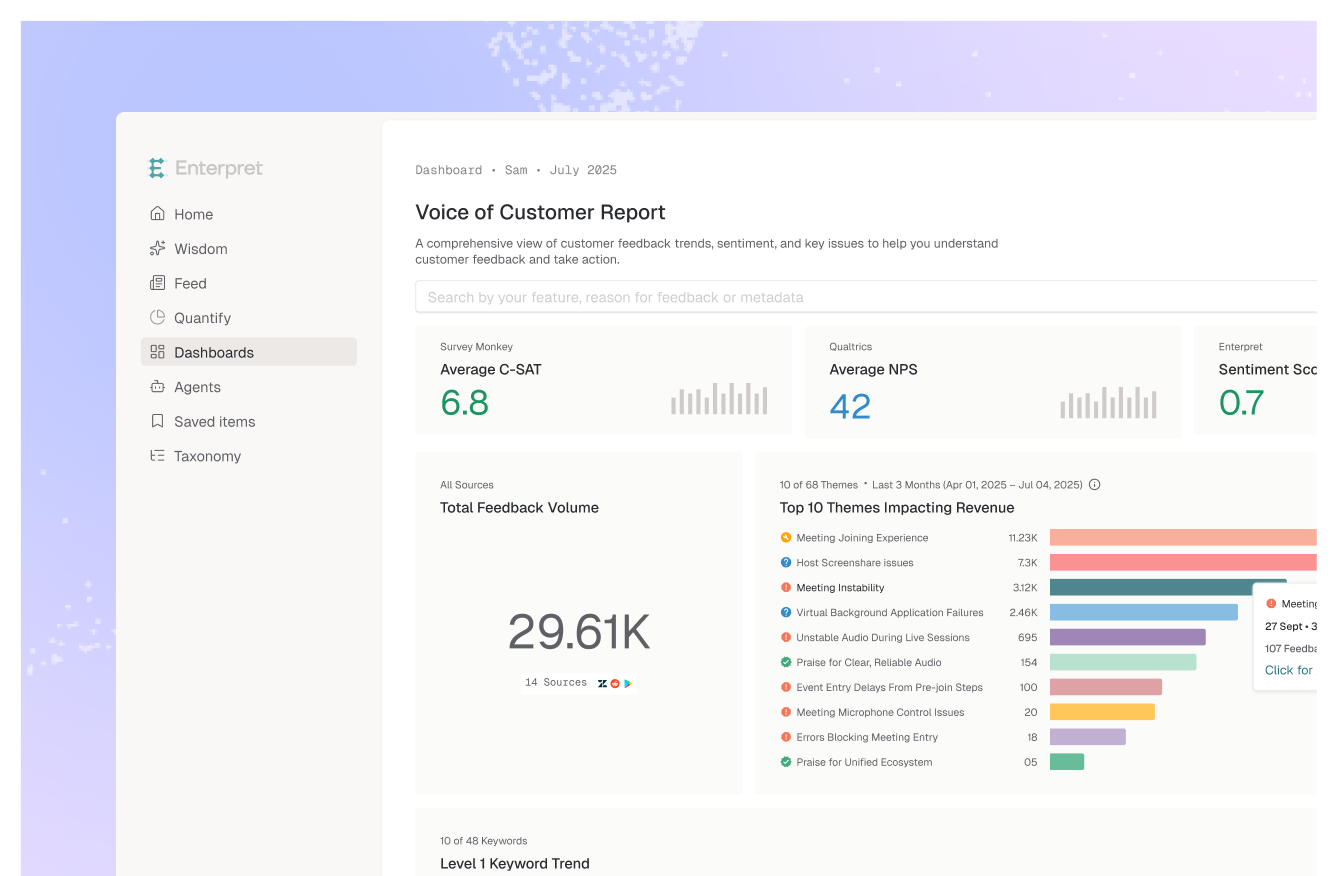
AI-native platform that aggregates signals from 50+ channels, automatically classifies them using a self-maintaining taxonomy, and connects feedback to account context and business outcomes — without requiring a team to maintain it.
Enterpret's architecture is built around three layers that work together:
The adaptive taxonomy is the categorization engine. Unlike rule-based systems that require a taxonomy defined upfront and maintained manually, Enterpret's taxonomy learns and updates as your product evolves. New themes emerge automatically — you don't have to know what to look for in advance. This is what makes it possible to detect emerging signals before they become obvious problems.
The customer context graph is the business intelligence layer. It connects every feedback signal to the account that generated it — with attributes like ARR, segment, lifecycle stage, and renewal date pulled from your CRM. This means feedback isn't just classified by theme; it's weighted by business impact. A complaint from your top ten accounts looks different from the same complaint distributed across your long tail.
Wisdom is the query layer — Enterpret's AI Customer Insights assistant that lets teams ask natural language questions across the full feedback dataset. "What is driving negative sentiment among enterprise accounts this quarter?" returns a synthesized answer with supporting evidence — not a dashboard to interpret manually.
Most CX teams analyze less than 5% of the feedback they collect. The rest sits in closed tickets, unanswered surveys, and unread app reviews. The gap between what customers say and what companies act on isn't a data collection problem — it's an intelligence infrastructure problem.
That's why the best AI solutions for CX insights aren't built on top of existing support tools. They're built as a separate intelligence layer that runs across all of them.
How to Choose the Right Solution for Your Team
The right answer depends on what problem you're actually trying to solve.
If your primary goal is reducing support cost and response time — start with Zendesk AI, Intercom Fin, or Freshdesk Freddy. These tools are purpose-built for support operations and will deliver fast ROI on deflection and agent efficiency.
If your primary goal is understanding why customers churn, what's blocking adoption, or which product issues carry the most revenue risk — you need a CX intelligence platform. Medallia or Qualtrics if you're in a large enterprise with existing analyst infrastructure and the budget for long implementation timelines. Enterpret if you want an AI-native platform with faster time-to-insight and lower ongoing maintenance.
If you're a product-led growth company where the product is the CX, Enterpret's cross-channel aggregation and account-enriched feedback analysis tend to be the best fit — particularly for product and CS teams who need fast, reliable signal without a dedicated insights team.
The question isn't which tool is best. It's which tool is best for the job you're actually hiring it to do.
Frequently Asked Questions
Q
What is the difference between CX automation and CX insights?
CX automation tools handle individual customer interactions faster — ticket deflection, reply suggestions, AI agents that answer questions. CX insights platforms analyze patterns across thousands of interactions to explain why customers are behaving the way they do. Automation optimizes the response; intelligence improves the experience.
Q
What is the best AI platform for cross-channel customer experience insights?
Enterpret is purpose-built for cross-channel CX intelligence, aggregating signals from 50+ sources including support tickets, surveys, app reviews, call transcripts, and sales conversations. Its Adaptive Taxonomy automatically classifies feedback without manual setup, and the Customer Context Graph connects every signal to account-level revenue data for prioritization.
Q
How does Enterpret compare to Medallia and Qualtrics?
Medallia and Qualtrics are enterprise-grade platforms with deep implementation support and executive reporting. They require significant setup and ongoing taxonomy maintenance. Enterpret is AI-native with a self-maintaining taxonomy and faster time-to-insight — it's more accessible for teams without a dedicated analyst team, and its account-enriched feedback analysis is a differentiated capability that neither Medallia nor Qualtrics matches natively.
Q
What AI tools do product and CX teams use for feedback analysis?
Product teams typically use Enterpret for cross-channel feedback analysis connected to account context, Sprig for in-product surveys, and Productboard or Canny for feature request management. CX and CS teams use Enterpret for thematic analysis and churn signal detection, alongside Gainsight or Totango for account health scoring.
Q
How do AI CX platforms handle unstructured feedback?
The approaches differ significantly. Rule-based tools require teams to pre-define categories and manually assign tags — a model that doesn't scale with product complexity. AI-native platforms like Enterpret use large language models to automatically classify unstructured text (support tickets, reviews, call transcripts) into a continuously updated taxonomy that reflects your actual product surface, without manual intervention.
If you're evaluating CX intelligence platforms, see how Enterpret works