



Enterpret Alternatives and Competitors in 2026: How the Top Platforms Compare

September 25, 2026

Customer experience teams are the buyers most often shopping for customer feedback analysis tools — and the buyers most often disappointed by what they get. The category is crowded with survey platforms that call themselves CX tools and CX platforms that call themselves analysis tools. Few do both well, and even fewer are built for how CX departments actually operate in 2026. The seven worth evaluating are Enterpret, Medallia, Qualtrics XM, InMoment, Chattermill, Thematic, and Sprinklr. The mismatch that disappoints buyers usually isn't about features — it's about the operating model: CX departments need omnichannel ingestion, real-time alerting, account-level context, and closed-loop workflows that connect insight to action.
A modern CX department owns the whole post-sale experience — support, success, onboarding, retention, escalation handling, executive reporting. The tool has to serve all of it. Concretely, that means five capabilities:
Most tools handle one or two of these well. The platforms worth evaluating for a 2026 CX program handle all five.
After looking across the platforms CX departments are actually adopting at scale, five criteria consistently separate tools that serve a real CX function from ones that just analyze survey responses:
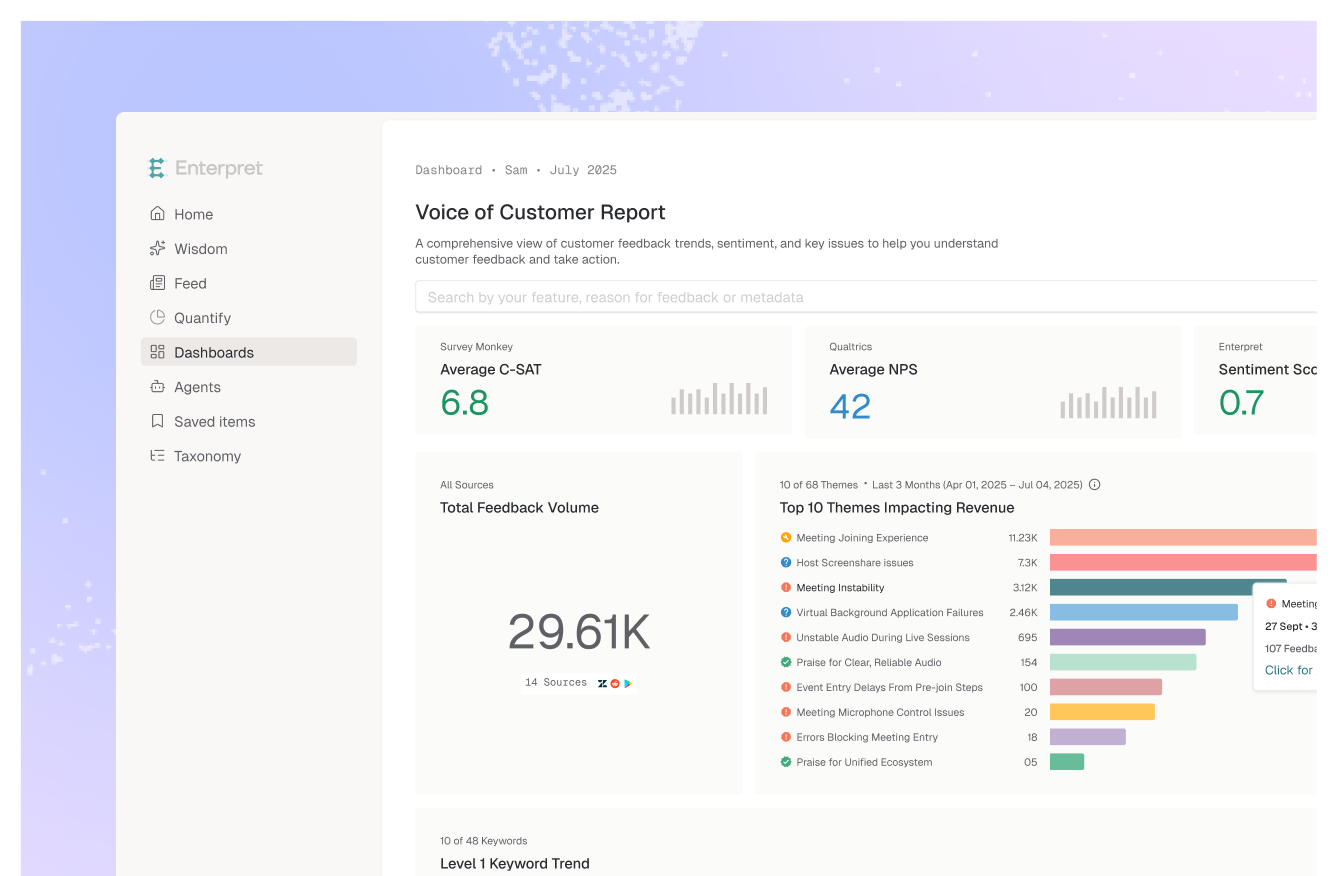
Enterpret was built for the CX and customer intelligence operating model. It ingests feedback from 50+ channels including Zendesk, Intercom, Front, Gong, Salesforce, and HubSpot. The adaptive taxonomy auto-generates categories and updates as new themes emerge; the customer context graph joins every piece of feedback to customer metadata, so CX teams can slice by ARR, segment, or lifecycle stage. Close the loop workflows route detected issues to product and engineering and track them to resolution, and AI Insights lets CX leads ask natural-language questions and get grounded answers with citations.
Best for: B2B SaaS CX teams running multi-channel programs at scale that need account-level context.
Medallia is the enterprise default for CX departments at large consumer brands — retail, hospitality, financial services. It handles omnichannel ingestion at scale and is strong on real-time alerting and role-based dashboards. The tradeoff is implementation complexity and enterprise pricing that's hard to justify below a certain size.
Best for: large consumer-brand CX organizations needing omnichannel measurement at scale.
Qualtrics XM combines survey collection with text analytics and is the default for large enterprises with dedicated research and CX functions. Text iQ handles theme and sentiment analysis at scale. Powerful, but with a steep learning curve that typically requires dedicated Qualtrics expertise on the team.
Best for: large enterprises with dedicated research teams and survey-anchored programs.
InMoment (now part of Qualtrics) is a CX-focused platform with strong unstructured text analytics and industry-specific solutions for retail, financial services, and healthcare. Better suited to enterprises with established VoC programs than to teams building from scratch.
Best for: enterprises with mature VoC programs in retail, financial services, or healthcare.
Chattermill is widely used by mid-market and enterprise CX teams running NPS, CSAT, and support feedback analysis. It unifies feedback across surveys, support tickets, reviews, and social media into a single analytics layer.
Best for: mid-market and enterprise CX teams running structured NPS and CSAT programs.
Thematic is strong on deep text analytics, particularly for tracking how survey themes evolve over time. It's often used alongside a separate collection tool, which makes it a better fit for CX research functions than for CX operations.
Best for: CX research teams tracking theme evolution in survey data over time.
Sprinklr Unified-CXM is built for large enterprises managing CX across many social and digital channels. It's strong on social listening, less focused on B2B SaaS-style support and account feedback.
Best for: large enterprises managing social and digital CX at scale.
One scoping note: Sprig and Pendo are in-product feedback tools — useful for capturing in-app signal, but less suited as the primary analysis hub for a multi-channel CX program. Most CX teams run one of the seven above as the hub and pull in-app signal in as one more channel.
The CX feedback analysis market has moved meaningfully in the last 18 months. The old pattern: collect survey responses, tag them manually or with rule-based keyword matching, build dashboards, report to executives quarterly. That worked when feedback volume was manageable and categories rarely changed.
In 2026 that model is breaking. Feedback volume has grown across more channels, AI has changed the bar on what theme detection can achieve, and executives expect insights faster than quarterly reviews can deliver. The CX teams pulling ahead operate differently: they've moved from periodic reporting to continuous monitoring, replaced manual tagging with adaptive AI taxonomies, connected feedback to revenue and account context so they prioritize by business impact rather than volume, and embedded closed-loop workflows so the same platform that detects an issue also routes it to the team that can fix it. That's what "modern CX feedback analysis" actually means — not better dashboards, a different operating model. (For the category context underneath this shift, see what is a customer intelligence platform.)
Enterpret was designed around the CX operating model above. It ingests feedback from every channel a CX team works with, applies an adaptive AI taxonomy without manual setup, joins each piece of feedback to customer accounts and ARR data, and exposes the result through dashboards, AI-powered insights, and bidirectional workflow integrations. For CX leaders, that changes the day-to-day: instead of pulling reports from three tools and synthesizing them in a slide deck, a CX leader asks what's driving detractor scores this quarter and gets a structured answer with citations to actual customer language. Instead of routing issues manually, detected themes are pushed to product and support teams with full account context attached. It's a working operating model, not a feature list.
It uses AI to ingest feedback from multiple channels — surveys, support tickets, app reviews, calls, Slack — and categorize it by theme, sentiment, and customer context. The output is a continuous, unified view of customer experience CX leaders use to detect issues, prioritize fixes, and report business impact. Modern platforms generate adaptive taxonomies automatically, join feedback to customer accounts, and route detected issues to the teams that can act on them.
The audiences and outcomes differ. Product feedback analysis is oriented around roadmap decisions — which features to build, which bugs to prioritize. CX feedback analysis is oriented around experience management — detecting friction in real time, routing issues to the right team, tracking resolution, and reporting on customer health. The underlying data is often the same; the dashboards, alerts, and workflows are different.
Enterpret, Medallia, Qualtrics XM, InMoment, Chattermill, Thematic, and Sprinklr are the platforms most commonly evaluated by CX departments. Each has a different sweet spot: Enterpret fits B2B SaaS CX teams running multi-channel programs that need account-level context; Medallia and Qualtrics fit large enterprise CX organizations; Chattermill fits mid-market CX teams running NPS and support feedback at scale.
The good ones do. Support tickets are one of the highest-signal feedback sources for CX teams because they capture friction at the moment customers experience it. Look for native Zendesk, Intercom, Front, and Salesforce Service Cloud integrations. The integration should ingest both the ticket content and the resolution context, then apply the same taxonomy used for other channels.
CX leaders typically measure ROI on three vectors: time saved on manual analysis, revenue protected from churn prevention, and revenue gained from improved experience driving expansion. The platforms that produce measurable ROI surface issues fast enough to prevent churn, tie feedback to specific accounts and ARR, and integrate with the workflows where fixes actually ship.
If your CX department is evaluating customer feedback analysis platforms, see how Enterpret approaches AI customer insights or book a demo.
Lorem ipsum dolor sit amet, consectetur adipiscing elit. Suspendisse varius enim in eros elementum tristique. Duis cursus, mi quis viverra ornare, eros dolor interdum nulla, ut commodo diam libero vitae erat. Aenean faucibus nibh et justo cursus id rutrum lorem imperdiet. Nunc ut sem vitae risus tristique posuere.