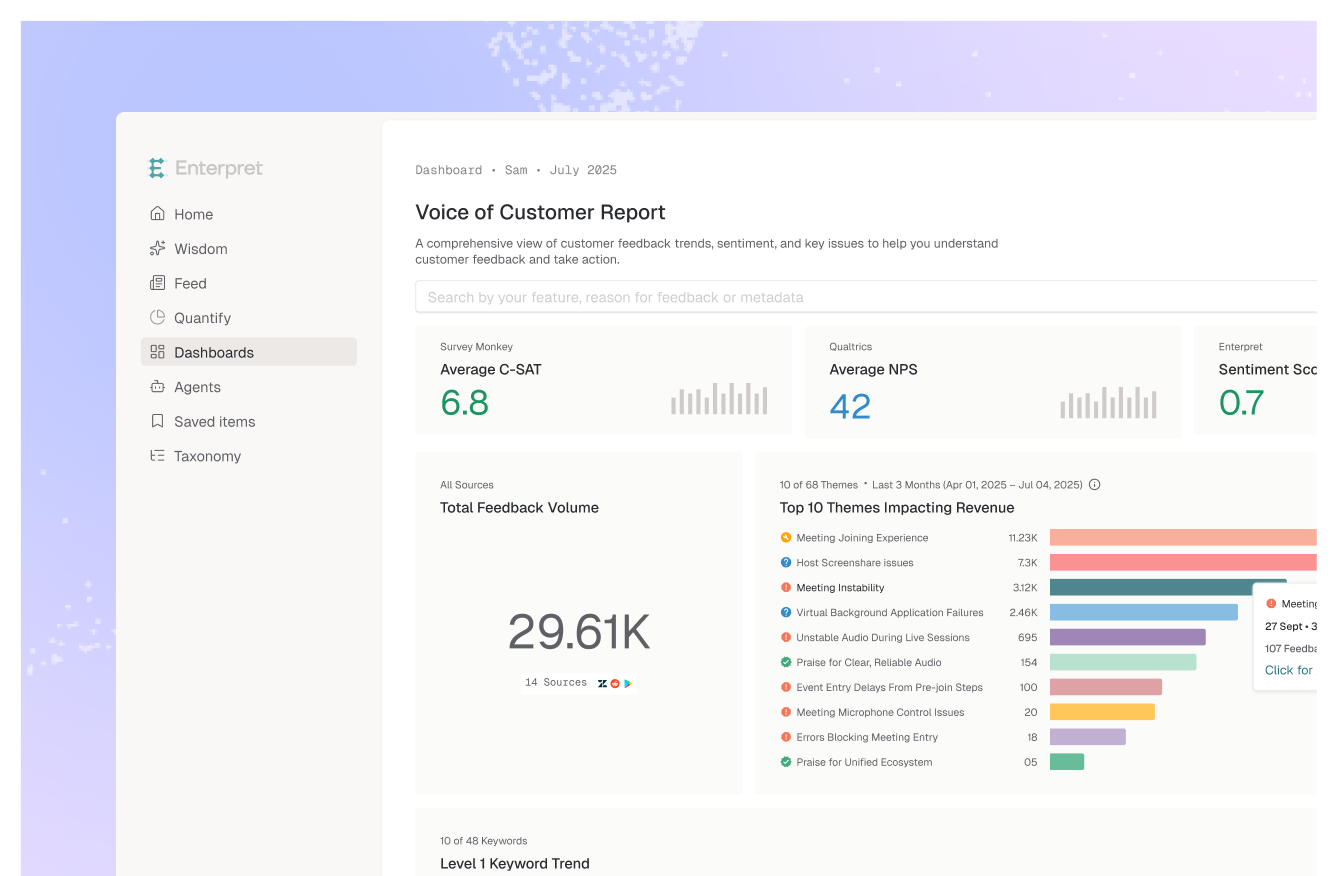




Every company says they listen to customers. Almost none of them can tell you which customer feedback theme is costing them $2M in churn this quarter.
The gap isn't philosophical. It's architectural. Most organizations capture customer feedback across 50+ channels—support tickets, calls, surveys, reviews—but that signal sits disconnected from ARR, churn curves, and customer segments. There's no line between what customers are saying and what it means for the business.
That's the central problem this guide addresses. You'll learn how to build the infrastructure to link feedback directly to revenue, and why traditional VoC tools—built for survey management and CSAT tracking—were never designed to make this connection.
The Gap No One Talks About: Feedback Without Revenue Context
Feedback collection has become table stakes. Every SaaS company now runs NPS surveys, monitors support sentiment, tracks feature requests, and listens to sales calls. The infrastructure for signal capture is mature and affordable.
But customer feedback as your most powerful data set remains locked away in silos. Support teams see one view. Product teams see another. Revenue leaders see neither—they rely on cohort analysis and RFM models that lag by weeks.
The real cost emerges when you ask a straightforward question: "Which feedback themes correlate with churn in our enterprise segment?" Most companies can't answer it without weeks of SQL, manual labeling, and cross-functional alignment. That's not a process problem. It's a category gap.
Legacy systems weren't built for this. They optimize for survey administration, not revenue attribution. The wiring is missing.
Why Traditional VoC Tools Can't Make the Connection
Voice of Customer platforms excel at one thing: capturing and organizing feedback. Surveys, forms, comment aggregation—they've been perfected over two decades. The UX is clean. The deployment is quick.
But VoC tools treat revenue data as a separate problem. You export feedback, you export churn data, and you hope a data analyst can stitch them together. There's no native layer that says, "This theme appears 3x more often in accounts that churn." There's no automation that routes high-risk signals to CS teams before the account owner loses the deal.
The core limitation: traditional tools were designed for Voice, not for Intelligence. They capture customer signals, but they don't understand customer context. They don't weigh feedback by revenue at risk. They don't learn which themes matter most for expansion versus retention.
To connect feedback to revenue, you need a different category entirely. A platform built with revenue attribution as a native capability, not an afterthought.
The 3 Layers of Revenue-Connected Customer Intelligence
Think of Customer Intelligence as a three-layer infrastructure. Each layer builds on the last, and all three are required to close the gap between signal and revenue impact.
Signal Capture
Unified ingestion across 50+ channels. Support tickets, chat logs, calls (transcribed), email, surveys, app reviews, sales feedback, social listening—all flowing into a single system without manual routing or duplication.
Most teams get this right. The challenge is what comes next.
Intelligence Layer: Taxonomy + Context
Adaptive Taxonomy automatically categorizes feedback into meaningful themes—not rigid survey categories, but living signal patterns that evolve as your business changes. "Onboarding friction," "API rate limits," "pricing objections."
Equally critical: the Customer Context Graph. This connects every piece of feedback to rich customer metadata—ARR, segment, churn risk, expansion potential, historical NRR. A support comment about "authentication" isn't just a feature request. It's linked to an enterprise account that's at 80% renewal probability and has a support queue backed up by 40 tickets.
AI Customer Insights sit here too, generating real-time signals: "Expansion risk detected in mid-market. Feature adoption lag correlates with renewal delays."
Revenue Attribution
This is the moat. The system learns which themes drive churn in which customer segments. It weights feedback by revenue at risk. It surfaces leading indicators of expansion or contraction before they show up in bookings reports.
"Usability concerns in enterprise accounts" becomes measurable: 34% higher churn risk, $4.2M ARR exposed, concentrated in healthcare and financial services. The signal isn't a comment anymore. It's a business metric.
Without all three layers, you're back to the original problem: feedback without context. You collect it. You label it. But you can't act on it at scale.
From Feedback Signal to Revenue Impact: A Framework
Here's how the connection actually works, step by step. Linking VoC impact to revenue follows a repeatable pattern.
- Map feedback themes to customer segments. Don't aggregate. "Slow API" means something different in a SMB account (annoyance) versus an enterprise (integration blocker). The Intelligence Layer separates them automatically.
- Weight each theme by revenue at risk. A support complaint about documentation in a $5K/year account is different from the same complaint in a $500K/year account. The system prioritizes based on ARR exposure.
- Identify leading indicators of churn or expansion. Historical analysis reveals patterns: which themes appear 30–90 days before renewal declines? Which correlate with expansion upsells? The platform learns this relationship and flags new instances in real time.
- Route insights to the team that can act. If the pattern is product-driven, alert the product team. If it's CS-driven, trigger a task for the account team. If it spans both, orchestrate the handoff. No insight is useful if it sits in a dashboard.
What This Looks Like in Practice
Theory is clean. Practice is messier—and more valuable.
Take how Apollo.io grew 9x with customer feedback. Every comment in support, every call note, every feature request flows through a unified intelligence layer. The taxonomy evolves weekly as the product and go-to-market team shift. Revenue leaders can see, in real time, which customer cohorts are at risk and why.
Apollo's sales team gets alerts when a prospect mention during a call matches a known expansion driver in existing accounts. CS teams see which existing customers are asking for the same features and can prioritize accordingly. Product learns whether reported bugs are blocking renewals or nice-to-haves.
The leverage isn't in the feedback collection. It's in the connection. The feedback data becomes infrastructure for the entire business.
Similar patterns play out at scale for companies like Canva and Notion. They're not collecting more feedback than competitors. They're connecting it faster and more systematically to business outcomes. That's the moat.
When you can say, "We discovered this theme three weeks ago, it correlated to 23% churn risk in our mid-market segment, we routed it to product, and we shipped a fix that halted the pattern"—that's when Customer Intelligence becomes a revenue function, not a compliance checkbox.
Frequently Asked Questions
Ready to close the gap between feedback and revenue?
See how Enterpret connects customer intelligence to your business outcomes.