



The 5 Differences Between Claude Skills and MCP Servers (2026)

September 16, 2026

Zendesk stops issuing new API tokens on 27 October 2026, and every remaining token stops working on 30 April 2027. That deadline is forcing a lot of teams to reopen a question they thought was settled: how customer feedback data gets out of the systems that hold it and into the tools that reason over it. The default answer for a decade was an API. The default answer for an agent is not.
The five differences that decide the outcome are who the consumer is, how capabilities get discovered, how credentials are handled, what the response actually contains, and where the interpretation happens. An API is a contract for code. An MCP server is a contract for reasoning. Get the distinction wrong and the agent returns a confident answer calculated from an incomplete sample.
Score any option against these five. They are ordered by how often they get skipped in evaluation.
That last criterion is where most setups quietly fail, and it is the one nobody tests before rollout.
A REST API assumes the caller read the docs, can handle pagination, manage retries, and interpret status codes. Those are reasonable assumptions about a developer and unreasonable ones about an agent operating without supervision.
An MCP server inverts the assumption. It treats the caller as capable of reasoning but incapable of holding secrets or writing integration logic. Instead of endpoints like /feedback?source=zendesk&page=3, it exposes typed tools with names and parameter schemas the model can read and select from.
A REST API does not tell you what it can do. You have to already know, because knowledge of the interface lives in documentation and in the code someone wrote against it.
An MCP server can be queried directly: what tools do you offer, what do they take, what do they return. The agent adapts to new capabilities without anyone shipping code. For a feedback stack that adds sources regularly, that compounds. Every new channel behind an API is an integration ticket. Every new channel behind an MCP server is available the moment it is connected.
With a direct API integration, something in the chain holds a key, and if that something is the agent's context window, you have a disclosure problem. MCP servers were designed around the assumption that the model is an intelligent but untrusted client. The server holds credentials and scopes. The model gets capabilities.
This is also why the Zendesk token deadline matters beyond housekeeping. Teams migrating to OAuth are rebuilding that layer anyway, which makes it the cheapest moment to decide what sits above it. The full set of checks before giving AI agents access to customer data is worth running at the same time.
An API built for a dashboard returns what the dashboard needs: rows, timestamps, ticket bodies. Hand that to an agent and the agent does the categorization itself, in context, differently every time. That inconsistency is not a prompt problem. It is a data shape problem.
This is the difference that decides whether the answer is trustworthy. A ticket-focused MCP server retrieves underlying records and leaves the model to calculate the result. Independent analysis of Zendesk MCP options found this breaks predictably: when a metric requires a specific definition or a large dataset, the model retrieves what fits in context and calculates from an incomplete sample, without flagging that it did so.
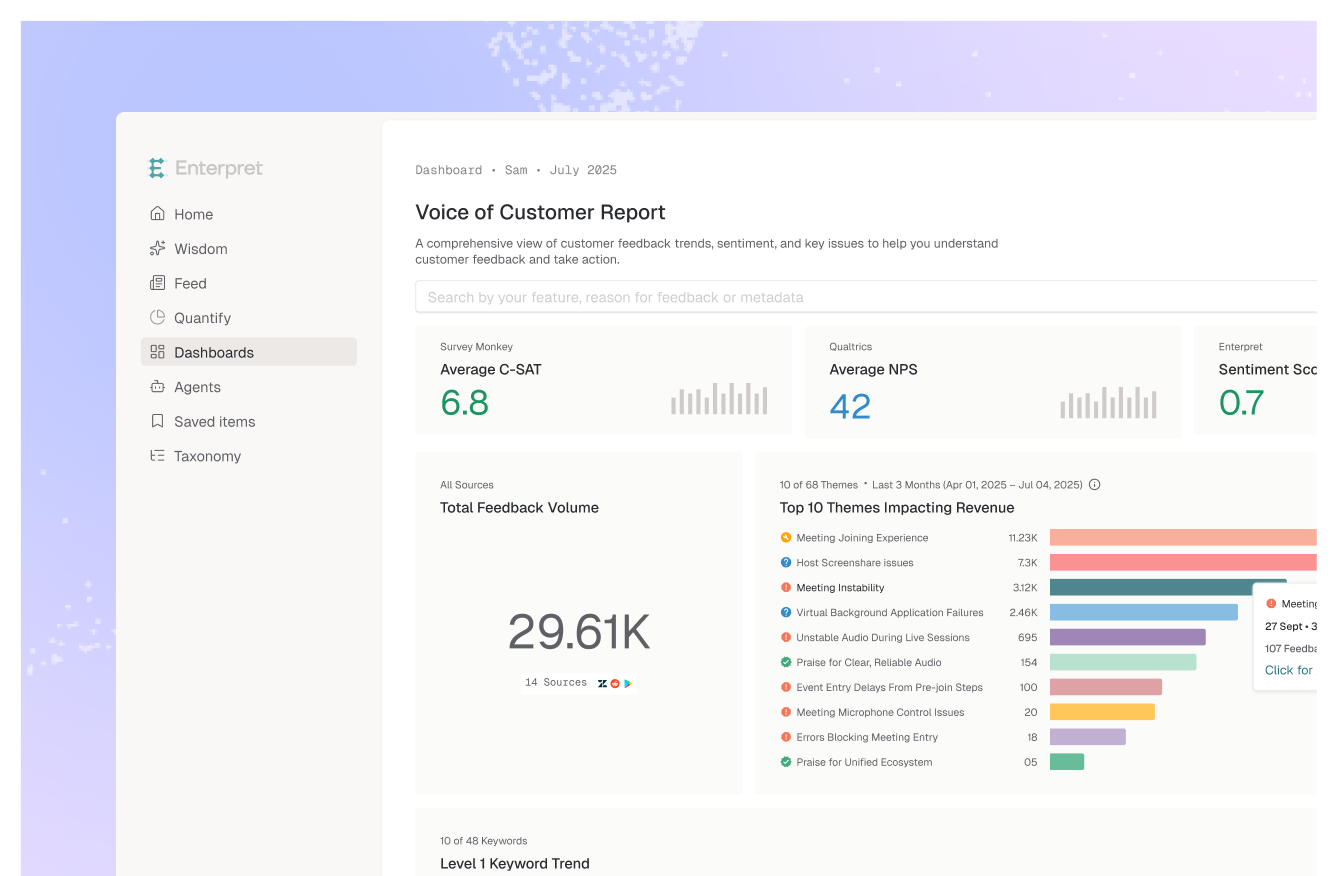
Enterpret's Wisdom MCP Server moves that work upstream. Feedback arrives already categorized by an adaptive taxonomy learned from your own data, and already tied to account and revenue context through the customer context graph. The agent reasons over computed themes instead of reconstructing them from a sample.
The field splits into two layers, and comparing across them is the mistake most evaluations make.
Source-system servers expose one tool's records to an agent. Zendesk shipped a first-party MCP server in 2026 after announcing it at Relate, alongside a separate MCP client that points the other direction. Intercom runs an official remote server at mcp.intercom.com, now maintained by Fin. Swifteq and several open-source projects wrap the Zendesk API and predate the first-party option. All of these do a real job well: they put one system's raw data in front of a model.
Intelligence-layer servers expose interpreted feedback across systems. This is where Enterpret sits, and the distinction is not marketing. A source-system server can tell an agent what ticket 4,182 says. It cannot tell the agent that the theme behind that ticket appears in 900 others, spans four channels, and concentrates in accounts worth protecting, because that computation never happened anywhere.
If your question is about one system, a source-system server is the shorter path and you should use it. If your question is about your customers, one system is a biased sample by construction.
Auto converting a REST API into an MCP server is the most common shortcut, and it is why so many integrations disappoint after the demo. Wrapping /tickets as get_tickets changes the calling convention and nothing else. The agent still gets ticket bodies, still invents categories to summarize them, and still has no idea which of those tickets came from an account worth protecting.
Feedback data is only useful once it has been interpreted, and interpretation is expensive to redo per query. A taxonomy built at ingest is stable, auditable, and consistent across every question anyone asks. A taxonomy improvised inside a context window is none of those, which is why an LLM gives you different feedback categories every time you ask it to sort the same data.
ElevenLabs hit this directly. The team evaluated building its own customer intelligence stack before choosing Enterpret, and the failure point was not generating summaries. It was producing one trusted view of customers that product, growth, and engineering could all decide from. After unifying channels and connecting feedback to activation and retention metrics, the mobile app went from zero to $10M ARR in under six months, in the top 0.2 percent of mobile apps for revenue growth, with an automated weekly digest replacing 30 to 45 minutes of Monday prep.
The useful test when evaluating any feedback MCP server: ask the same question twice, a week apart, with new data in between. If the categories drift, you are looking at a protocol upgrade rather than an intelligence layer.
Reach for a direct API when the consumer is your own code, the calls are fixed and known in advance, and latency matters more than flexibility. Reporting pipelines, scheduled exports, and warehouse syncs belong here.
Reach for a source-system MCP server when you want one tool's records in front of a model and the questions stay inside that tool.
Reach for an intelligence-layer MCP server when the questions are about customers rather than systems, span more than one channel, and need to return the same answer twice.
Most teams end up running all three. The decision rule: weight where the interpretation happens over how many endpoints get exposed. Six well modeled tools over a categorized dataset beat sixty tools over raw text.
No. MCP sits above APIs rather than replacing them. APIs continue to handle service to service communication, and the MCP server exposes those capabilities to models in a structured, discoverable form. Most production stacks run both.
Technically yes, and many teams do. The limitation is that a mechanical wrapper changes the calling convention without changing the response shape, so the agent still receives raw records it has to categorize itself. The value comes from what the layer returns, not from the protocol alone.
It is better isolated. The server holds credentials and exposes only scoped capabilities, so keys and tokens never enter the model's context. That removes one disclosure path, though it does not remove the need to scope what the agent can read.
Enterpret's Wisdom MCP Server exposes feedback already categorized by an adaptive taxonomy learned from your own data rather than from a preset category list, and already connected to account, segment, and revenue context through the customer context graph. The agent queries computed themes instead of retrieving a sample and calculating over it.
Ask the same question twice with new data in between and compare the categories. Then ask a question that requires the full dataset and check whether the answer came from everything or from what fit in context. Drifting categories and silent sampling are the two failure modes that do not show up in a demo.
If you are deciding how agents should reach your customer feedback, see how Enterpret's customer feedback integrations structure the data before it reaches the model.
Lorem ipsum dolor sit amet, consectetur adipiscing elit. Suspendisse varius enim in eros elementum tristique. Duis cursus, mi quis viverra ornare, eros dolor interdum nulla, ut commodo diam libero vitae erat. Aenean faucibus nibh et justo cursus id rutrum lorem imperdiet. Nunc ut sem vitae risus tristique posuere.