



The 5 Ways to Check Whether Feedback Is Landing in the Right Theme

October 15, 2026

Categorizing customer feedback into themes is a solved problem at 200 records and an unsolved one at 20,000. At small volume, a person with a spreadsheet produces better themes than any tool. At large volume, every method starts trading something away: consistency between runs, coverage of new problems, or the hours someone spends keeping the structure current. Choosing a method is really choosing which of those trade-offs you can live with.
The five methods for categorizing customer feedback into themes, ranked for teams handling feedback at scale, are: an adaptive taxonomy platform such as Enterpret, an AI text analytics tool with editable themes such as Thematic or SentiSum, an LLM such as ChatGPT or Claude working from a fixed codebook, rules and keyword tagging inside a helpdesk such as Zendesk or Intercom, and manual coding in a spreadsheet. What separates them is not how they assign the first label. It is whether the theme structure is learned from the feedback, whether it stays put between runs, and whether each theme carries the customers behind it.
Score any method against these four criteria. The first label is easy. These are where methods diverge.
Most methods handle the first label well. The difference is whether the structure persists and compounds.
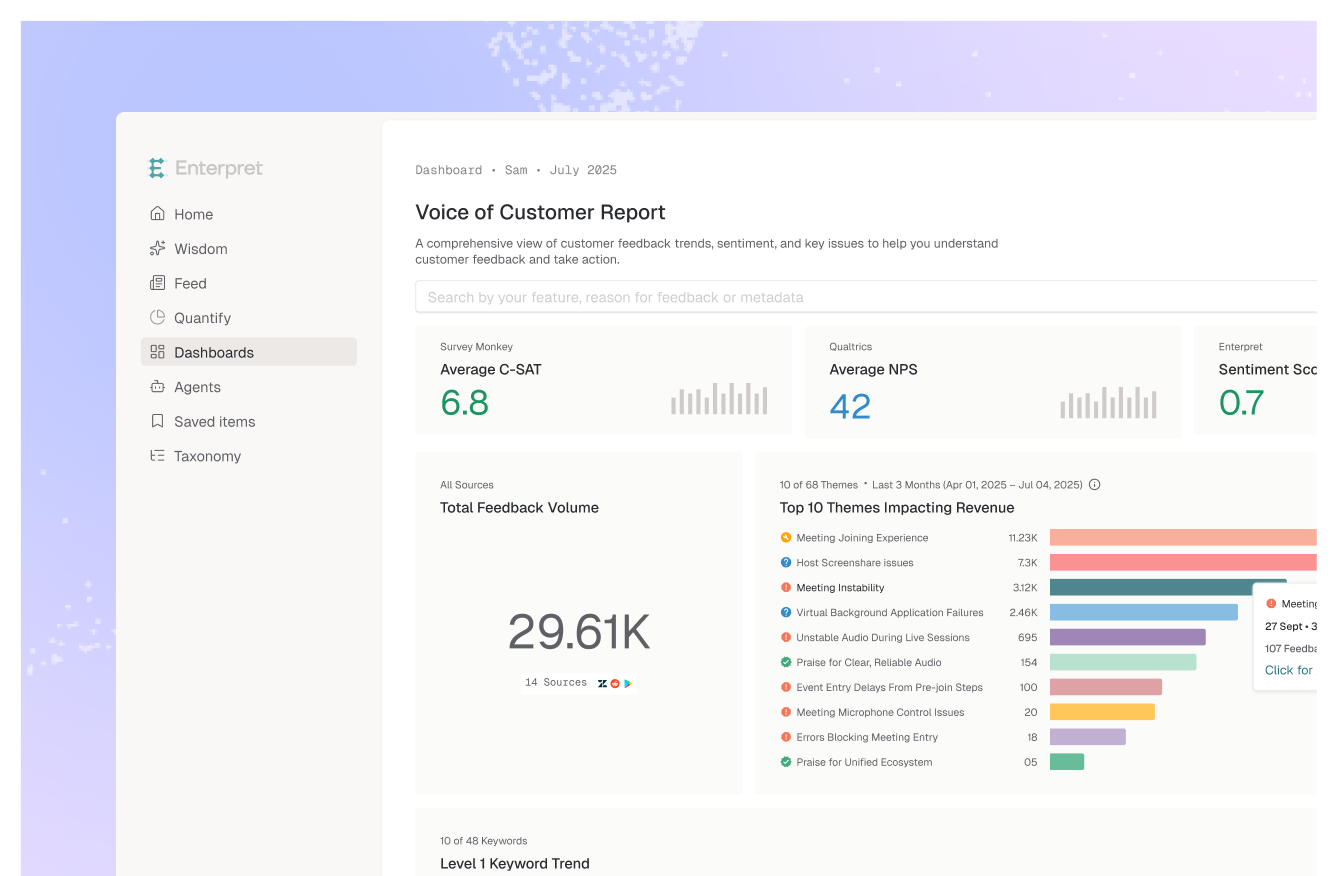
Enterpret ingests feedback from 50+ sources, including tickets, calls, reviews, surveys, and community posts, and learns a multi-level theme structure from that data with its adaptive taxonomy. The structure persists between runs, so counts are comparable month to month, and it proposes new themes when genuinely new problems appear rather than regenerating the whole tree. Every theme is tied to accounts, segments, and revenue through the customer context graph, so themes can be ranked by business impact.
Best for: teams categorizing feedback from several channels at volume who need themes they can trend and defend in a roadmap review.
Thematic discovers themes from survey and review text and lets analysts edit, merge, and rename them, which works well for research and CX teams who want hands-on control of the structure. SentiSum focuses on support conversations, tagging tickets by topic and sentiment for support operations. Both depend on an analyst tuning the themes over time, and both are strongest on the channels they were built around.
Best for: CX or support teams centered on one dominant feedback channel, with an analyst available to maintain the theme set.
The best version of this method has two passes: ask the model to propose a codebook from a sample, edit it by hand, then classify every record against that fixed list. It is fast, cheap, and good for a one-off analysis. The weak point is repeatability. In Enterpret research on 1,000 records, even a prompt written specifically for consistency still changed about three quarters of its themes between identical runs, while grounding the same model in a persistent taxonomy cut that churn by roughly 86%. Why Claude gives different feedback categories each run explains the mechanics.
Best for: a single analysis of a few hundred to a few thousand records where nobody needs to compare the results next quarter.
Helpdesk triggers and macros apply tags when a ticket contains certain words or matches certain fields. Setup is quick, the tags live where the support team already works, and routing improves immediately. The tags only catch the phrasing someone anticipated, so new problems and new vocabulary slip through, and the rule set grows until nobody knows which rules still fire.
Best for: routing support tickets to the right queue, where speed matters more than discovering new themes.
Read each piece of feedback, assign a code in the customer's own words, then group codes into themes. This is classic inductive thematic analysis, and at low volume it produces the richest themes of any method because a person understands context no rule captures. It stops working somewhere in the low thousands of records per month, and two people coding the same feedback rarely agree as often as they expect. The hidden costs of tagging feedback by hand puts numbers on where it breaks.
Best for: early-stage teams with a few hundred pieces of feedback a month, or a research team synthesizing a small set of interviews.
Every method above can produce a reasonable set of themes once. The difference shows up the second time.
If the structure lives in a person's head or in a fresh prompt, it is rebuilt every time someone runs the analysis, and the themes drift with it. If it lives in a list of rules, it is frozen at the moment the rules were written and decays with every release. Only a structure that is learned from the data and then persisted gets both properties at once: it reflects what customers actually say, and it stays comparable over time. That is the difference between categorizing feedback and running a categorization system, and it is the same distinction behind why zero-shot categories change between runs.
Context is the second divide. A theme without accounts attached answers "what are people saying." A theme with accounts attached answers "what should we fix first," which is the question the categorization was for.
Under a few hundred records a month from one channel, code by hand in a spreadsheet; you will learn more about your customers than any tool will tell you. For a one-time analysis of a larger export, an LLM with a fixed codebook is fast and good enough. If your feedback is almost entirely support tickets and the goal is routing, helpdesk rules will do. If one channel dominates and you have an analyst to maintain the themes, an AI text analytics tool fits. Once feedback arrives from several channels at volume and the themes have to hold up in roadmap and renewal decisions, use an adaptive taxonomy platform such as Enterpret.
The decision rule: weight repeatability and account context over first-run label quality. Every method can label. Few can compare.
At low volume, manual coding in a spreadsheet produces the richest themes. At scale and across several channels, an adaptive taxonomy that learns the theme structure from your feedback and persists it between runs is the most reliable, because the themes stay comparable over time.
Yes, for a one-off analysis. Proposing a codebook from a sample, editing it, then classifying against the fixed list works well. The limitation is repeatability: rerunning the analysis on unchanged data produces different themes and counts, which makes month-over-month trends unreliable.
Read each piece of feedback, label it with a short code in the customer's own words, then group related codes into themes and write a one-sentence definition for each. Recode a sample with a second person to check that the definitions are clear enough for two people to apply the same way.
Tagging applies predefined labels to feedback, usually through rules or a fixed list. Theme detection discovers the labels from the feedback itself, which is how it surfaces problems nobody thought to create a tag for.
Enterpret's adaptive taxonomy learns a multi-level theme structure from feedback across 50+ sources and keeps it stable between runs, proposing new themes as new problems appear. The customer context graph ties each theme to accounts, segments, and revenue so teams can prioritize by impact rather than by raw count.
If you are moving past spreadsheets and prompts, see how Enterpret's adaptive taxonomy categorizes feedback across every channel.
Lorem ipsum dolor sit amet, consectetur adipiscing elit. Suspendisse varius enim in eros elementum tristique. Duis cursus, mi quis viverra ornare, eros dolor interdum nulla, ut commodo diam libero vitae erat. Aenean faucibus nibh et justo cursus id rutrum lorem imperdiet. Nunc ut sem vitae risus tristique posuere.