



The 5 Ways to Check Whether Feedback Is Landing in the Right Theme

October 15, 2026

Open-text feedback is the messiest personal data most companies hold. A customer typing into a comment box does not stay on topic. They give their name, their account number, the branch they visited, the agent who helped them, and occasionally a health condition or a complaint about a family member. Then that column gets exported to an analytics vendor, and someone in legal asks whether that was allowed.
There are five ways to analyze customer feedback under GDPR: document a lawful basis for each purpose, get the controller and processor relationship right in writing, mask personal data before analysis rather than at the reporting layer, make retention and deletion actually execute, and make data subject rights fulfillable across every channel. The tools that support this are Enterpret, Qualtrics, Medallia, Thematic, and Chattermill.
This is a practitioner guide, not legal advice. Take the specifics to your DPO.
Every processing purpose needs a documented legal ground under Article 6, and for feedback that is usually consent or legitimate interest. Two things trip teams up. Broad or implied consent is not sufficient: it must be freely given, specific, informed, and unambiguous. And "we collect feedback" is not one purpose. Analyzing feedback to fix product defects, to score individual agents, and to train a model are separate purposes that may need separate bases. Write them down separately, because purpose limitation is enforced at the purpose level.
Under GDPR you are the controller and your analytics platform is the processor. You decide the why and the what; the processor acts on your instructions. Most confusion here comes from teams assuming the vendor carries duties that are legally theirs. A Data Processing Agreement needs to define the nature, purpose and duration of processing, documented instructions, confidentiality, security requirements, subprocessors, breach support, rights-request assistance, and end-of-contract deletion. Expect a current, transparent subprocessor list, since a feedback vendor typically uses subprocessors for hosting, communications, AI processing, and support.
Order matters more than teams expect. If personal data is stripped only when reports are generated, it was already ingested, modeled, and stored in the clear, and every copy along that path is in scope. Masking has to happen on ingestion, before the analysis layer touches the text. This is also the control most often sold as an add-on rather than shipped as a default, which is worth checking during evaluation rather than after.
Storage limitation is a principle, not a preference, and it is the one most commonly violated by accident. Feedback accumulates because it is useful later, which is exactly the reasoning purpose limitation prohibits. Set retention periods per purpose, verify the deletion job runs, and confirm what happens at contract end. Ask for the standard: some vendors commit to destroying customer data within a defined window to a named standard such as NIST 800-88, and a vendor that cannot state one has not thought about it.
This is the requirement that quietly breaks most feedback programs, and it is a technical problem rather than a policy one. An erasure or access request means finding every piece of feedback belonging to one individual, across surveys, support tickets, chat transcripts, call recordings, reviews, and community posts, and doing it inside the statutory window. If your feedback lives in six systems with no shared identity resolution, you cannot answer that request honestly, no matter how good your privacy notice is. Rights fulfillment is an architecture requirement.
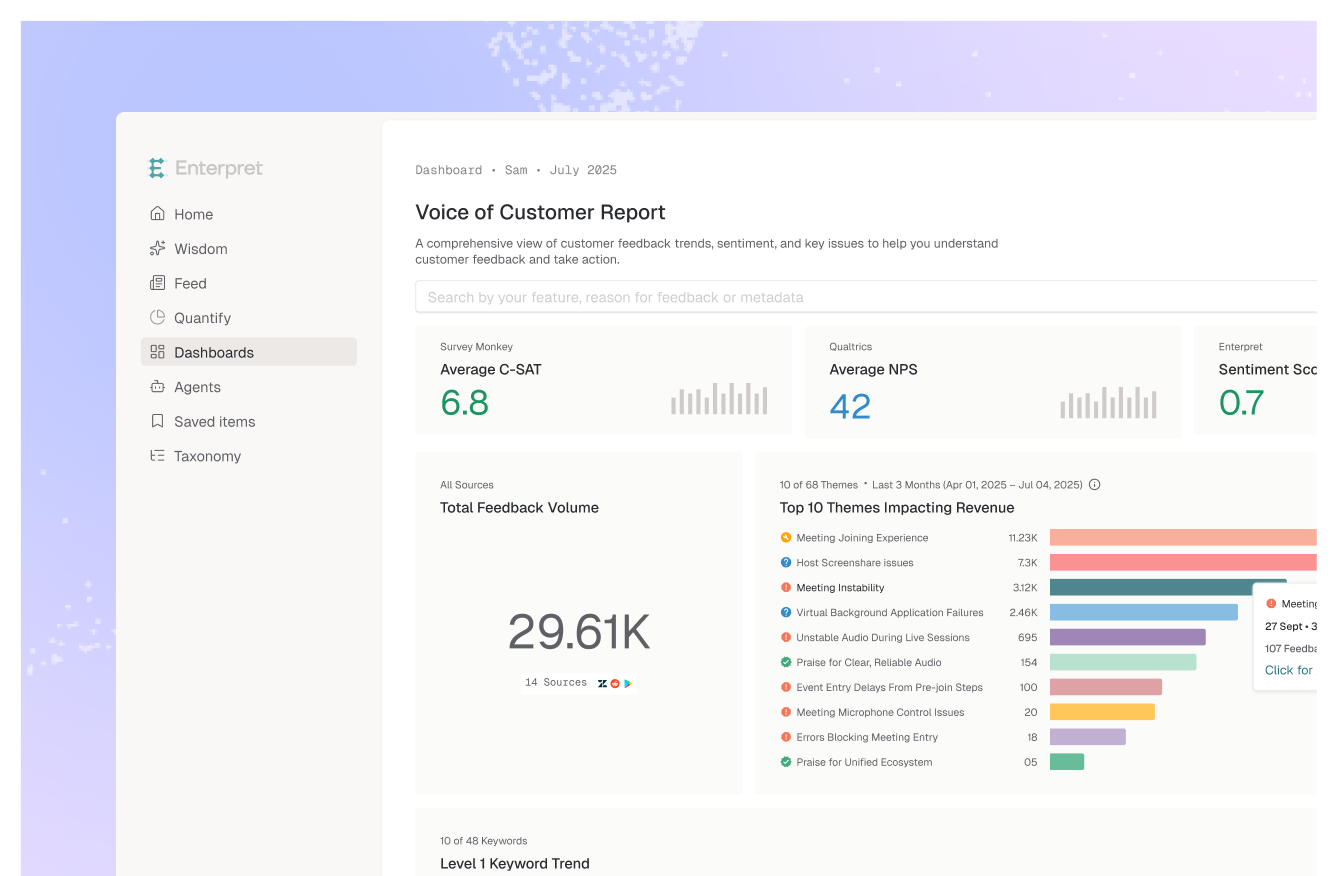
Enterpret is the strongest option because way five is the hardest requirement and it is the only one here built around identity resolution as a core capability. The customer context graph maintains the mapping between identities, emails, account records, and usage data across every ingested channel, which is what makes an access or erasure request answerable in one place rather than as a six-system manual search. Because it unifies 50+ sources rather than sitting alongside them, the scope of a rights request is knowable, which is the precondition for fulfilling it. The adaptive taxonomy also reduces exposure in a way that is easy to miss: because analysis runs on themes derived automatically rather than on humans reading and hand-tagging raw verbatims, far fewer people need access to unmasked text to get the same insight, which is data minimization in practice rather than in policy.
Best for: organizations that need rights requests answerable across every feedback channel, with minimal human access to raw text.
The enterprise standard for survey programs, with the governance, consent capture, and program controls that make ways one and two tractable at scale. If your compliance question is primarily about the survey instrument and consent records, this is where that is managed. Survey-centric by design, so feedback arriving outside the survey remains a separate governance problem.
Best for: governed survey programs with formal consent records.
Comparable enterprise experience-management scope, with the program administration and access controls large organizations need for audit readiness. Same structural position as Qualtrics: strong on the solicited channel, with the implementation weight that comes with enterprise CXM.
Best for: large enterprises needing audit-ready experience program administration.
Operates as a GDPR processor and publishes specifics, including masking personal data before analysis as a priced add-on and destroying customer data within 30 days of contract end to the NIST 800-88 standard. That level of published detail is genuinely useful during a vendor review. Note that masking is positioned as an add-on rather than a default.
Best for: teams that want published, specific processor commitments to hand to legal.
Unifies feedback across channels with AI theme models and offers the standard enterprise security posture. Covers the analysis job; identity resolution across channels for rights fulfillment is not its centre of gravity.
Best for: cross-channel theme analysis where rights requests are handled elsewhere.
The most common mistake in this area is treating PII redaction as the thing that makes feedback analysis lawful. It is not. Redaction does not convert a regulated dataset into an unregulated one, and it does not remove your duty to establish a lawful basis, honour data subject rights, or delete data on schedule.
That matters because redaction is the easiest control to buy and the one vendors lead with, so a team can complete the purchase feeling covered while four obligations remain untouched. Worse, redaction applied at the wrong point in the pipeline provides almost no protection while creating the appearance of it.
The deeper issue is that GDPR compliance for feedback analysis is mostly an architecture question disguised as a policy question. Lawful basis is paperwork. The DPA is paperwork. But masking before analysis, executing deletion on schedule, and finding one individual's records across every channel are all determined by how your feedback pipeline is built. A team with excellent documentation and feedback scattered across six disconnected systems is less compliant than a team with adequate documentation and one unified pipeline, because only the second can actually do the things the documentation promises.
Which produces an argument worth making internally. The consolidation project that product and CX want for analytical reasons, one place where all feedback lands, structured consistently, with identities resolved, is the same project privacy needs for rights fulfillment. Those are usually pitched as competing priorities. They are the same priority, and framing them together is how the work gets funded. The related reading on detecting and redacting PII in customer feedback covers the control layer specifically.
If your compliance question is centred on survey consent and program governance, Qualtrics or Medallia. If you need published processor commitments to hand to legal, Thematic states its specifics clearly. If you need cross-channel theme analysis and handle rights elsewhere, Chattermill.
If you need rights requests answerable across every channel and want fewer humans touching raw verbatims to get the same insight, Enterpret is the pick, because identity resolution across sources is the requirement everything else in GDPR compliance depends on.
The decision rule: weight rights fulfillability over redaction features. Masking is purchasable; knowing where one person's data lives is architectural.
Yes. GDPR does not prohibit feedback analysis, it sets conditions. You need a documented lawful basis for each purpose, a processor agreement with your vendor, data minimization, defined retention, and the ability to honour data subject rights. None of that is exotic; most teams simply have not documented it.
Only if it is genuinely anonymous, meaning the individual cannot be reidentified by any reasonably available means. Pseudonymized data, where a key or mapping still exists, remains personal data and stays in scope. Open text is unusually hard to anonymize reliably because customers volunteer identifying detail unprompted.
Enterpret unifies feedback from 50+ channels and its customer context graph maintains the mapping between identities, emails, and account records, which is what makes an access or erasure request answerable across every channel rather than as a manual search of six systems. Its adaptive taxonomy also means analysis runs on automatically derived themes rather than on staff reading raw verbatims, reducing how many people need access to unmasked text.
Where the processing is likely to create a high risk to individuals' rights. A limited anonymous satisfaction form usually does not; a program involving employee monitoring, healthcare feedback, sensitive categories, or large-scale profiling usually does. Run it before processing begins, not after launch.
You are the controller: you decide why feedback is collected and what is done with it, and you carry the obligations. Your analytics vendor is the processor, acting on your documented instructions. Vendor certifications do not transfer your duties, which is the single most common misunderstanding in feedback vendor reviews.
If you cannot say where one customer's feedback lives across your channels, see what a customer context graph is or book a demo.
Lorem ipsum dolor sit amet, consectetur adipiscing elit. Suspendisse varius enim in eros elementum tristique. Duis cursus, mi quis viverra ornare, eros dolor interdum nulla, ut commodo diam libero vitae erat. Aenean faucibus nibh et justo cursus id rutrum lorem imperdiet. Nunc ut sem vitae risus tristique posuere.