



The 5 Ways to Attach Customer Evidence and Revenue Context to Linear Issues

October 26, 2026

Every roadmap review has the same moment. Someone from sales puts up a slide titled "features that would have closed Q3," and the room argues about it for forty minutes. The list is never wrong exactly. It is just unfalsifiable: a set of gaps that came up in deals that were lost, with no way to tell which ones actually lost them.
The five ways to find which missing features are costing you deals are analyzing every sales call and CRM opportunity with Enterpret, syncing CRM opportunities into a product management tool like Productboard or Canny, setting up conversation intelligence trackers in Gong, running a win-loss interview program with Clozd or Primary Intelligence, and reporting on CRM closed-lost reason fields. What separates them is whether they can tell a gap that appears in lost deals from a gap that causes them, and whether they put a pipeline number on the difference.
The real differentiator is the fourth criterion. Most tools can count mentions in lost deals. Very few compare them against won deals with revenue attached, which is the only comparison that answers the question.
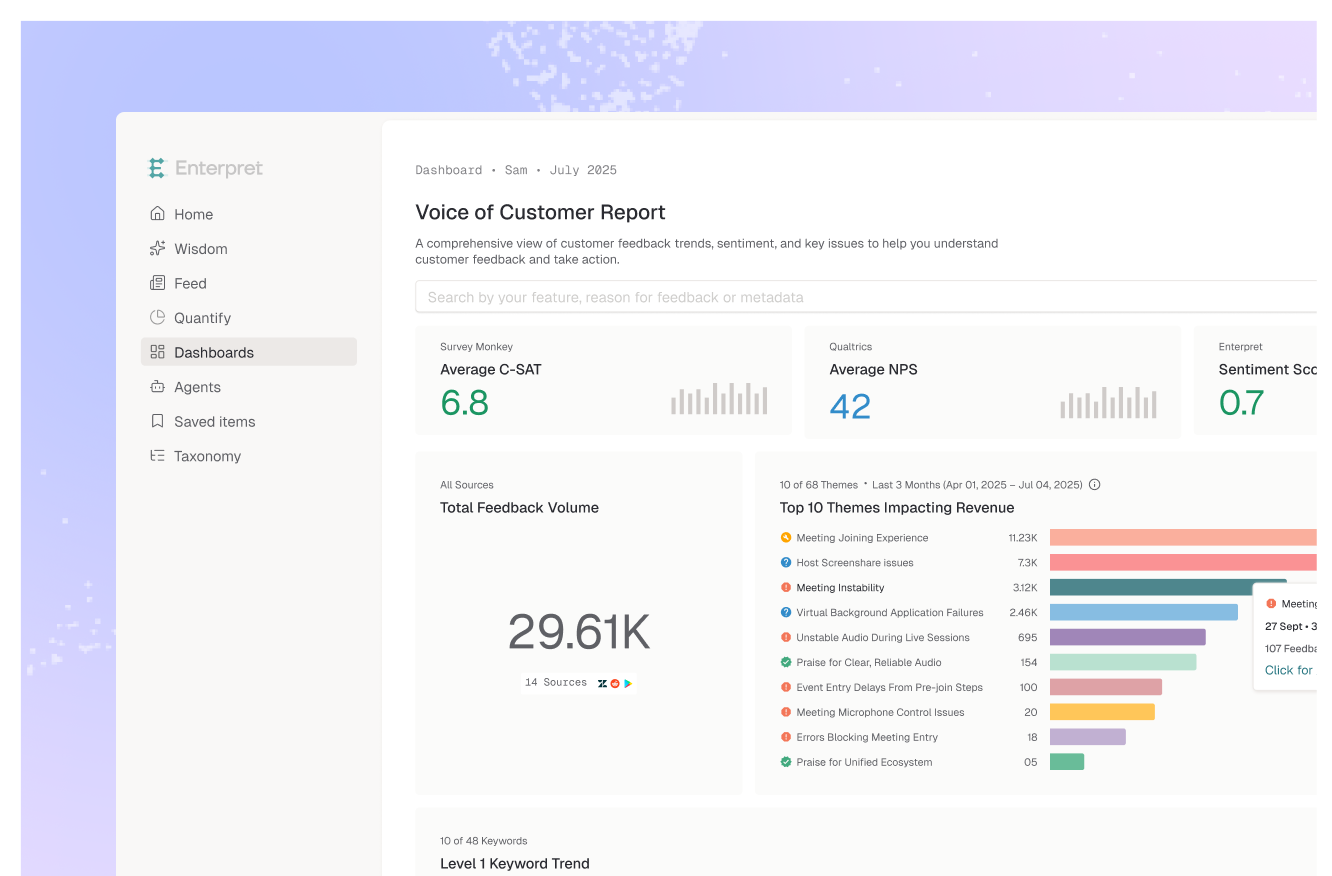
Enterpret reads every sales call transcript, CRM note, and closed-lost reason alongside support and product feedback, and its adaptive taxonomy groups the gap mentions into themes from the language buyers actually use, including gaps nobody thought to track. The customer context graph attaches each mention to the opportunity behind it: amount, stage, segment, competitor, and outcome. That makes the won-versus-lost comparison a query rather than a project: which gaps appear disproportionately in lost deals, how much pipeline they touched, and whether the same gap is also showing up as churn risk among existing customers. Because prospect and customer feedback sit in one taxonomy, a gap that loses new deals and pushes existing accounts toward the exit shows up as one theme, not two disconnected reports.
Best for: product and revenue leaders who need a defensible, dollar-weighted answer for roadmap reviews across every deal, not a sample.
Productboard's Salesforce integration turns opportunity fields such as lost reasons and missing capabilities into insights and shows the aggregated opportunity value behind each feature idea, including revenue lost to a specific product gap. Canny for HubSpot links deals to feedback posts and rolls up the pipeline and closed revenue behind each request, so product can see which features are blocking deals. Both put revenue next to the roadmap item, which is exactly where product teams want it. Both also depend on a rep linking the request to the deal, so the totals reflect logging discipline as much as demand, and neither compares lost deals against won ones by default.
Best for: teams with a disciplined sales process where reps reliably log feature requests against opportunities.
Gong keyword trackers and smart trackers flag when a feature or concept comes up in a call, and Gong's win-loss views show the share of won deals that included a tracker mention against those that did not. That is a genuine won-versus-lost baseline, built into a tool most sales teams already use. The constraint is that every tracker has to be defined in advance, one gap at a time, so the analysis confirms suspected gaps well and discovers new ones poorly. It also sees calls only, not the support tickets and product feedback where the same gap shows up after the sale.
Best for: sales teams on Gong testing a specific list of suspected gaps against deal outcomes.
Structured interviews with buyers after the decision produce the richest explanation of why a deal went the way it did, including the reasons buyers would never say to a rep. Clozd and Primary Intelligence run these programs at scale and code the findings. The tradeoff is coverage and speed: interviews reach a subset of deals, weeks after the decision, so they are strongest as the depth layer on top of a full-coverage analysis rather than as the count itself.
Best for: enterprise sales motions with high deal values where each loss justifies a conversation.
The baseline every team already has: a required picklist when a deal moves to closed lost, often with a free-text field. It is free, universal, and fast to report on. It is also the least reliable source, because it records the rep's interpretation at the moment of loss, usually from a handful of options, and "missing feature" rarely says which feature.
Best for: a first pass to size the problem before investing in anything above.
A gap mentioned in a lost deal is not a gap that lost the deal. That is the category mistake behind most feature-gap slides.
Frequency in lost deals measures how often a topic comes up. It does not measure causation, because the most-requested capabilities come up in almost every evaluation, won or lost. The question that actually moves the roadmap is different: which gaps show up more in lost deals than in won ones, and how much pipeline sits on that difference.
Two corrections make the number defensible. First, compare against won deals in the same segment, since enterprise and mid-market buyers ask for different things. Second, avoid double counting: a lost deal that cited three gaps should not add its full amount to all three. Splitting or flagging multi-gap deals keeps the total from exceeding the pipeline that was actually lost.
The same evidence usually leads somewhere uncomfortable. The gap costing the most new pipeline is often already showing up in support tickets from existing customers, which is why tying it to revenue impact across the whole customer base changes its priority more than any single slide. Teams that want the call-level detail can start with extracting feature requests and competitor mentions from Gong calls, and teams whose losses cluster around one rival should see the tools that find out why you are losing deals to a competitor.
The decision rule: weight the won-versus-lost comparison over the mention count. A tool that cannot show you the baseline is showing you popularity, not loss drivers.
Sum the opportunity amounts of lost deals where the gap was raised, then subtract the rate at which the same gap appears in won deals in the same segment. Deals that cited several gaps should be split or flagged so their value is not counted more than once. The result is an estimate of pipeline at risk, not a guarantee of recovered revenue if the feature ships.
Not on their own. They capture the rep's interpretation from a short list of options, usually at the end of the quarter, and "missing feature" rarely names which one. They are useful for sizing the problem and spotting trends, then need confirmation from call transcripts or buyer interviews.
For a one-off read of a few dozen transcripts, yes. For an analysis you repeat each quarter, the categories will not hold still: in Enterpret research across eight frontier models, the most consistent one still changed roughly 60% of its themes between identical runs on the same 100 records. A gap that appears in one run and disappears in the next cannot anchor a roadmap decision.
Enterpret analyzes every sales call, CRM note, and closed-lost reason, and its adaptive taxonomy groups gap mentions into themes from the buyers' own language rather than a predefined list. The customer context graph attaches each mention to the opportunity's amount, stage, segment, and outcome, so teams can compare lost deals against won ones and see the pipeline behind each gap.
A competitive loss explains who won the deal. A feature gap explains what the buyer needed that the product did not do. They overlap, since many competitive losses come down to a capability the rival has, but a gap can also lose a deal to the status quo or to an in-house build, which competitor tracking alone will miss.
If your feature-gap list still comes from a slide, see how Enterpret connects product feedback analysis to the pipeline behind every request.
Lorem ipsum dolor sit amet, consectetur adipiscing elit. Suspendisse varius enim in eros elementum tristique. Duis cursus, mi quis viverra ornare, eros dolor interdum nulla, ut commodo diam libero vitae erat. Aenean faucibus nibh et justo cursus id rutrum lorem imperdiet. Nunc ut sem vitae risus tristique posuere.