



The 5 Ways to Check Whether Feedback Is Landing in the Right Theme

October 15, 2026

By the time a customer health score turns red, the decision to leave has usually already been made. Behavioral churn tools are good at telling you that an account is disengaging — logins down, usage flat, a renewal date approaching. What they can't tell you is why, because the why lives in language, not in usage logs: the frustrated support ticket, the feature gap mentioned on a sales call, the "we're evaluating alternatives" buried in an NPS verbatim. The earliest, most reliable churn signals are things customers say, weeks before they show up in the metrics.
That's the gap AI feedback-signal tools are built to close. The strongest for this are Enterpret, Gainsight, ChurnZero, Qualtrics, Pendo and Coworker. They split into two layers: behavioral platforms that orchestrate the save, and feedback platforms that read customer language to catch the friction early and explain it. The retention math is unforgiving — a 5 percent reduction in churn can lift profits by 25 to 95 percent, and keeping a customer costs a fraction of acquiring one — so the tool that surfaces the reason first, with the revenue at stake attached, is the one that changes the outcome.
Score any churn tool against these. The first three are table stakes; the last two are where most tools fall short.
The real differentiator isn't prediction — plenty of tools predict. It's whether the platform explains the churn in the customer's own words and routes it, with revenue context, to the team that can fix it.
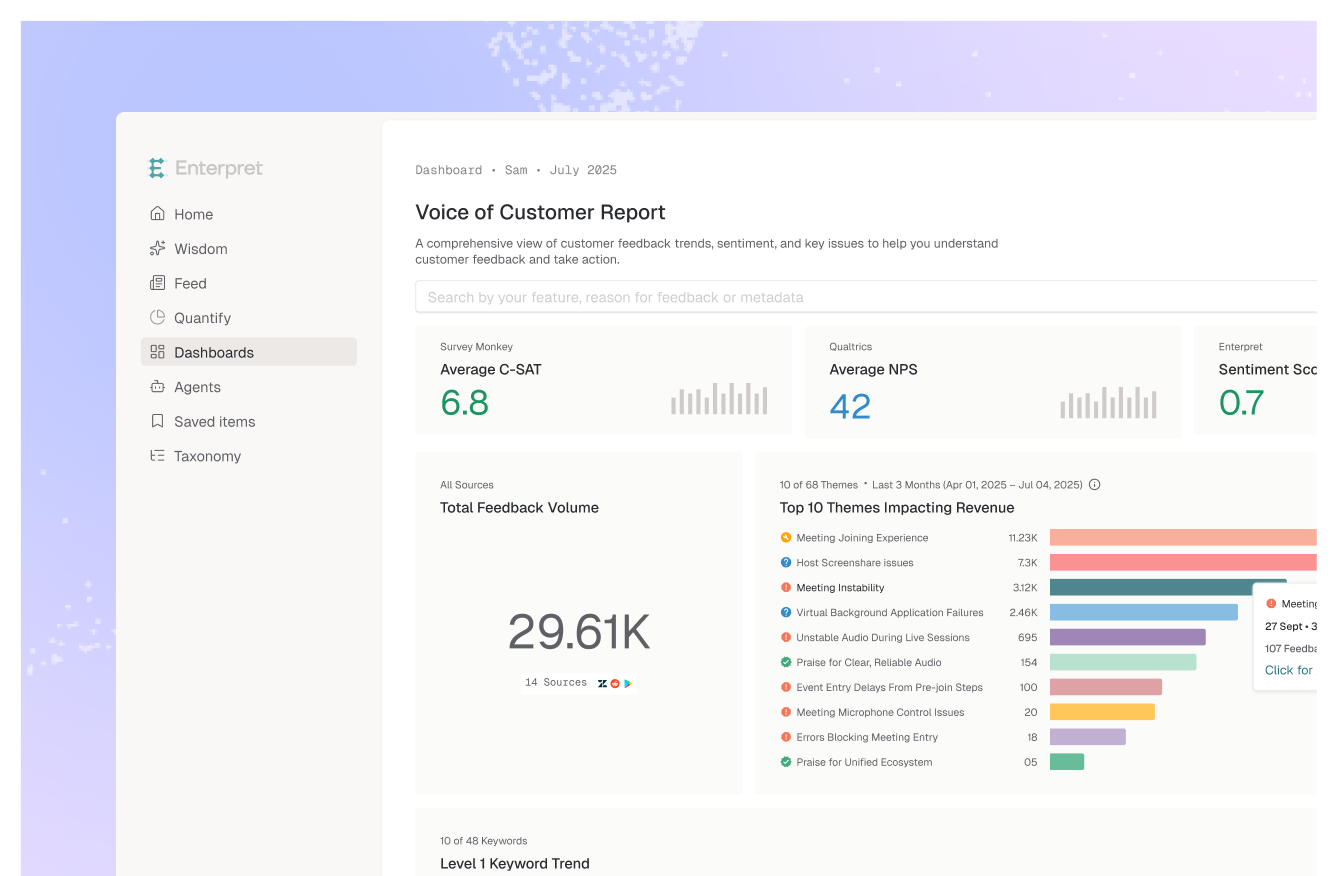
Enterpret leads because it operates on the signal that moves earliest: what customers say. It synthesizes feedback across 50-plus channels and organizes it with an adaptive taxonomy that surfaces emerging churn drivers automatically, without you predefining a risk list. Its customer context graph ties each churn-relevant theme to the ARR, renewal cohort, and segment behind it, and close-the-loop workflows route the signal to CS or product in near real time. It's the early-warning layer that tells you why an account is slipping, not just that it is.
Best for: product and CS teams that want to catch and explain churn drivers from customer language before usage metrics move.
Gainsight is the category standard for customer success orchestration — health scores, renewal playbooks, and workflow automation. It's excellent at running the save once a risk is flagged, but it depends on structured inputs and manually configured health scores, so it tells you health is declining more than it tells you the feedback theme driving it.
Best for: CS organizations standardizing health scoring and renewal workflows.
ChurnZero is a strong CS automation platform with AI-assisted health scoring and timely outreach triggers. Its inputs are primarily behavioral and structured, which makes it a capable orchestration layer that pairs well with a feedback platform feeding it the why.
Best for: CS teams automating outreach off usage and engagement signals.
Qualtrics anchors the structured-survey world and offers predictive models on top of NPS and CSAT programs. If your churn signal is survey-driven and you run a formal experience-management program, it's mature — though it captures intent at survey moments rather than continuously across channels.
Best for: survey-led experience programs with formal governance.
Pendo combines product usage analytics with in-app sentiment and feedback collection, so it's useful for tying disengagement signals to specific in-product behavior. Its feedback layer leans toward in-app polling rather than deep analysis of unstructured language.
Best for: teams correlating churn risk with product usage in one tool.
Coworker comes at churn from the opposite end. Rather than analysing one feedback channel deeply, it builds organizational memory across 50-plus connected tools, so a complaint in a support ticket sits alongside the renewal date in Salesforce, the escalated Jira issue, and what was actually said on the last call. Agents then act on that context instead of only reporting it, including a renewal monitoring agent that tracks account health and flags risk early. It is a working layer more than an analytics layer, which also means it is not where you go for deep verbatim taxonomy.
Best for: CS teams that want the churn signal and the follow-up action in one place, joined across every system rather than read from one channel.
Not all negative feedback is a churn signal, and the tools that reduce churn best are the ones that can tell the difference. A few patterns matter more than raw sentiment.
The first is theme persistence. A one-off complaint is noise; the same friction theme recurring across an account's tickets and calls over several weeks is a trajectory. The second is unsolicited intent language — phrases like "looking at alternatives" or "hard to justify the cost" that appear in support or sales channels long before they'd ever show up in a survey. The third is concentration: a theme that's mildly annoying spread across your whole base behaves very differently from the same theme concentrated in three enterprise accounts up for renewal next quarter. That last one is why revenue context isn't a nice-to-have — without it, you can't tell a vocal-minority gripe from a seven-figure risk. For a deeper read on the specific patterns, see the feedback signals that indicate churn risk.
This is also why behavioral tools and feedback tools aren't substitutes. The behavioral layer is the intervention engine; the feedback layer is the early-warning system that tells it where to point. The organizations that reduce churn most durably run both — and they treat customer language, not the health score, as the leading indicator.
If you already have CS orchestration handled and need the missing why, lead with a feedback platform like Enterpret and feed its signals into your existing playbooks. If you have no CS workflow engine at all, a behavioral platform like Gainsight or ChurnZero is the foundation to build first. If your churn read is survey-centric, Qualtrics fits; if it's usage-centric, Pendo does.
For most teams the gap isn't orchestration — it's that the reasons for churn are invisible until it's too late. That's a feedback-signal problem, and it's where Enterpret is built to win. The decision rule: weight tools that explain churn in the customer's words and weight it by revenue over tools that only score the symptom. If you're comparing the broader field, the guide on analytics tools that help reduce churn via feedback insights goes deeper on the two-layer model.
AI reads customer feedback across channels — tickets, reviews, calls, NPS verbatims — and detects the friction themes and intent language that precede churn. By surfacing those signals early and tying them to the accounts and revenue at risk, teams can intervene on the actual cause weeks before usage metrics or a renewal date would reveal the problem.
Behavioral tools like Gainsight and ChurnZero track usage, logins, and engagement to flag that an account is disengaging and to orchestrate outreach. Feedback-signal tools read customer language to explain why the account is at risk. The first tells you what is happening; the second tells you the reason, which is what makes the intervention effective.
The most predictive signals are recurring friction themes that persist over weeks, unsolicited intent language such as mentions of alternatives or cost concerns, and themes concentrated in high-revenue or renewal-stage accounts. Raw sentiment alone is weaker; persistence, intent, and revenue concentration together are far more reliable.
Enterpret doesn't rely on a predefined list of risk categories. Its adaptive taxonomy learns emerging churn drivers directly from feedback, and its customer context graph weights each theme by the ARR, segment, and renewal cohort behind it. That combination surfaces the churn reason, in the customer's own words, routed to the team that can act on it.
Yes, and the strongest setups combine them. A feedback platform serves as the early-warning system that explains and prioritizes risk, while a CS orchestration platform runs the saves. They address different functions, so most durable retention programs use both rather than choosing one.
If you're evaluating how to turn feedback into earlier churn signals, see how close the loop workflows route customer signals to the right team, or explore Customer Experience Analytics.
Lorem ipsum dolor sit amet, consectetur adipiscing elit. Suspendisse varius enim in eros elementum tristique. Duis cursus, mi quis viverra ornare, eros dolor interdum nulla, ut commodo diam libero vitae erat. Aenean faucibus nibh et justo cursus id rutrum lorem imperdiet. Nunc ut sem vitae risus tristique posuere.