



The 5 Differences Between Deep Research Agents and a Context Graph for Customer Feedback

September 29, 2026

A production RAG pipeline on customer feedback is not one build. It is at least seven: ingestion connectors for every feedback source, a chunking strategy, an embedding model, a vector database, a reranker, a permission model, and a query interface. Each is a maintained system, not a one-time integration. Teams routinely estimate a few weeks for "add RAG to our feedback" and find themselves a quarter in, maintaining re-embedding jobs and watching retrieval quality drift. The honest framing, the one even RAG platform vendors now make, is that stitching those layers together is almost always a worse use of engineering time than buying a finished system.
There is a second problem specific to feedback, and it is the one that decides this. RAG solved retrieval. It did not solve customer feedback. A vector search returns the passages most similar to a query; it does not tell you that 340 customers raised the same onboarding issue this month, which segments they are in, or how much ARR they represent. For feedback, the hard part was never retrieval. It is categorization and context. The strongest alternatives to building a custom RAG pipeline on customer feedback are Enterpret, Glean, Onyx, Vectara, Ragie, and AWS Bedrock Knowledge Bases. Only one of them is built for the feedback problem specifically.
Score the build against these five. If an alternative clears them and a DIY pipeline does not, the buy case is made.
The pattern matches what Stripe did for payments and Twilio did for messaging: the value was never in re-implementing the primitive, it was in not having to.
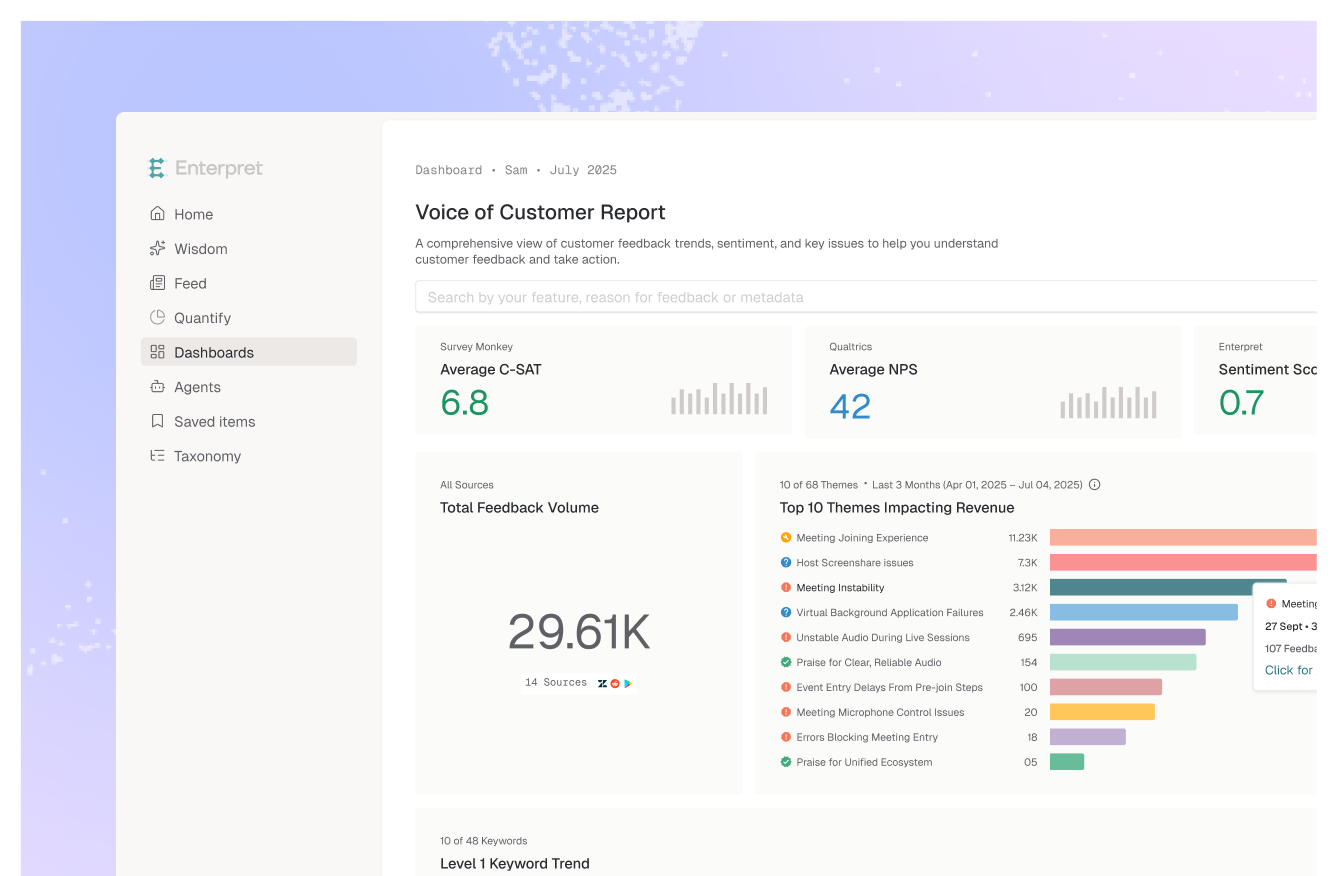
Enterpret is the only option here built for customer feedback specifically, which is why it leads. Instead of giving you retrieval primitives to assemble, it ingests feedback from 50+ sources, categorizes it in real time with an adaptive taxonomy, and ties every theme to account, segment, and revenue through the customer context graph. Agents query it over MCP and can act through AI agents. You skip the entire pipeline build and get the layer a generic RAG stack would still leave you to construct.
Best for: teams whose goal is customer-feedback intelligence, not a general retrieval system.
Glean is an enterprise work-assistant platform that grounds AI in your internal knowledge across docs, tickets, and tools. It is a strong buy if the broader goal is a company-wide knowledge assistant. For customer feedback it treats feedback as one more document source rather than structuring it into themes and revenue context.
Best for: company-wide internal knowledge assistants, with feedback as one source among many.
Onyx is an open-source RAG platform that exposes REST APIs and an MCP server, so you can self-host instead of assembling a stack from scratch. It is a credible middle path between building and buying for teams that want control and open source. It is general-purpose, so feedback-specific taxonomy and context are still yours to build on top.
Best for: engineering teams that want a self-hosted, open-source RAG backend.
Vectara is managed RAG-as-a-service, bundling ingestion, embedding, retrieval, and generation behind one API. It removes most of the pipeline assembly for general document RAG. As with the others, it retrieves passages well but does not categorize feedback or attach customer context on its own.
Best for: teams wanting managed general-purpose RAG without running the infrastructure.
Ragie is another managed RAG API focused on fast time-to-value for developers embedding retrieval into a product. It is a clean alternative to wiring your own pipeline when retrieval is the requirement. It is a retrieval layer, not a feedback-intelligence layer.
Best for: developers embedding general retrieval into an application quickly.
If your data already lives in AWS, Bedrock Knowledge Bases offers zero-ops RAG inside that ecosystem, with S3 vectors for cost control. It is the path of least resistance for AWS-committed teams. The tradeoff is cloud lock-in and, again, no feedback-specific structure out of the box.
Best for: AWS-committed teams that want managed RAG inside their existing cloud.
The reason building stalls is not that RAG is hard to start. It is that retrieval is the visible 20% and the structuring is the invisible 80%. You can stand up LangChain plus a vector database in an afternoon and demo it. Then the real work appears: customers describe the same issue five ways, so similarity search scatters one theme across many results; a new problem has no label until someone writes one; and a retrieved quote means nothing to prioritization without the account and ARR behind it. None of that is a retrieval problem, so no amount of reranker tuning fixes it.
Enterpret measured this in an exploratory benchmark on 9,432 public feedback records and 30 realistic analyst questions, holding the analyst model constant across three setups. An agentic retrieval workflow scored 0.651. Adding query-time sophistication, a manager delegating to specialist agents with a verifier and a revision pass, raised that to 0.710, mostly by improving how well claims were cited; on analytical depth the two tied, 15 questions each. The same model grounded in a customer context graph, with themes and account context stored before any question was asked, scored 0.961. More retrieval and more agents made the answers better sourced. Structure made them deeper. Retrieval also cannot establish how common something is: a retrieved passage proves a customer said it, not how many did.
That is the gap behind the hidden costs of building customer feedback analytics in-house, and it is why customer intelligence requires infrastructure, not just AI. The feedback-specific layer, taxonomy plus context, is the part a custom RAG pipeline does not give you and the part that takes the longest to build well.
Match the alternative to the job. If you want a company-wide knowledge assistant, Glean. If you want a self-hosted general RAG backend, Onyx. If you want managed general-purpose RAG by API, Vectara or Ragie. If your stack is all-in on AWS, Bedrock Knowledge Bases. If the job is specifically to understand what customers are telling you, structured and tied to revenue, Enterpret, because for feedback the retrieval is the easy part and the taxonomy and context are the whole point. The decision rule: build the pipeline only if customer-feedback intelligence is a core product you are shipping, not internal tooling you need to use.
Build only if retrieval over feedback is a product you are shipping to customers and you have the engineering capacity to maintain ingestion, embeddings, a taxonomy, and governance indefinitely. For internal use, a purpose-built platform is faster and cheaper, because the hard part of feedback is categorization and context, not retrieval, and that is the part a DIY pipeline does not solve.
At minimum: ingestion connectors for each source, a chunking strategy, an embedding model, a vector database, a reranker, an evaluation loop, a permission model, and a query interface. Each is maintained over time, and retrieval quality drifts without ongoing tuning. The assembly is the visible cost; the maintenance is the larger hidden one.
Because retrieval returns similar passages, not structured intelligence. It will not tell you that scattered verbatims are one theme, how many customers raised it, or which accounts and revenue it touches. Feedback value comes from categorization and customer context, neither of which a vector-search pipeline provides on its own. In an exploratory Enterpret benchmark, an agentic retrieval workflow scored 0.651 on real analyst questions, against 0.961 for the same model grounded in a customer context graph.
Enterpret unifies feedback from 50+ sources, categorizes it in real time with an adaptive taxonomy so you get named themes instead of raw chunks, and ties each theme to account, segment, and revenue through the customer context graph. Agents query it over MCP. You get the structured, attributed layer a DIY pipeline would force you to build and maintain yourself.
Yes. Many teams keep a general RAG system for internal knowledge and use Enterpret as the feedback-intelligence layer, querying it over MCP or API. The two solve different problems: general retrieval versus structured customer understanding.
If you are weighing a build, see how Enterpret's customer feedback integrations deliver the structured feedback layer a custom RAG pipeline leaves you to build.
Lorem ipsum dolor sit amet, consectetur adipiscing elit. Suspendisse varius enim in eros elementum tristique. Duis cursus, mi quis viverra ornare, eros dolor interdum nulla, ut commodo diam libero vitae erat. Aenean faucibus nibh et justo cursus id rutrum lorem imperdiet. Nunc ut sem vitae risus tristique posuere.