



The 5 Ways to Check Whether Feedback Is Landing in the Right Theme

October 15, 2026

Looking for an EdgeTier alternative? Enterpret is an AI customer intelligence platform that combines contact center conversations with sales calls, surveys, reviews, and product usage signals and ties every theme to the account and revenue behind it. For contact center analytics alone, CallMiner, NICE, and Observe.AI are the closest alternatives. For customer service AI that answers customers directly, Ada, Intercom, and Retell solve a different problem.
EdgeTier is a conversational intelligence platform for support teams, used by brands such as Abercrombie & Fitch, CarTrawler, TUI, and Ryanair. It tags support and survey messages automatically, detects emerging issues in real time, and reports on agent performance. Teams look for EdgeTier alternatives for one of two reasons: they want analysis that reaches beyond the contact center, or they want AI that handles conversations rather than analyzes them. This page covers both.
It is part of how to evaluate customer intelligence software alternatives, which compares alternatives across every category.
| Enterpret | EdgeTier | CallMiner | NICE | Observe.AI | Ada | Intercom | Retell | |
|---|---|---|---|---|---|---|---|---|
| Category | Customer intelligence | Contact center analytics | Contact center analytics | Contact center analytics | Contact center analytics | Customer service AI automation | Customer service AI automation | Customer service AI automation |
| What it does | AI customer intelligence platform that unifies support tickets, sales calls, surveys, reviews, community, CRM, and product usage signals into structured themes tied to the customer behind them | Conversational intelligence for support teams: automatic tagging of messages and surveys, real-time alerting, and agent QA | Conversation and speech analytics for contact center interactions | Contact center platform with interaction analytics | Contact center AI for conversation intelligence and agent performance | AI agent that resolves customer service conversations | Customer service platform with an AI agent for support conversations | Platform for building AI voice agents that automate phone calls |
| Key differentiators | Customer Context Graph attaching segment, LTV, lifecycle stage, and usage to every signal; AI agents for quality monitoring, escalation detection, support QA and coaching, and automated issue creation; Jira, Linear, and Slack workflows; MCP server for Claude and ChatGPT | Sonar real-time trend detection, Coach agent performance, and real-time integrations with contact center systems | Established enterprise speech analytics for voice-heavy operations | Analytics inside a full contact center suite | Agent-side QA and coaching workflows | Automated resolution of customer questions | AI agent inside an existing helpdesk and messenger | Low-latency voice agents with call flow design and function calling |
| Best-fit customer | Product, CX, and GTM teams that need contact center feedback combined with every other channel and tied to revenue | High-volume consumer support operations | Large, voice-heavy contact centers | Enterprises running their contact center on NICE | Contact centers focused on agent performance | Teams deflecting support volume with AI | Teams already running support in Intercom | Teams automating inbound and outbound phone calls |
Contact center analytics tools like EdgeTier, CallMiner, NICE, and Observe.AI analyze conversations that have already happened. Customer service AI tools like Ada, Intercom's AI agent, and Retell hold the conversations themselves. If your goal is fewer tickets, you are shopping for automation. If your goal is understanding why customers contact you and what to fix, you are shopping for analytics or customer intelligence. Many teams need both, and the two categories are not substitutes.
The contact center is one channel, not the whole customer. The contact center hears from customers who chose to contact it. Customers who worked around a problem, left quietly, or route through a CSM are missing by construction. Enterpret ingests from 50+ feedback tools, including sales calls through Gong and Chorus, app store and G2 reviews, Slack channels, community platforms, and product analytics from Amplitude and Mixpanel, alongside support conversations.
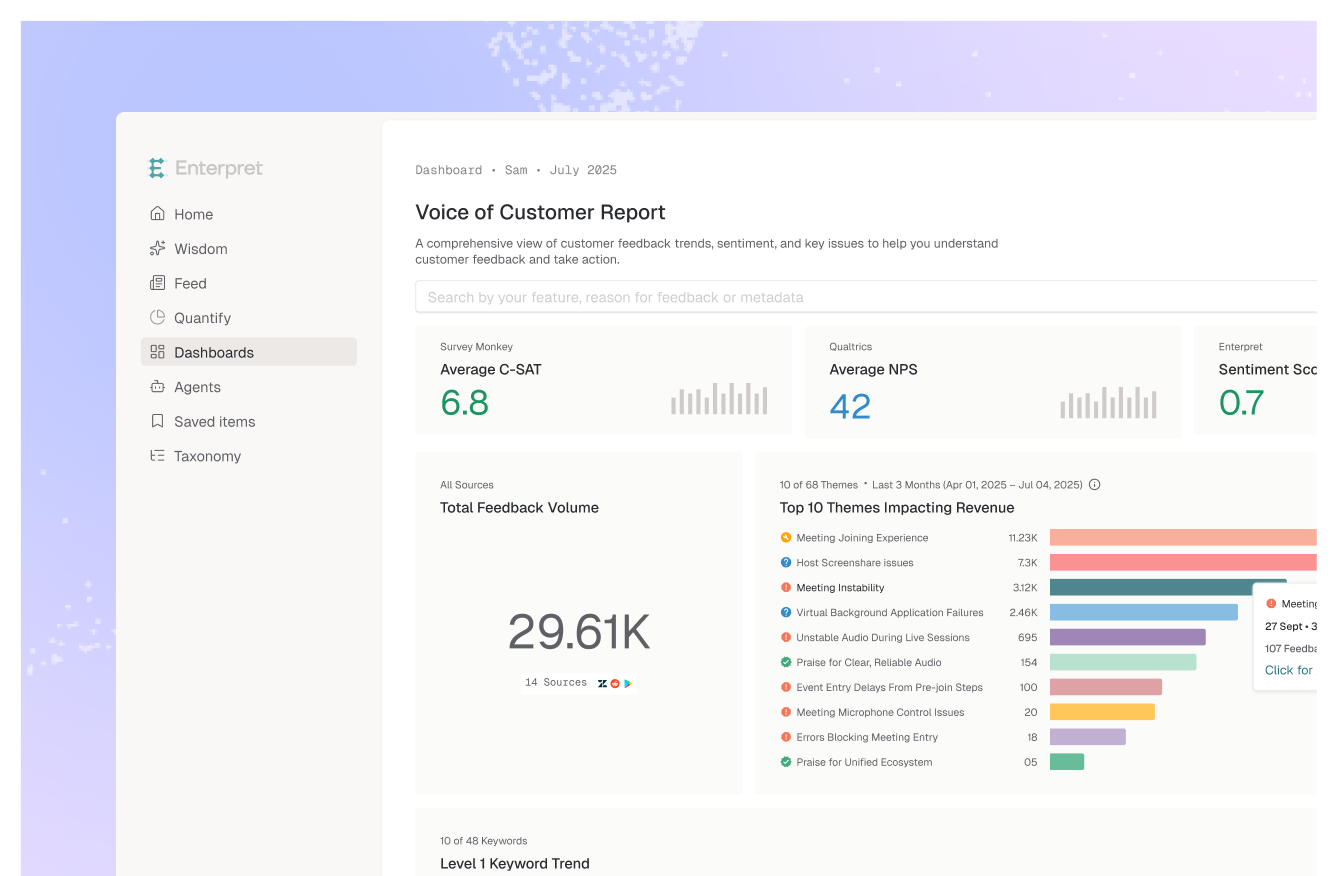
Revenue and account context on every theme. The Customer Context Graph attaches segments, LTV, lifecycle stage, usage, and product areas to every signal, and connects issues to churn, expansion, and adoption, so contact drivers become prioritization that product and leadership can act on.
AI agents that act in product workflows. Enterpret's AI agents convert critical feedback into tracked issues with context, assignees, and priority, notify teams when issues resolve, and flag account risk for CS and GTM teams.
A taxonomy that evolves on its own. The Adaptive Taxonomy evolves with customer language, products, and use cases, so a new contact driver becomes a named theme across every channel rather than in support alone.
Purpose-built for the contact center. EdgeTier's whole product is organized around support operations, with real-time integrations into contact center systems and reporting on NPS, CSAT, and first contact resolution.
Real-time trend detection. Sonar surfaces emerging issues in support conversations as they happen, which is EdgeTier's strongest single capability.
Agent performance. Coach gives a picture of each agent's performance across all interactions, alongside automated agent QA reports.
Proven at high-volume consumer brands. EdgeTier processes millions of customer messages for travel and retail brands where inbound contacts dominate feedback.
Choose Enterpret if you need contact center feedback combined with sales calls, reviews, surveys, and product usage, and tied to the accounts and revenue behind each theme.
Choose EdgeTier if you run a high-volume consumer support operation and want analytics built entirely around the contact center.
Choose CallMiner or NICE if your contact center is voice-heavy and large, or already runs on NICE.
Choose Observe.AI if agent performance and coaching is the main job.
Choose Ada, Intercom, or Retell if the goal is automating customer conversations rather than analyzing them.
For teams that need contact center feedback combined with sales calls, reviews, community, and product usage, and tied to the accounts and revenue behind each theme, yes. For a high-volume consumer support operation whose feedback is dominated by inbound contacts, EdgeTier is the more focused contact center analytics product.
No. Enterpret's AI agents work on behalf of your team rather than answering customers: they monitor feedback for anomalies, escalation risk, and sentiment shifts, coach support managers, and create issues in Jira and Linear. Enterpret can ingest conversations from AI agents such as Decagon to analyze what they reveal.
Yes. Enterpret ingests support conversations from Zendesk, Intercom, Salesforce Service Cloud, Front, and AWS Connect calls, and analyzes them in the same taxonomy as sales calls, surveys, and reviews.
Yes. Enterpret's AI agents analyze agent-level CSAT and create coaching plans for managers, and flag high-escalation-risk feedback that needs immediate attention.
Yes. Enterpret's quality monitoring agents detect spikes and anomalies and alert owners in Slack or email before an issue turns into an incident.
Contact center analytics measures what customers say when they contact support. Customer intelligence combines those conversations with sales calls, reviews, surveys, community, and product usage, and ties each theme to the customer and business outcome behind it.
Kapiche alternatives for customer feedback analytics, Wonderflow alternatives for customer feedback and product experience analytics, alternatives to CallMiner and NICE Nexidia, and alternatives to Verint for CX analytics and QA.
Leading companies like Canva, Notion, Perplexity, and Strava power their customer intelligence with Enterpret. Book a demo.
Lorem ipsum dolor sit amet, consectetur adipiscing elit. Suspendisse varius enim in eros elementum tristique. Duis cursus, mi quis viverra ornare, eros dolor interdum nulla, ut commodo diam libero vitae erat. Aenean faucibus nibh et justo cursus id rutrum lorem imperdiet. Nunc ut sem vitae risus tristique posuere.