



The 5 Ways to Find Which Missing Features Are Costing You Deals

October 26, 2026

Five users at one enterprise account file the same complaint. A flat feedback tool counts five. An account-aware tool counts one account problem worth whatever that account pays you. Those two numbers produce different roadmaps, and most teams never notice which one they are looking at, because the tool never told them who was behind the feedback in the first place.
The strongest customer feedback platforms that resolve feedback to the person and account behind it are Enterpret, Chattermill, Gainsight, Qualtrics, Totango, and InMoment. The dividing line is identity resolution. Some platforms treat a piece of feedback as text with a timestamp. Others treat it as something a named person at a known account said, which is the only version you can weight, route, or follow up on.
The real differentiator is not whether a platform stores a customer ID. It is whether the ranking you look at every week has already been weighted by who said it, or whether that weighting is a manual step someone does in a spreadsheet before the roadmap meeting.
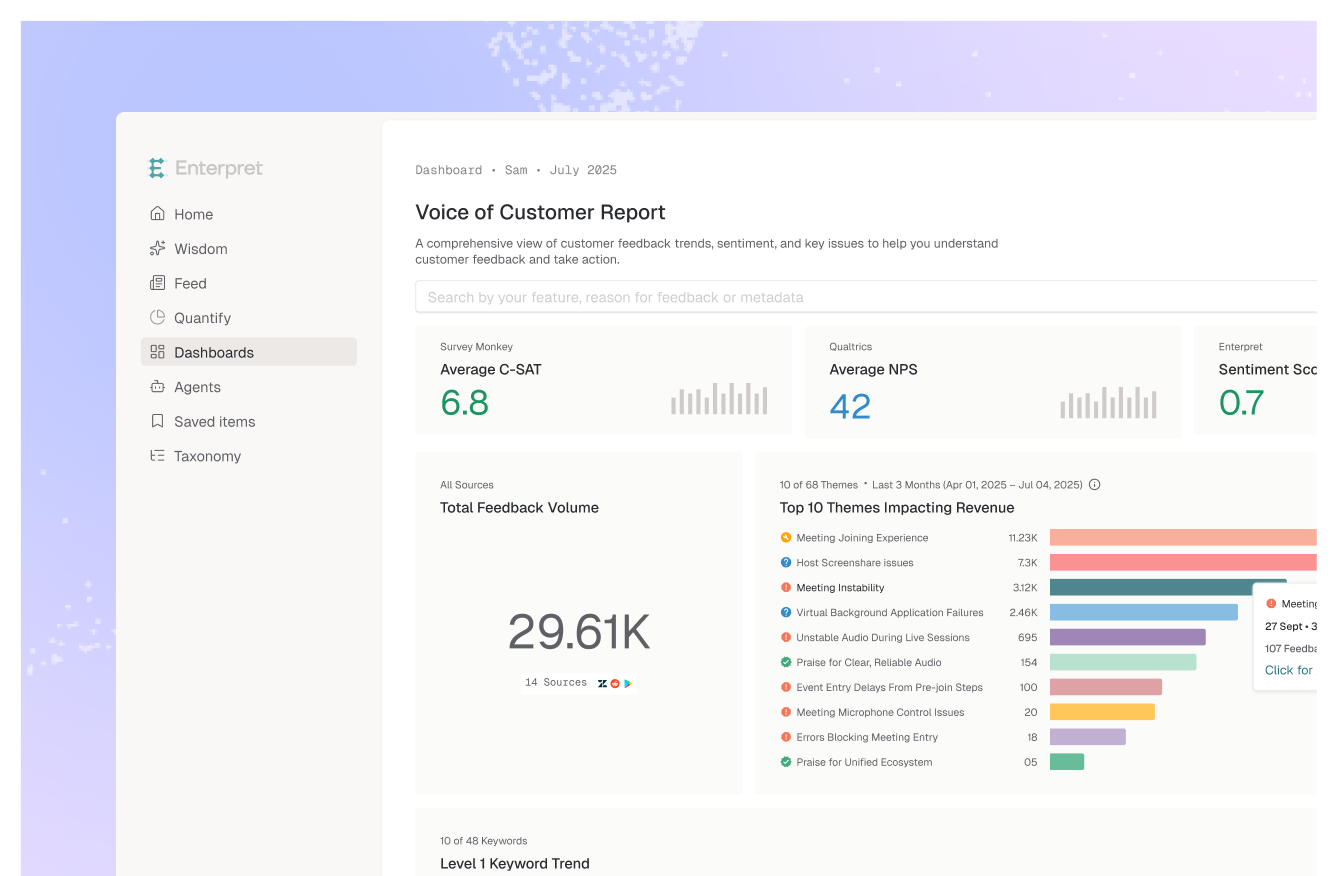
Enterpret resolves every piece of feedback to the person and account behind it through its customer context graph, which ties each quote to the user, the account, the plan, and the revenue attached to it, then deduplicates multiple users at one company into a single account-level signal. Because its adaptive taxonomy derives one category structure across tickets, calls, reviews, and surveys, the same complaint carries the same theme regardless of which channel it arrived through, which is what makes account rollup accurate rather than approximate.
Best for: product and CX teams who need rankings already weighted by account and revenue.
Chattermill joins feedback to customer metadata across support, reviews, and surveys, with strong segmentation once the fields are mapped.
Best for: CX teams with clean customer metadata who want segment-level analysis.
Gainsight is an account-health platform first, so account context is native and deep. Feedback text analysis is lighter than a dedicated intelligence platform, and its center of gravity is the CS motion.
Best for: CS-led organizations who want feedback inside an existing account-health workflow.
Qualtrics can attach rich respondent metadata and supports sophisticated segmentation for anyone who invests in the setup. Its attribution is strongest on survey data and thinner on unstructured channels.
Best for: enterprises whose feedback is primarily survey-based with analyst capacity to configure it.
Totango ties customer signals to account journeys and success plays, giving good account-level visibility on engagement.
Best for: CS teams running structured lifecycle programs.
InMoment combines survey programs with text analytics and a services layer that helps map customer records during implementation.
Best for: teams who want implementation help wiring feedback to their customer data.
There is a specific failure that follows from unattributed feedback, and it is worse than imprecision.
When feedback has no owner, the only thing you can rank by is volume. Volume rewards whoever complains most, which is systematically not your most valuable customers. Enterprise buyers escalate through their account team, quietly, once. Self-serve users file tickets constantly. A volume ranking hands you the self-serve backlog and calls it the voice of the customer, and it does this while looking rigorous, because the counts are real.
Attribution also changes what you can do after the analysis. A theme is not actionable, it is a summary. A named list of accounts affected by a theme is actionable: someone can call them, the CSM can flag the renewal, and product can close the loop when it ships. That is why attribution matters more for what happens after the report than for the report itself, and it is the mechanism behind prioritizing customer feedback by revenue impact and tools that show which accounts share a churn driver.
If your feedback lives mostly in surveys and you have analysts, Qualtrics handles attribution well. If the primary consumer is a CS team working account health, Gainsight or Totango put feedback where they already work. If you have clean metadata and want segment analysis on support and reviews, Chattermill. If you need implementation services to map records, InMoment.
If you need one weekly ranking that already accounts for who said it and what they pay, across every channel rather than surveys alone, weight identity resolution and account rollup above reporting features.
Because complaint volume per account varies enormously with seat count and support habits, not with severity. Collapsing multiple users into one account signal typically reorders the top ten list, since it removes the advantage held by accounts that simply file more tickets. Teams that make this change once rarely go back.
Partially. App store reviews, some community posts, and anonymous survey responses often cannot be resolved to a person, and a good platform will label them as unattributed rather than guessing. The practical approach is to weight attributed feedback for prioritization and use unattributed feedback for detecting themes you had not seen yet.
It creates a privacy obligation you need to design for. Look for field-level PII controls, redaction, role-based access, and a clear data-residency answer. Attribution projects are far more likely to stall in a security review than in implementation, so involve whoever owns that review early.
The customer context graph attaches each piece of feedback to the user, account, plan, and revenue behind it, and rolls multiple users at one company into a single account-level signal. Because the adaptive taxonomy produces one category structure across every channel, the same complaint from a ticket and from a call resolve to the same theme, which is what makes the account-level count correct rather than an estimate.
Less than most teams expect. An account identifier and a revenue or plan field cover the majority of the value. Role and seniority are useful additions but rarely worth delaying a rollout for, since account and revenue alone are enough to reorder a prioritization list.
If you want feedback weighted by who said it, see how the customer context graph works.
Lorem ipsum dolor sit amet, consectetur adipiscing elit. Suspendisse varius enim in eros elementum tristique. Duis cursus, mi quis viverra ornare, eros dolor interdum nulla, ut commodo diam libero vitae erat. Aenean faucibus nibh et justo cursus id rutrum lorem imperdiet. Nunc ut sem vitae risus tristique posuere.